Fire and water checks
Hot work permits: the permit, the checks and the fire watch
A hot work permit is a written authorisation, issued by the business that controls the workplace before any welding, cutting, grinding, brazing, soldering or other work that produces heat, flames or sparks begins, that names the job, the place and the time, the fire precautions to be in place, and the fire watch to be kept during and after the work.
Also written for United Kingdom · Ireland · United States · Canada · New Zealand · South Africa
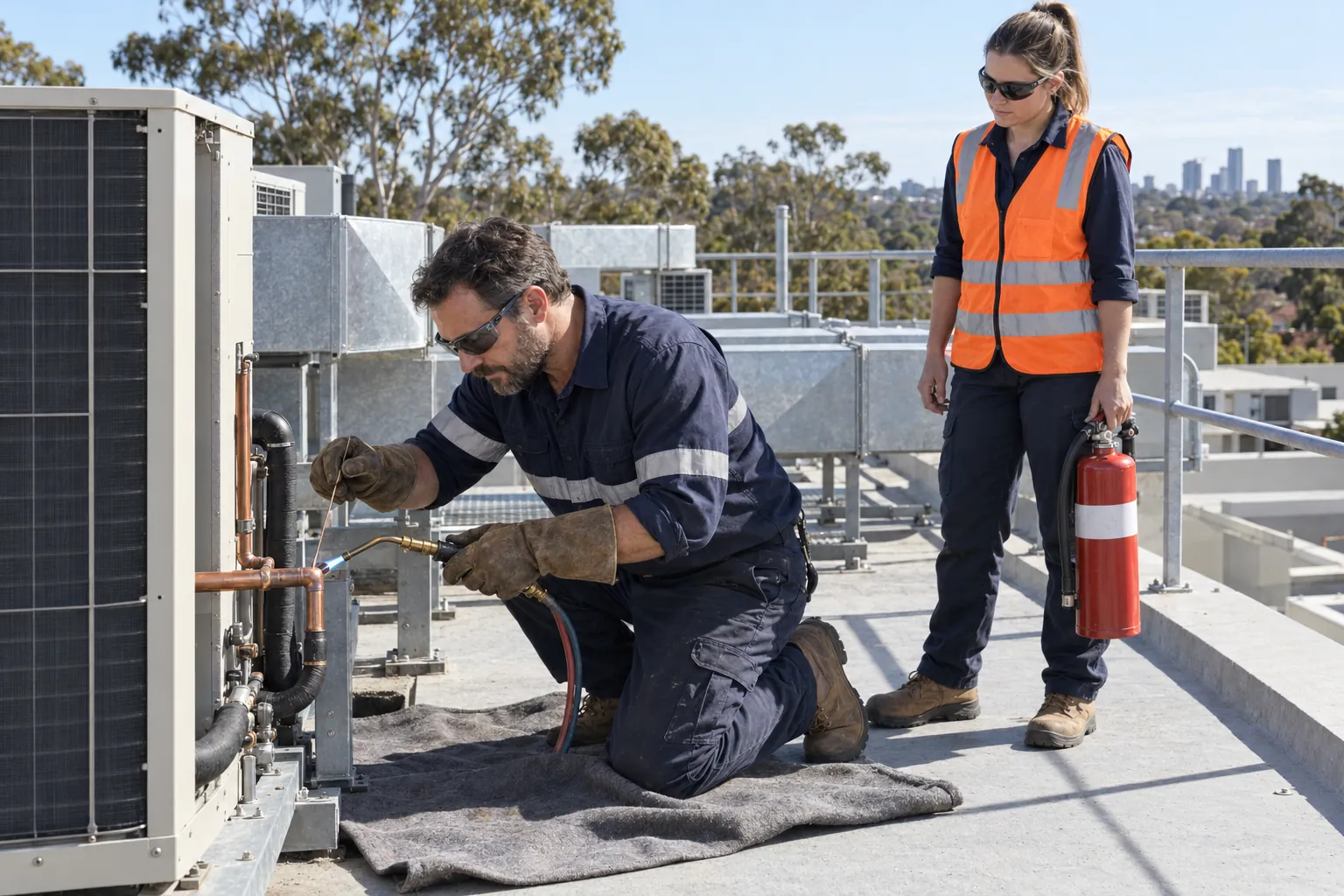
No Australian WHS law requires one by name for ordinary premises, but the model Code of Practice: Welding processes says documented procedures for welding outside a confined space should include one, and points to AS 1674.1, the Australian Standard on fire precautions for welding and allied processes, now in its 2025 edition. This guide covers where the duty comes from, what counts as hot works, what the permit and checklist cover, the fire watch and total fire bans, alarm isolations and contractors, and how a building shows the checks were done.
01
Where the hot work permit comes from
No Act or regulation in the model WHS laws uses the words "hot work permit". The permit is how a workplace meets several general duties when someone is about to bring flames, sparks or heat into it:
- The primary duty. Section 19 of the Work Health and Safety Act 2011 requires a person conducting a business or undertaking (PCBU) to ensure, so far as is reasonably practicable, "the provision and maintenance of safe systems of work". Under section 20, a person with management or control of a workplace must ensure, so far as is reasonably practicable, that the workplace, the means of entering and exiting it "and anything arising from the workplace are without risks to the health and safety of any person".
- Shared duties. Section 46 requires duty holders for the same matter to "consult, co-operate and co-ordinate activities" with each other: the contractor, the facility manager and often the tenant.
- Fire and explosion. Under the Work Health and Safety Regulations 2011, regulation 52 requires a PCBU to manage risks from ignition sources in a hazardous atmosphere that are not part of the deliberate work, such as electrical equipment where flammable vapour or gas may collect, and regulation 53 requires flammable or combustible substances to be kept at "the lowest practicable quantity". Regulations 35 and 36 set the order of controls: eliminate the risk first where reasonably practicable (regulation 35), then substitute, isolate or engineer, and only then administrative controls such as a permit, and PPE (regulation 36).
The practical guidance is the model Code of Practice: Welding processes, approved for the Commonwealth jurisdiction as the Work Health and Safety (Welding Processes) Code of Practice 2015; states and territories that use the model laws approve their own versions, so check with your regulator whether it has legal effect where you are. Its section on fire and explosion says that when welding in an area that is not a confined space, "you should still document specific procedures which should include the issue of a 'hot work permit'", and refers to AS 1674.1 for further guidance.
The standard is AS 1674.1:2025 Safety in welding and allied processes, Part 1: Fire precautions, published by Standards Australia on 24 January 2025, replacing AS 1674.1-1997. Standards Australia says it specifies "requirements for the reduction of fire and explosion risks associated with the performance of welding and other hot work activities in hazardous environments", and its contents include supervision, risk assessment, site inspection, the hot-work permit, firewatching and a final inspection. It is a paid document; ask the contractor which edition their permit follows.
02
What counts as hot works, and avoiding them first
The Victorian Department of Education's Hot Work policy for government schools gives a definition that works for any building: "An operation involving open flame, abrasive grinding and cutting, welding, thermal or oxygen cutting or heating and other related heat-producing or spark-producing operations." The Welding processes code counts brazing and soldering as welding, and names grinding as a process that "can also generate heat, flames and sparks". In an office, school or strata building, hot work includes small tasks, and each should have a hot works permit:
- welding or cutting steel, such as repairing a balustrade, a gate frame or a plant platform;
- brazing copper refrigerant pipework for air-conditioning, or soldering water pipework in a plant room or riser;
- torch-applied roofing membranes on a flat roof or podium;
- angle grinders and cut-off saws, and oxy-acetylene or plasma cutting during strip-out.
The most dangerous are drums and tanks. WorkSafe Victoria's 2025 alert warns: "Even if containers appear empty, rinsed, or labelled 'clean,' hot work can cause residual liquids and vapours to ignite, causing serious injury or death from explosion or fire." Its first control is to "Eliminate hot work on drums and tanks"; otherwise they must be decontaminated and certified gas-free by a competent person.
The first question on any permit is whether hot work is needed at all, because regulation 35 puts elimination ahead of any permit. In buildings that usually means press-fit or mechanical pipe joints instead of soldered or brazed ones, bolted instead of welded brackets, or the part taken to a workshop. If the hot work cannot be avoided, the permit records the control measures for each hazard.
Some hot work is also high risk construction work. Regulation 291 of the WHS Regulations includes construction work on or near chemical, fuel or refrigerant lines or pressurised gas mains or piping, in an area that may have a flammable atmosphere, or with a risk of a fall of more than 2 metres; regulation 289 counts repair and maintenance as construction work, though not minor repair or maintenance. Where the work qualifies, regulation 299 requires a safe work method statement (SWMS) before it starts, as well as the permit.
03
What a hot work permit and its checklist should cover
AS 1674.1 sets the requirements, and permit templates from insurers, fire contractors and property owners vary in layout. Whatever the form, it should record the job, the exact location, the start and expiry times, the precautions checked before work, the person doing the work, the issuer, the fire watcher and the final sign-off. The checklist is completed at the work site, by the issuer and the person doing the work together, not at a desk in advance.
SafeWork NSW's hot work safety alert (September 2018), written after plastic mesh screening caught alight during oxy-acetylene cutting on a demolition site, sets out what a hot work permit system typically considers:
- flammable or combustible materials identified, and removed or covered with non-flammable covers or screens;
- the space confirmed not to be a confined space, and services located, protected and isolated;
- adequate ventilation, and gas cylinders undamaged and fitted with flashback arresters;
- firefighting equipment ready, and the area isolated and signed;
- a fire watch person to monitor the hot work environment;
- emergency and evacuation procedures established, and non-flammable PPE worn;
- a post-work check for smouldering material before leaving the area.
The same alert says "A copy of the hot work permit should be kept in the site file as well as being displayed at the site", and that training should be given to all site personnel and contractors, covering the hazards of hot work, the permit system, firefighting equipment, and emergency and evacuation procedures.
The Welding processes code adds fire-resistant barriers to stop sparks reaching combustible materials, a work area free of rubbish, paper or dust, no flammable materials stored nearby, and firefighting equipment kept close. It also says to consider "the areas and businesses surrounding the workplace": the tenancy next door, the ceiling space above and the floor below.
04
The fire watch, the final check and total fire bans
Fires from hot work often start after the work has stopped. WorkSafe Victoria's safety alert Fire caused by hot works at a quarry (January 2020) warns that "Fires may also start well after the completion of any hot work activities due to residual heat". It says to assign a designated fire watch person, and to "Conduct post work inspections for smouldering material prior to leaving the area. For example, before a break, at the end of a shift or at the completion of work."
For Victorian government schools, the Department of Education's Hot Work policy requires principals to "ensure that a trained fire watch observer is appointed and present for the entire duration of the hot work task", able to operate fire and emergency equipment. The same policy requires that employees undertaking hot work tasks as part of their role are trained for them, and that training records are kept.
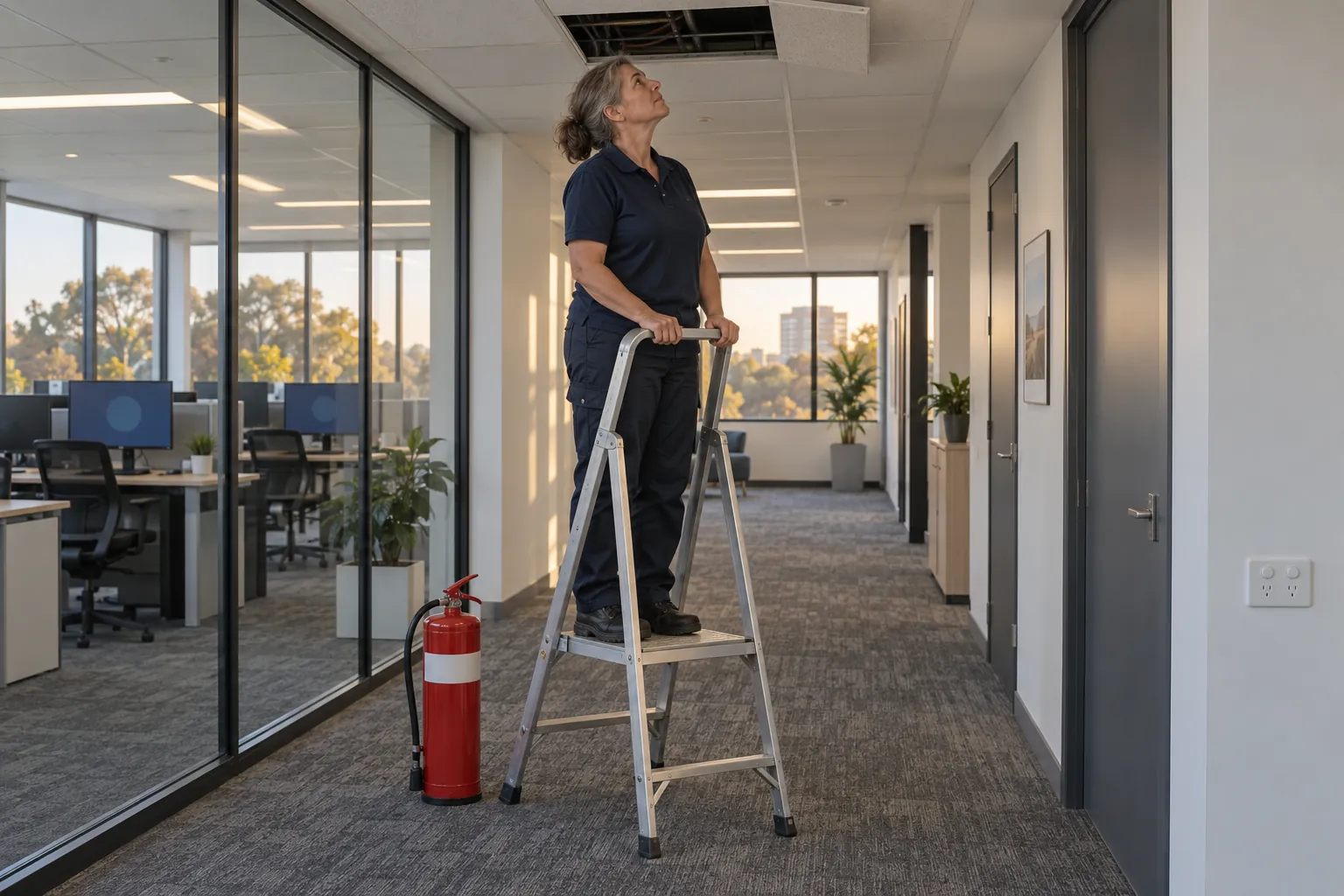
How long the hot work fire watch continues after the work stops is set on the permit, following AS 1674.1, the risk assessment and any condition in the building's insurance; set a longer watch where heat could reach a ceiling void, riser, insulation or roof cavity. The watch should continue through breaks, and the final check should cover the floor below, the far side of walls and any void the work touched.
In bushfire seasons the fire services add their own rules. The CFA's Can I or can't I? page says that during the fire danger period in country Victoria, welding, grinding, soldering, abrasive cutting discs and gas cutting are not allowed unless conditions are met, including a fire-resistant shield or guard, at least 1.5 metres cleared of flammable material or wetted down, a hose or a knapsack spray of at least 9 litres, and a person in attendance at all times who can put out a fire. On a Total Fire Ban day the answer is no, though "In limited circumstances, CFA, DEECA or FRV may issue a permit on Total Fire Ban Days." Other states' fire services publish their own rules; check them before outdoor or roof work in summer.
05
Who issues the permit, isolations, contractors and the record
- The issuer is usually the facility manager, building manager or a nominated person for the business that controls the site. They should know the building, inspect the work area before issuing the permit, and have the authority to stop the work.
- The contractor plans the work, provides the SWMS where one is required, brings trained people and extinguishers, and accepts the permit's conditions. The Department of Education's procedure, for example, requires contractors to submit a SWMS for any hot work task covering removal of ignition sources and flammable material, isolation of the work area and signage, emergency procedures, PPE and a fire watch observer, with a signed copy retained.
- The fire watcher is trained, not doing the work, has extinguishers to hand, and stays for the work, the breaks and the period after.
- The person signing off confirms the final check is done and any fire alarm isolation is restored before the permit is closed.
Isolating the fire alarm is the step most often left undone, or done too widely. Fire Rescue Victoria's page on false alarms says "Trade activities can regularly generate dust, heat and fumes which may activate smoke detectors", that "minimum isolation methods" should be used, and that depending on its length and purpose "an isolation may amount to a disconnection in which case a building permit is required." FRV charges for preventable false alarms, at a published $675 per truck per 15 minutes in 2026–27. Isolate only the zone or detectors being worked near, record who asked and when, and name the person who will restore it.
Completed permits are records. Keep each one in the site file, as SafeWork NSW suggests, with the SWMS where there is one, and look through them now and then for work done without a permit, permits signed off before the fire watch could have finished, and isolations with no restoration time.
06
Where the fire watch record fails, and what SiteClara does about it
The permit is usually filled in carefully at the start. The weak point is what follows: fire watch times written up together at the end, the final check signed at 3.45 pm because the contractor had to leave, the tenancy below assumed rather than checked, the detector zone left isolated overnight, and the site copy of the permit still in a ute. Asked how the watch was kept, the permit shows a signature and a time, not the checks.
SiteClara records checks at the place they are done. A printed QR poster, with an optional NFC tag behind it, goes at each location where checks happen, such as a plant room, a roof access, a riser or a floor. Staff scan the code or tap the tag on their own phone, with no app to install, see the checks due there, and mark each done or explain what stopped them. Each scan records the named person and the time, with a photo when one is asked for, so a fire watcher checking the work area and the floor below leaves timed, photographed entries rather than one signature at the end. A problem found, such as a scorch mark or a detector zone still isolated, is reported there with a photo and stays on the team's list of jobs until someone closes it.
The supervisor sees what is due, done and missed and records why a check was missed. Each day they approve a report that goes to nominated management or client contacts at 8am the next morning, showing what was reported, completed and still open, and how scheduled checks went, such as the end-of-day fire checks.
07
Questions people ask
When would I need a hot work permit?
Before any welding, cutting, grinding, brazing, soldering or other work that produces heat, flames or sparks. The model Code of Practice: Welding processes says that when welding in an area that is not a confined space, you should still document specific procedures which should include the issue of a hot work permit; work in a confined space needs a confined spaces entry permit under the WHS Regulations. SafeWork NSW's hot work safety alert says it is essential to implement a hot work permit system before carrying out any hot work on site.
Why would you need a hot work permit?
Because hot work brings an ignition source to materials that may not look flammable. SafeWork NSW's hot work safety alert lists the hazards: fire from heat, sparks or molten metal, explosions when working on drums, tanks, pipes or vessels that contain or have contained flammable liquids, gases or materials, burns, toxic fumes and oxygen depletion. The permit makes someone identify each hazard and eliminate it, or control the risk, before work starts.
What are the safety procedures for hot work?
A hot work permit system, with the permit reviewed and signed off by the people in control of the site and those involved in the hot work. SafeWork NSW's hot work safety alert lists them: remove or cover flammable and combustible material, confirm it is not a confined space, protect services and isolate them where practicable, ventilate, fit flashback arresters to gas cylinders, have firefighting equipment ready, keep a fire watch person, wear non-flammable PPE, and check for smouldering material before leaving the area.
What are the Australian standards for hot work safety?
The main one is AS 1674.1:2025 Safety in welding and allied processes, Part 1: Fire precautions, which Standards Australia says specifies requirements for reducing fire and explosion risks from welding and other hot work; its contents include the hot-work permit, firewatching and a final inspection. The model Code of Practice: Welding processes also names AS 1674.2 for electrical safety in welding.
Can you do hot work on a total fire ban day?
Not in the open air in Victoria, unless CFA, DEECA or FRV has issued a permit. The CFA's Can I or can't I? page says welding, grinding, soldering and gas cutting are banned on Total Fire Ban days, and that in limited circumstances CFA, DEECA or FRV may issue a permit. Other states' fire services set their own rules.
08
Further reading, and a hot work permit checklist to take away
Read the model Code of Practice: Welding processes, section 3.4 on fire and explosion, and buy AS 1674.1:2025 from Standards Australia. SafeWork NSW's hot work safety alert and WorkSafe Victoria's alerts on Fire caused by hot works at a quarry and cutting into drums and fuel tanks are short and practical, and the Victorian Department of Education's Hot Work policy is a clear model for bringing contractors on site. See also our guides to fire alarm testing and the fire safety logbook.
Before any hot work in your building, check that:
- the issuer is named, knows the building and can stop the work;
- the permit covers one job, one location and one period, with an expiry time;
- a SWMS is in hand where the work is high risk construction work;
- the checklist was completed at the work site, including the floor below and any void;
- only the zone being worked in is isolated, with a named person to restore it;
- the fire watch continues through breaks and for the full period the permit sets;
- outdoor work is checked against fire danger period and total fire ban rules;
- the permit is displayed at the work site and comes back to the site file.
Sources
Every document this guide quotes or links to, in the order it first cites them.
- Work Health and Safety Act 2011 legislation.gov.au
- Work Health and Safety Regulations 2011 legislation.gov.au
- Code of Practice: Welding processes legislation.gov.au
- AS 1674.1:2025 Safety in welding and allied processes, Part 1: Fire precautions store.standards.org.au
- Occupational Health and Safety Act 2004 legislation.vic.gov.au
- Welding or cutting into flammable drums or fuel tanks worksafe.vic.gov.au
- Hot Work policy www2.education.vic.gov.au
- Hot work safety alert safework.nsw.gov.au
- Fire caused by hot works at a quarry worksafe.vic.gov.au
- Can I or can't I? cfa.vic.gov.au
- False alarms frv.vic.gov.au
Related guides
 Fire and water checksWorkplace fire safety checklist: the checks, who does them and the records they leaveA workplace fire safety checklist for Australia: the emergency plan duty, state fire safety rules, daily to annual checks, who does each, and what records show.
 Fire and water checksFire alarm testing in commercial buildings: who tests what, and what the record must showFire alarm testing in Australian commercial buildings: AS 1851 routine service, state maintenance law, what the building team checks, records and false alarms.
 Fire and water checksFire safety logbook: what to record, who keeps it and for how longWhat a fire safety logbook should hold in Australia: AS 1851 service records, Victoria's ESM records, the NSW fire safety statement and Queensland's rules.
 Fire and water checksFire warden duties: what the chief warden and floor wardens do, day to day and when the alarm soundsWhat a chief warden and floor wardens do in an Australian workplace: the law behind the role, the routine checks, the job in an evacuation, and the records to keep.