Fire and water checks
Hot work permits in New Zealand: the permit, the checklist and the fire watch
A hot work permit is a written authorisation, issued before any welding, cutting, grinding, brazing, soldering or other work that produces open flames, heat or sparks begins, that fixes where and when the work may be done, the precautions to take before and during it, and the fire watch to keep once it stops.
Also written for United Kingdom · Ireland · United States · Canada · Australia · South Africa
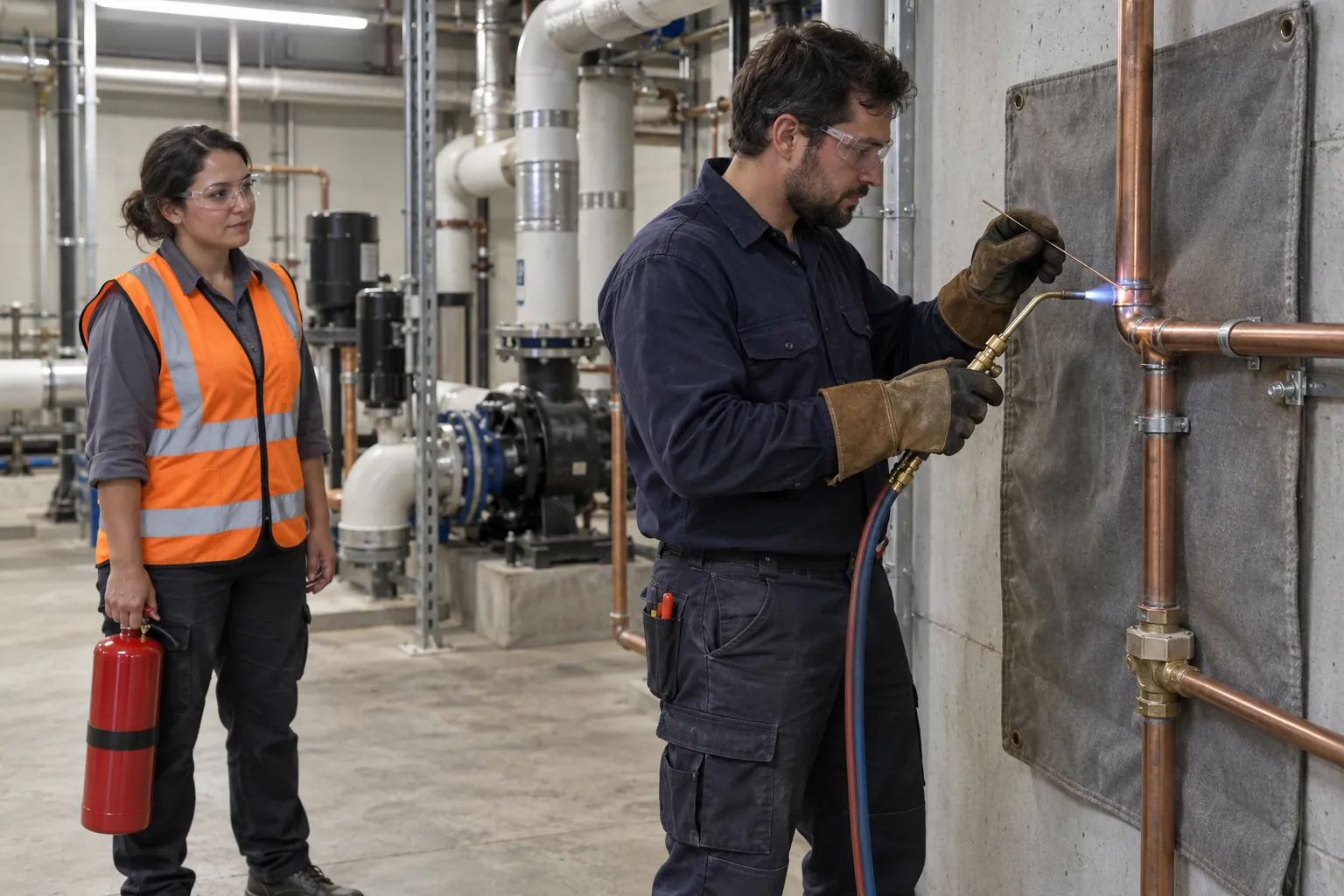
No New Zealand statute names the permit, but the Health and Safety at Work Act 2015 requires the fire risk to be eliminated or minimised so far as is reasonably practicable, WorkSafe's welding guidance says to use a hot work permit and to keep a fire watcher on watch for at least 30 minutes after the work finishes, and Vero's hot work checklist asks for 60. This guide covers what counts as hot work, what the permit and its checklist contain, how long a permit and its fire watch last, who does what when a contractor works in an occupied building, and how the building shows the watch was kept.
01
What a hot work permit is, and the law behind it in New Zealand
A hot work permit is a permit-to-work for one job that could start a fire: the work, the place, how long the permit is valid, the precautions before, during and after, and who authorises, does, watches and closes it. The issuer signs it before anyone strikes an arc or lights a torch.
No New Zealand Act or regulation requires a document called a hot work permit. The duty to control the risk comes from the Health and Safety at Work Act 2015 (HSWA). WorkSafe's Introduction to the Health and Safety at Work Act 2015 summarises the sections that matter:
- Section 30: risks must be eliminated so far as is reasonably practicable, and if a risk cannot be eliminated, minimised so far as is reasonably practicable.
- Section 36, the primary duty of care: a PCBU must ensure, so far as is reasonably practicable, the health and safety of workers, and that other people are not put at risk by its work.
- Section 37: a PCBU who manages or controls a workplace must ensure, so far as is reasonably practicable, that the workplace, the means of entering and exiting it, and anything arising from it are without health and safety risks. The PCBU that manages or controls the building, such as its owner, holds this duty while a contractor works there.
WorkSafe's guidance on health and safety in welding names the permit: "Use a hot work permit that clearly states the control measures required to carry out the work safely." Its guidance on cutting and welding drums and tanks (February 2023) lists a permit to work form among the control measures.
Where flammable vapours or combustible dust may be present, WorkSafe's interpretive guidelines on the General Risk and Workplace Management Regulations, part 2 (November 2022) explain regulations 22 and 23: the PCBU with management or control of the workplace must manage the risks of atmospheres with potential for fire or explosion, and of ignition sources in them, by the prescribed process in regulations 5 to 8. The guidelines list "sparks from activities such as welding, cutting, grinding and crushing" first among ignition sources, while noting that regulation 23 does not include ignition sources that are part of a deliberate process or activity, whose risks must still be managed.
WorkSafe's welding page names the standard AS 1674; MBIE's Building CodeHub lists AS 1674.1-1997 (R2016) Safety in welding and allied processes – Part 1: Fire precautions, which sets precautions before and during hot work, and the older NZS 4781:1973 Code of practice for safety in welding and cutting, which Vero's permit form still names. Both are paid documents.
02
What counts as hot work, and avoiding it first
WorkSafe says welding "and associated processes such as grinding" generate heat, flames and sparks, and that hot metal, sparks and droplets of molten metal and slag can easily start a fire. Vero's hot work checklist applies to "cutting, welding, grinding, hot air gun, blow lamps or torches, application of hot bitumen, open flame or other heat producing work". In a commercial building that means jobs such as:
- welding a repair to a balustrade, bracket or steel frame;
- brazing or soldering copper pipework in a plant room, riser or ceiling void;
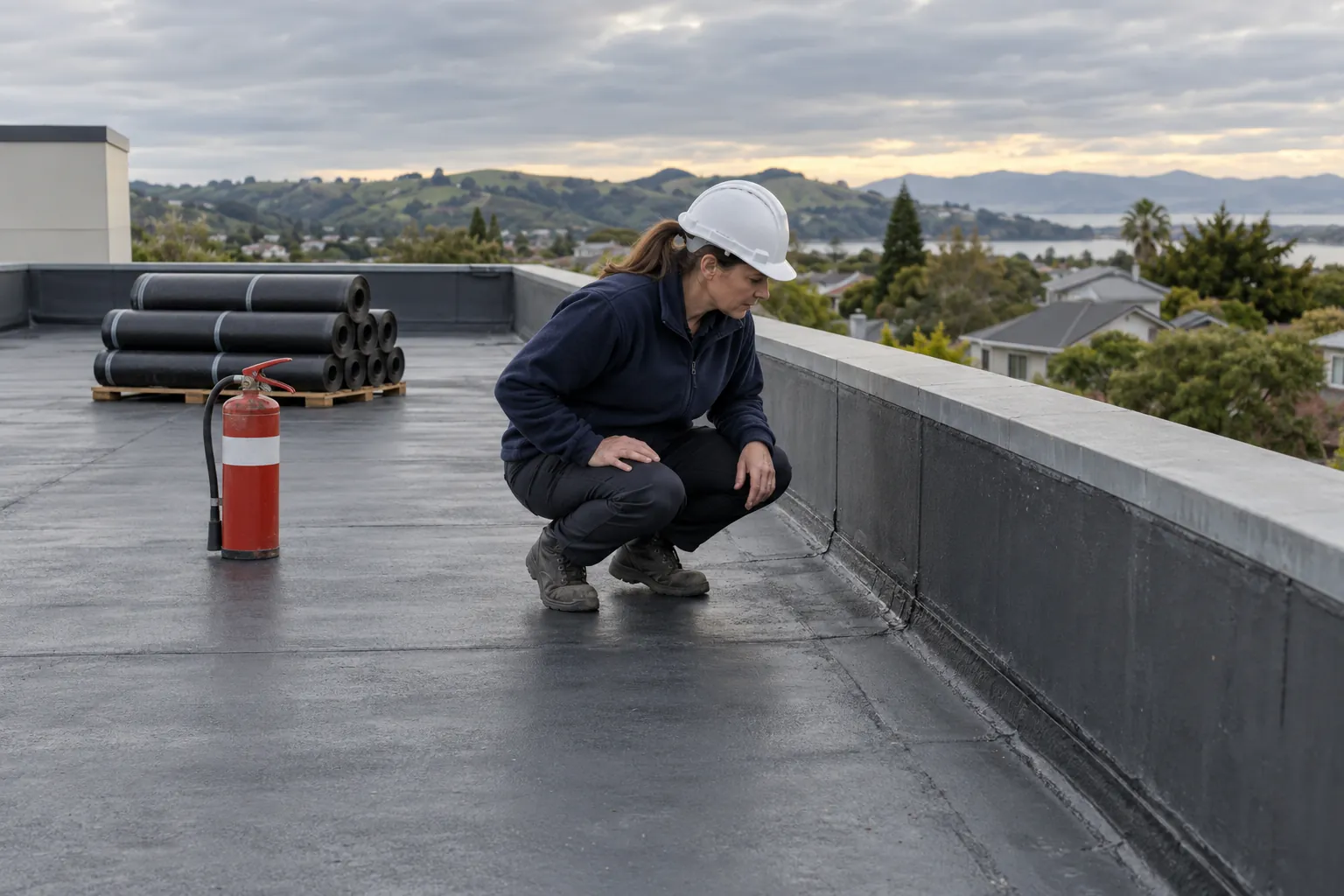
- torch-on membrane roofing and hot bitumen on a flat roof;
- angle grinders and gas cutting, including removing old fixings;
- hot air guns, blow lamps and other open flames used to strip paint;
- cutting or welding a drum, tank or pipe that has held a flammable substance.
The last is the most dangerous: WorkSafe warns that "drums and tanks that seem to be empty can contain residues of flammable substances or flammable vapours".
The first question on any permit is whether hot work is needed at all, because section 30 puts elimination first. WorkSafe says to "consider other methods instead of hot work such as cold cutting or cold repair techniques". Vero's checklist opens with "Always consider can the job be avoided and is there a safer way?" and allows only cold cutting on expanded plastic sandwich panels, with no exceptions. Mechanical pipe joints, bolted fixings or taking the item to a workshop remove the need for a permit in the building.
03
What a hot work permit and its checklist contain
There is no official New Zealand template; insurers publish their own. FMG's hot works advice says "A hot works permit system should be used if hot work is conducted outside of a designated area or where the object being worked on or other combustible materials nearby cannot be moved", and offers clients a permit pack. Vero's permit records the date, location and nature of the work, the tradesperson and contracting company, any special instructions, the issuer's name and signature, and the date and time the permit expires. Before approving the work, the site foreman or their appointee "shall inspect the work area and confirm precautions have been taken to prevent fire". The checklist confirms:
- that other options to hot work have been considered;
- that sprinkler and automatic fire alarm systems are in service, and where the nearest manual call point is;
- that equipment is in good order, gas cylinders are secure and flashback arrestors fitted where needed;
- that firefighting equipment is ready: extinguishers on hand and, if possible, a connected hose nearby;
- that the operator is trained and competent, with a second person on hand as the fire watch;
- within 10 metres: floors swept, and no flammable substances or combustible materials, or where unavoidable, protect them with welding curtains, blankets or fire-resistant covers;
- covers below elevated work, and wall and floor openings covered so sparks and hot debris cannot travel;
- tanks purged of flammable vapours or contents.
WorkSafe's welding guidance adds fire-resistant barriers, good ventilation, clearing away "wood, fabric, cardboard, dust, or rubbish" first so nothing nearby can fuel a fire, and locking the gas off at the valve straight after use. It warns that sparks, flames and heat can travel a considerable distance, so the far side of a wall, the ceiling void and the floor below belong on the walk-round.
Vero's Hot tips for hot work says the permit, completed before work starts, "serves as both your safety checklist and proof that proper precautions have been taken". If a point cannot be met, the work waits.
04
The fire watch, the final check and how long a permit lasts
Fires from hot work often start after the work stops, when a spark has lodged in a void or heat has travelled along a pipe; as Vero puts it, "A fire may not start right away". The New Zealand sources set these periods:
- WorkSafe: "Nominate someone to act as a fire watcher. They should remain on watch for at least 30 minutes after the hot work finishes."
- Vero: the fire watch is trained in extinguishers and sounding the alarm, is "in continuous attendance including for 60 minutes after work ceases" and has a mobile phone for emergencies; a final safe site check is made 60 minutes after completion and the permit recorded as closed.
- FMG: a fire watcher while the work is done, an extinguisher near the work and a post-work inspection.
Treat WorkSafe's 30 minutes as a minimum: where the insurer or contract asks for longer, the longer period applies. The watcher should not be the person doing the work, and should monitor the work area, the far side of walls, the space above and the floor below, through breaks as well as after.
No New Zealand law sets how long a permit may run; the permit sets its own expiry. One task, one place and no longer than the shift keeps it honest, with the final check done before the people who must do it go home.
Keep the completed permit. WorkSafe's quick guide Identifying, assessing and managing work risks calls written records good practice, and says more risky work requires more complex records.
05
Who issues the permit, who watches, and the alarms and sprinklers
- The issuer inspects the area before the permit is issued and authorises the work for the PCBU that manages or controls the building: often the facilities manager, building manager or building engineer, or the site manager on a construction site.
- The person doing the work, often a contractor, completes the permit with the issuer and does only the work it has authorised; WorkSafe expects workers to be adequately trained in the safe use of all plant, substances and equipment, and FMG says workers should not use, or be asked to use, any equipment they are not trained and certified for.
- The fire watcher is a second person, trained in using extinguishers and sounding the alarm, in continuous attendance with extinguishers to hand and a mobile phone for emergencies.
- The person closing the permit makes the final check, confirms nothing is smouldering and any isolated alarm is back in service, and signs off.
The building and the contractor are both PCBUs with duties over the same work, so section 34 requires them to consult, co-operate and co-ordinate. WorkSafe's advice on PCBUs working together says you cannot "contract out of your health and safety duties, or push risk down the contracting chain to another PCBU". In a multi-tenancy building the floor below may be another tenant's, so agree access for the fire watch first.
Fire and Emergency New Zealand's page on preventing unwanted alarms says third-party contractors cause many unwanted alarms, that building owners and managers should warn contractors about alarm systems, and to contact your fire alarm contractor if help may be needed to isolate an alarm system temporarily or to clean detectors afterwards. Its designers' guide on construction, refurbishment and demolition sites (F5-12 GD, May 2025) says an isolation should follow NZS 4512:2021, section 7, with a notice on the alarm panel saying which parts are not working; and that before shutting down sprinklers you notify Fire and Emergency in writing at least 24 hours beforehand and tag the main stop valve. Isolate as little as the work needs and name who will put it back. MBIE's guidance on specified systems and compliance schedules lists sprinklers and fire warning systems among the specified systems, so tell whoever looks after the building warrant of fitness too.
If hot work does start a fire, WorkSafe's page What events need to be notified? lists "an implosion, explosion or fire" among notifiable incidents. The site must not be disturbed until an inspector gives permission, and records kept for at least five years.
06
Where the fire watch record fails
The permit is usually filled in carefully at the start. The weak point is what follows: the watch times written up together at the end, the final check signed at 3.45pm for work that stopped at 3.30pm because the contractor had another job, the ceiling void and the floor below assumed rather than looked at, the alarm zone isolated at 9am and still isolated at 5pm, and the completed permit still in the van. Asked later how the watch was kept, the permit shows a signature and a time, not the checks.
SiteClara records checks at the place they are done. A printed QR poster, with an optional NFC tag behind it, goes at each location where checks happen, such as a plant room, a roof access, a riser or a floor. Staff scan the code or tap the tag on their own phone, with no app to install, see the checks due there, and mark each done or explain what stopped them. Each scan records the named person and the time, with a photo when one is asked for, so a fire watcher checking the work area, the void above and the floor below leaves timed, photographed entries rather than one signature at the end. A problem found, such as a scorched surface or an alarm zone still isolated, is reported there with a photo and stays on the team's list of jobs until someone closes it.
The supervisor sees what is due, done and missed, and records why a check was missed. Each day they approve a report that goes to nominated management or client contacts at 8am the next morning, showing what was reported, completed and still open, and how scheduled checks went.
07
Questions people ask
Is a hot work permit a legal requirement in New Zealand?
Not by name, but the duty behind it is: HSWA requires PCBUs to eliminate or minimise risks so far as is reasonably practicable, and WorkSafe's guidance on health and safety in welding says to use a hot work permit that clearly states the control measures required. Insurers often expect one as well.
When would I need a hot work permit?
Whenever hot work is done somewhere not set up for it. FMG's hot works advice says a permit system should be used if hot work is conducted outside a designated area, or where the object being worked on or combustible materials nearby cannot be moved; in an occupied building, where little can be moved, that covers most jobs.
What are examples of hot work?
WorkSafe's guidance on health and safety in welding names welding, grinding, oxy-acetylene gas cutting, plasma cutting and air gouging, with brazing and soldering as associated processes. Vero's hot work checklist adds hot air guns, blow lamps or torches, hot bitumen and any other open flame or heat producing work.
How long is a hot work permit valid for?
Until the expiry the issuer writes on it: no New Zealand law fixes a period, and Vero's hot work checklist has a "Permit expires" date and time for the issuer to fill in. Keep it to one task, one place and one shift.
How long should a fire watch last after hot work?
At least 30 minutes after the hot work finishes in WorkSafe's guidance, and 60 minutes in Vero's hot work checklist, which also asks for a final safe site check 60 minutes after completion. Follow the longer period where your insurer or contract sets it.
08
Further reading, and a hot work permit checklist to take away
Start with WorkSafe's health and safety in welding, then Fire and Emergency's preventing unwanted alarms for contractors and isolations. Your insurer's own permit and conditions come first; Vero and FMG both publish theirs. See also our guides to fire alarm testing and overlapping duties.
Before any hot work in your building, check that:
- before anyone decides to carry out hot work, someone has asked whether a cold method would do the job;
- the issuer is named, knows the building and can stop the work;
- the permit covers one task, one place and one shift, with an expiry time;
- the area within 10 metres, the far side of walls, the void above and the floor below are cleared or protected;
- extinguishers are at hand and the fire watcher is trained and not doing the work;
- any alarm isolation is arranged with the fire alarm contractor and named for reinstatement, and any sprinkler shutdown notified in writing 24 hours ahead;
- the fire watch runs for the insurer's or contract's period, never less than WorkSafe's 30 minutes;
- the work is planned to finish early enough for the watch and final check;
- the completed permit comes back to the issuer and is kept.
Sources
Every document this guide quotes or links to, in the order it first cites them.
- Health and Safety at Work Act 2015 legislation.govt.nz
- Introduction to the Health and Safety at Work Act 2015 worksafe.govt.nz
- Health and safety in welding worksafe.govt.nz
- Cutting and welding drums and tanks worksafe.govt.nz
- Interpretive guidelines on the General Risk and Workplace Management Regulations, part 2 worksafe.govt.nz
- AS 1674.1-1997 (R2016) Safety in welding and allied processes – Part 1: Fire precautions codehub.building.govt.nz
- NZS 4781:1973 Code of practice for safety in welding and cutting codehub.building.govt.nz
- Changes to health and safety law worksafe.govt.nz
- Small PCBUs' main duties worksafe.govt.nz
- Hot work checklist vero.co.nz
- Hot works advice fmg.co.nz
- Hot tips for hot work vero.co.nz
- Identifying, assessing and managing work risks worksafe.govt.nz
- PCBUs working together worksafe.govt.nz
- Preventing unwanted alarms fireandemergency.nz
- Designers' guide on construction, refurbishment and demolition sites fireandemergency.nz
- Specified systems and compliance schedules building.govt.nz
- What events need to be notified? worksafe.govt.nz
Related guides
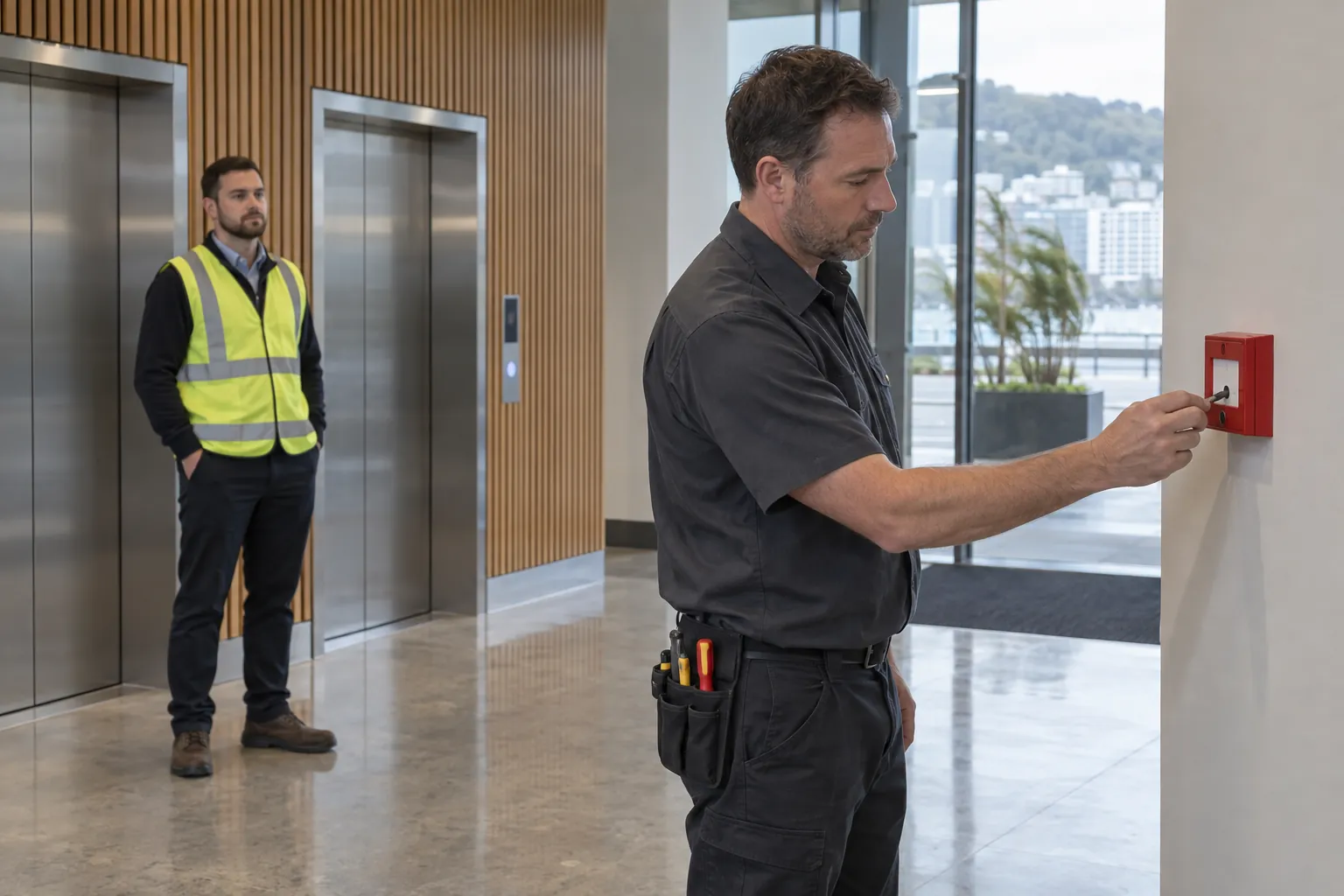 Fire and water checksFire alarm testing in New Zealand: what the compliance schedule asks, and what the building team can doFire alarm testing in New Zealand: SS 2 on the compliance schedule, NZS 4512:2021, the IQP's monthly and annual visits, and what the building team records.
 Fire and water checksFire warden duties: the everyday checks, and the job when the alarm soundsWhat a fire warden does in a New Zealand building: where the role sits in the evacuation scheme, the everyday checks, the job when the alarm sounds, and the record.
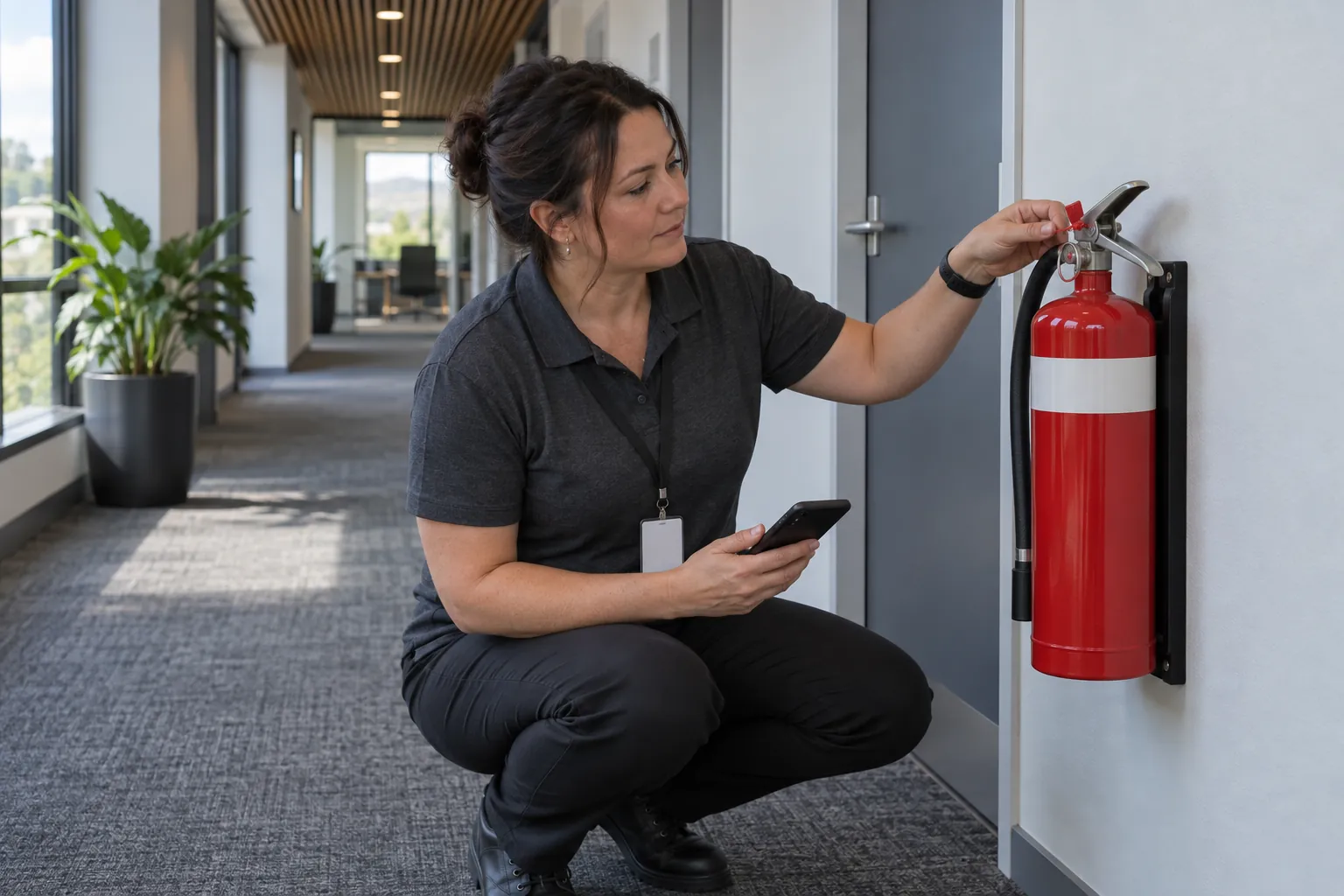 Fire and water checksFire extinguisher inspection in New Zealand: the owner's duty, NZS 4503 and the checks in betweenWhat the law asks of fire extinguishers in New Zealand, what NZS 4503:2005 maintenance means, and how the building team inspects them between service visits.
 Premises and facilities managementOverlapping duties: sharing health and safety when several PCBUs work in one buildingOverlapping duties under HSWA 2015: when PCBUs share a building or a contracting chain, how to consult, co-operate and co-ordinate, and how to show it works.