Fire and water checks
Hot work permits: the checklist, the fire watch and the fire code rules
A hot work permit is a written authorization, issued before any welding, cutting, grinding, soldering, torch-applied roofing or other work that uses open flames or produces heat or sparks begins, that records where and when the work may happen, the fire precautions taken before it starts, and the fire watch and final inspection that follow it.
Also written for United Kingdom · Ireland · United States · Australia · New Zealand · South Africa
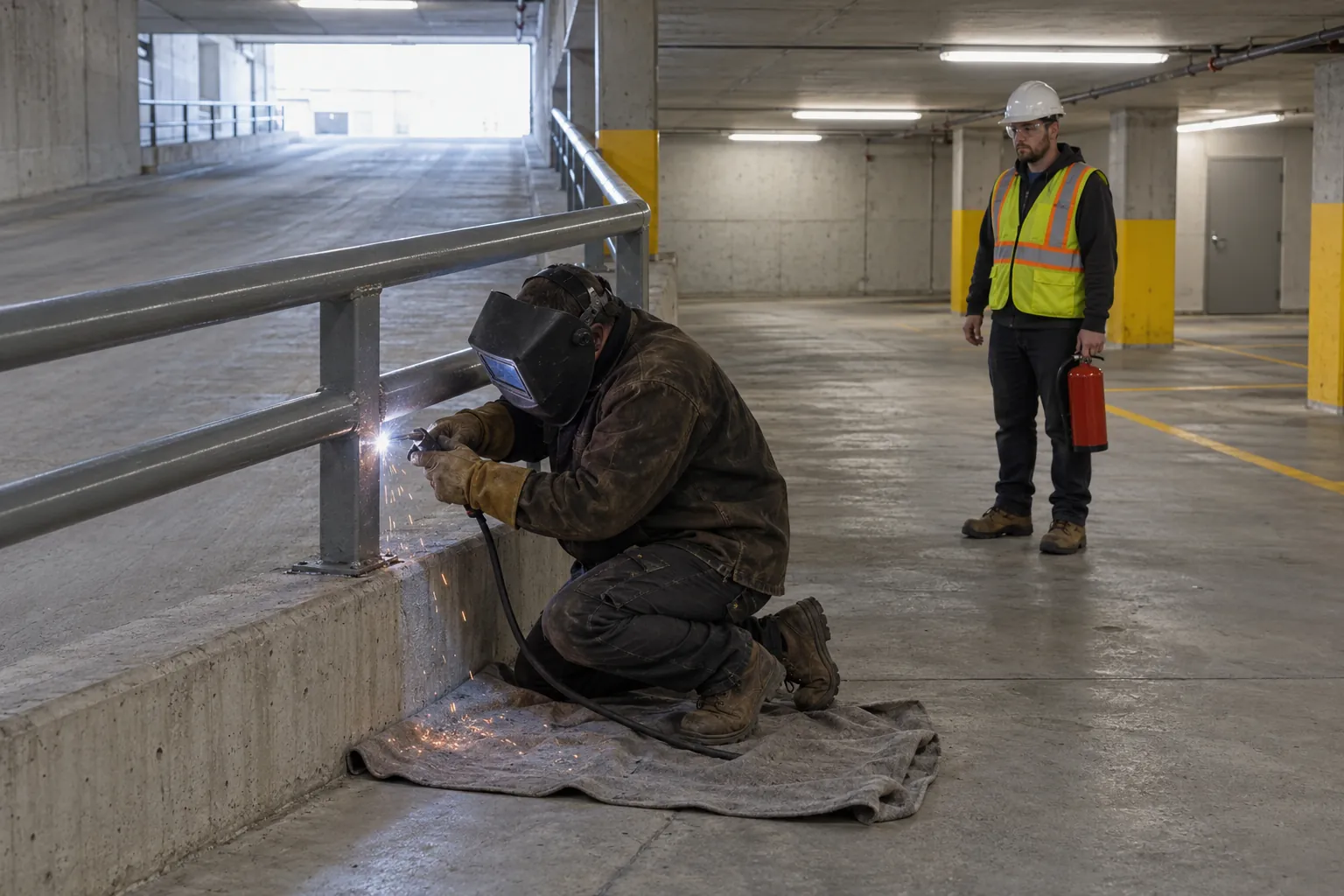
Canada's fire codes do not require a permit by name, but they set the conditions a permit checks: under the National Fire Code of Canada 2025, hot work that cannot be moved to a noncombustible area needs combustibles within 15 m protected, a continuous fire watch during the work and for at least 60 minutes after it, and a final inspection, while Ontario sets its own rules in Section 5.17 of the Ontario Fire Code. This guide covers what counts as hot work, what a hot work permit and its checklist should contain, how long the fire watch and the permit last, who does what, and how a building shows the checks were made.
01
What a hot work permit is, and the fire code behind it
Hot work is any work that uses open flames or produces heat or sparks near something that can burn. The Canadian Centre for Occupational Health and Safety (CCOHS) puts it plainly in its fact sheet Welding – Hot Work: "Working with ignition sources near flammable materials is referred to as 'hot work.'" It notes that fires often result from brief jobs in areas not designed for such work.
The model fire code is the National Fire Code of Canada 2025, published by the National Research Council of Canada (NRC). Section 5.2 of Division B, Hot Works, applies to "hot works involving open flames or producing heat or sparks, including but not limited to, cutting, welding, soldering, brazing, grinding, adhesive bonding, roofing operations, thermal spraying and thawing pipes" (Sentence 5.2.1.1.(1)), and requires that work to conform to CSA W117.2, Safety in welding, cutting and allied processes, the 2019 edition of which the code references (Sentence 5.2.1.1.(2)).
Neither the National Fire Code nor the Ontario Fire Code requires a document called a hot work permit. They set the conditions hot work must meet, and the permit is the document that shows, job by job, that somebody checked those conditions before the work started and after it stopped. CCOHS describes getting a hot work permit as one step in a hot work management program, alongside policies, procedures, training and posted signs.
The duty reaches the building from several directions:
- The fire code. Section 5.2 of the National Fire Code 2025 sets where hot work may be done, how combustibles are protected, the fire watch and the final inspection, and under Sentence 2.8.2.9.(1) the fire safety plan for areas where hot works are conducted must include those measures, so the building's fire safety plan is where the procedure belongs.
- Ontario's own code. The Ontario Fire Code, O. Reg. 213/07 has its own Section 5.17, Hot Works, and Section 5.11, Hot Surface Applications, for torch-applied roofing. References here are to the consolidation current from January 1, 2026.
- Workplace safety law. In Ontario, clause 25 (2) (h) of the Occupational Health and Safety Act requires an employer to "take every precaution reasonable in the circumstances for the protection of a worker", and on a construction project section 123 of the Construction Projects regulation, O. Reg. 213/91 says: "Precautions to prevent a fire shall be taken when using a blow torch or welding or cutting equipment or a similar piece of equipment."
02
What are examples of hot work, and can it be avoided?
In an ordinary commercial or institutional building, most hot work is small, routine maintenance done by a contractor. Common examples that need a hot work permit:
- welding a bracket, a handrail or a guardrail in a parking garage or stairwell;
- soldering or brazing copper pipe in a mechanical room or a riser;
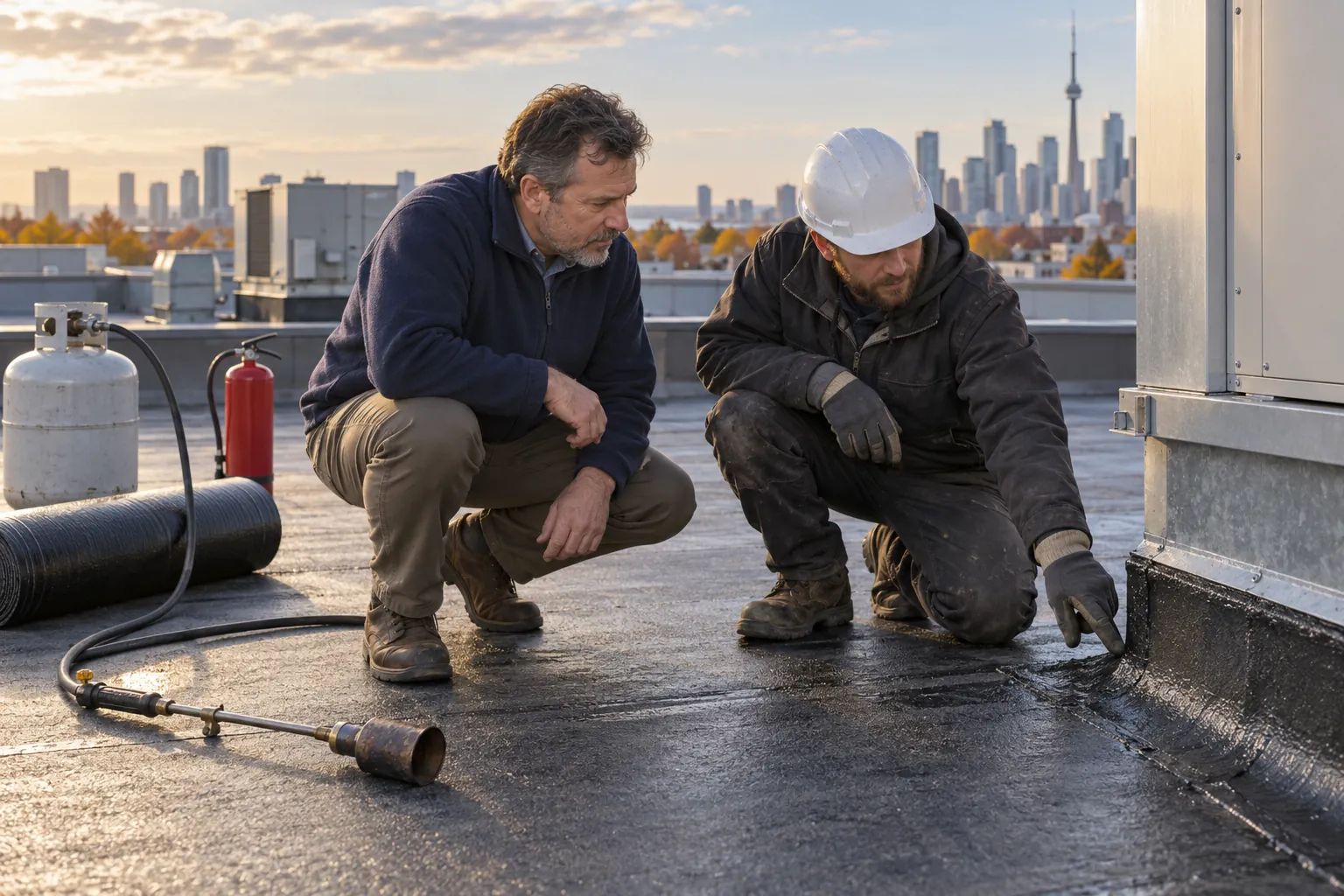
- torch-applied roofing membrane on a flat roof, which the National Fire Code names as hot work (Sentence 5.2.1.1.(1)) and Ontario covers in Section 5.11;
- cutting with an angle grinder, a cut-off saw or an oxy-fuel torch;
- thawing frozen pipes with a torch, a winter job the national code names;
- work on ventilation or kitchen exhaust ducts, which the Ontario Fire Code allows only once the system is shut down, the duct cleaned of combustible deposits and any combustible lining or covering the work could ignite removed (Sentence 2.6.1.10.(1));
- anything done to a tank, drum, pipe or container that contains, or has held, a flammable or combustible liquid or gas.
The last is the most dangerous: both codes forbid hot work on containers, equipment or piping containing flammable or combustible liquids or flammable gases unless they have been cleaned and tested with a gas detector, or safety measures are taken in line with good engineering practice, and forbid it outright on a totally enclosed container (National Fire Code Article 5.2.3.4.; Ontario Fire Code Article 5.17.3.3.).
The first question on any permit is whether hot work is needed at all. CCOHS suggests substitutes: manual hydraulic shears instead of saw or torch-cutting, mechanical bolting instead of welding, screwed or flanged pipe instead of sweat soldering, and a mechanical pipe cutter instead of torch or radial saw cutting.
Any substitute must be assessed in turn so it introduces no new hazard. The second question is whether the job can move. The National Fire Code's starting point is that hot work is done "in an area free of combustible and flammable contents, with walls, ceilings and floors of noncombustible construction or lined with noncombustible materials" (Sentence 5.2.3.1.(1)), such as a maintenance shop. A bracket that can be welded in the shop and bolted on site needs no fire watch in the building.
03
What a hot work permit and its checklist should contain
No Canadian code prescribes a hot work permit template, so the form is the organization's own, built from the conditions the code sets. A useful permit records:
- the job and the exact location, including what lies above, below and beyond the walls;
- who is doing the work, for which company, and that they are trained, as Sentence 5.2.1.2.(1) of the National Fire Code requires;
- who authorized it, with the date, start time and expiry time;
- the checklist below, completed at the work site;
- each fire watcher's name, when the watch ends and when the final inspection is due;
- any part of a fire alarm or sprinkler system shut down for the work, and when it was restored;
- the sign-offs: work finished, fire watch completed, final inspection done, permit closed.
The hot work permit checklist confirms, before work starts, that:
- combustible and flammable materials within 15 m are removed or protected with noncombustible materials, or thoroughly wetted where they can be neither (National Fire Code Article 5.2.3.2.; in Ontario, kept at least 15 m away or protected by sheet metal or other noncombustible material);
- openings in walls, floors and ceilings that sparks could pass through are covered or closed, or the area beyond is treated as part of the work area (Sentence 5.2.3.1.(3));
- any process producing flammable vapours or combustible dust has been stopped;
- flammable gas piping nearby is protected; in Ontario, the section within 1 m of the torch is covered with wet noncombustible insulation 6 mm thick;
- at least one portable fire extinguisher is in the hot work area;
- the equipment has been examined for leaks and defects before use; in Ontario it is inspected daily or before use and leak tested monthly (Article 5.17.2.6.);
- walls, partitions and ceilings have been checked for combustible material, floors swept and duct openings covered, as CCOHS recommends;
- sprinklers and extinguishers are working, and a trained fire watcher is posted.
If any line cannot be ticked honestly, the permit should not be issued. A checklist completed at a desk, before anyone has looked at the floor below, is no check at all.
04
The fire watch, the final inspection, and how long a permit lasts
Fires from hot work often start after the work stops, when a spark has lodged in a void or heat has travelled along a pipe or through a roof deck. That is why the code's requirements continue past the end of the job. When hot work cannot be done in a noncombustible area, Sentence 5.2.3.1.(2) of the National Fire Code 2025 requires:
- combustible and flammable materials within 15 m protected against ignition;
- "a continuous fire watch" during the hot work "and for a period of not less than 60 min after its completion";
- a final inspection of the hot work area and adjacent exposed areas either 4 hours after the work is completed, or straight after the fire watch, in which case a more comprehensive inspection is required.
The explanatory note says a comprehensive inspection should include concealed spaces, building equipment, storage and combustible refuse, with thermal scanners or infrared thermometers where obstructions block a visual check. The watch itself must be kept by "personnel equipped with and trained in the use of fire extinguishing equipment" (Article 5.2.3.3.), and by more than one person where combustible materials are exposed but cannot be directly observed by the first person on watch (Sentence 5.2.3.2.(3)).
Ontario differs. Section 5.17 of the Ontario Fire Code sets no fire watch period for welding and cutting. For torch-applied roofing, Article 5.11.2.5. requires a firewatch over areas within 5 m of the torch and wherever combustibles under the roof or beyond a wall might be ignited, toured at least once each hour until at least 3 hours after the work stops, or 2 hours if a hand-held thermal imaging camera is used.
CCOHS advises a trained fire watcher "within the work area, including lower levels if sparks or slag may fall during welding, including during breaks, and for at least 60 minutes after work has stopped", and longer for some work, "up to 3 or more hours". Our fire watch guide covers how to run and log the watch itself.
How long is a hot work permit valid for? No Canadian code sets a period, so the issuer sets an expiry on each one. The safe pattern is one task, one location, one shift, with the expiry before the trained people leave the building. The code's timings decide the latest a job can finish: welding that ends at 3 p.m. needs a fire watch until at least 4 p.m., and then either a final inspection at 7 p.m. or a comprehensive inspection at 4 p.m. If nobody trained will be there to do it, the work should stop earlier.
05
Who issues the permit, who watches, and who signs it off
The codes say what has to happen, not who signs. CCOHS says a hot work program should decide who authorizes, performs and monitors hot work, and that each role, contractors and fire watchers included, must be trained for it. In a typical building the roles look like this:
- The issuer authorizes the work: often the facility manager, the building operator or chief engineer, or the property manager, who knows what is above, below and behind the work and can refuse or stop a job.
- The person doing the work, usually a contractor, must be trained in the safe use of the equipment (National Fire Code Sentence 5.2.1.2.(1)), examines the equipment before use, and completes the checklist with the issuer at the work site.
- The fire watcher is trained, equipped with extinguishing equipment and not doing the work, and watches during it, through breaks, on the floor below and for the full period afterward.
- The person closing the permit does the final inspection when the code requires, confirms anything shut down for the work is back in service, and returns the permit to the issuer.
Fire alarm detectors need particular care. Isolating detectors so the work does not set off the alarm is a temporary shutdown of part of a fire protection system, and Sentence 6.1.1.4.(1) of the National Fire Code 2025 requires that "alternative measures shall be taken to ensure that protection is maintained." In Ontario, Article 6.3.1.3. requires the fire department, occupants and supervisory staff to be notified when any part of a fire alarm system is shut down. Isolate only what the work needs, and name who restores it.
In Ontario, Sentence 2.8.2.1.(5) of the Fire Code requires the fire safety plan to be revised before demolition or construction, including hot surface applications, starts in or on the building, with temporary measures for the occupants and procedures to control the fire hazards. A roofing contract is a fire safety plan change, not only a permit.
Keep the closed permits. Under Article 1.1.2.1. of the Ontario Fire Code, where the Code requires tests and corrective measures or operational procedures, "records shall be made noting what was done and the date and time it was done"; electronic records are accepted, and Article 1.1.2.2. keeps a required record for at least two years. Whether a given permit is a required record is a question for your fire department; keeping it with the building's fire safety log book costs nothing.
06
Where the hot work record fails, and what SiteClara does about it
The permit is usually filled in carefully at the start. The weak point is everything after: the fire watch times written up together at the end, the final inspection signed at 4:10 because the contractor needed to leave, the floor below assumed rather than checked, and the closed permit still on the dashboard of a service van. Asked afterward how the watch was kept, the permit shows a signature and a time, not the checks.
SiteClara records checks at the place they are done. A printed QR poster, with an optional NFC tag behind it, goes at each location where checks happen: a mechanical room, a roof access, a riser, the floor below the work. Staff scan the code or tap the tag with their own phone, with no app to install, see the checks due there and mark each done, or explain what stopped them. Each scan records the named person and the time, with a photo when one is asked for, so a fire watcher leaves timed, photographed entries for the work area, the floor below and the far side of a wall, not one signature at the end. A problem found, such as a scorched surface or a detector zone still isolated, is reported there with a photo and stays on the team's list of jobs until someone closes it.
The supervisor sees what was due, done and missed at each location and records the reason for anything missed. Each day they review the record, add a note and approve a report that goes to nominated managers the next morning, so the property manager or the client can see that the fire watch and the final inspection happened, check by check, rather than taking it on trust.
07
Questions people ask
What is a hot work permit in Ontario?
It is the building's written authorization for one hot work job, showing that the precautions in the Ontario Fire Code, O. Reg. 213/07 were checked before the work and after it. The Fire Code does not require a permit by name, but Section 5.17 requires hot work to be done in a noncombustible area or with combustibles kept at least 15 m away or protected, and at least one portable extinguisher in the hot work area; Section 5.11 adds an hourly firewatch for torch-applied roofing lasting at least 3 hours after the work, or 2 hours with a thermal imaging camera.
When would I need a hot work permit?
Whenever work that uses open flames or produces heat or sparks is done outside a dedicated area free of combustibles. The National Fire Code of Canada 2025 lists cutting, welding, soldering, brazing, grinding, adhesive bonding, roofing operations, thermal spraying and thawing pipes, and requires extra precautions, a fire watch and a final inspection whenever that work cannot be done in a noncombustible area.
How long is a hot work permit valid for?
Neither the National Fire Code of Canada 2025 nor the Ontario Fire Code sets a validity period, so whoever issues the permit sets an expiry on each one. The National Fire Code does set the timings the permit must leave room for: where the work cannot be done in a noncombustible area, a continuous fire watch during the work and for at least 60 minutes after it, then a final inspection 4 hours after the work is completed or, straight after the fire watch, a more comprehensive one (Sentence 5.2.3.1.(2)).
What are examples of hot work?
Sentence 5.2.1.1.(1) of the National Fire Code of Canada 2025 names cutting, welding, soldering, brazing, grinding, adhesive bonding, roofing operations, thermal spraying and thawing pipes, and says the list is not exhaustive. CCOHS, in its fact sheet Welding – Hot Work, defines hot work as working with ignition sources near flammable materials and gives welding, soldering and cutting as examples.
08
Where to read more, and a hot work permit checklist to take away
The National Fire Code of Canada 2025 is a free PDF from the NRC: hot work is Section 5.2 of Division B, with the explanatory notes at the end of Part 5; check the Codes Canada publications page or your provincial fire marshal for the edition your province enforces. In Ontario, read the Ontario Fire Code, O. Reg. 213/07 on e-Laws, especially Sections 5.17 and 5.11, Article 2.8.2.1. and Subsection 1.1.2., with the Occupational Health and Safety Act. CCOHS's Welding – Hot Work sets out a hot work program and good practices. See also our guide to the fire watch.
Before any hot work in your building, check that:
- someone has asked whether a cold method, or a move to the shop, would do the job;
- the issuer is named, knows the building, and can stop the work;
- the permit covers one task, one location and one shift, with an expiry time;
- the checklist was completed at the work site, within 15 m, above, below and beyond the walls;
- the fire watcher is trained, has an extinguisher and is not doing the work;
- only the detectors the work needs are isolated, and someone is named to restore them;
- the fire watch runs through breaks and for at least 60 minutes after the work, and the final inspection is done when the code sets, by someone still on site;
- closed permits come back to the issuer and are kept with the fire safety records.
Sources
Every document this guide quotes or links to, in the order it first cites them.
- Welding – Hot Work ccohs.ca
- National Fire Code of Canada 2025 nrc.canada.ca
- Ontario Fire Code, O. Reg. 213/07 ontario.ca
- Occupational Health and Safety Act ontario.ca
- Construction Projects regulation, O. Reg. 213/91 ontario.ca
- List of Codes Canada publications nrc.canada.ca
Related guides
 Fire and water checksFire watch: when the code requires one, and how to run it properlyWhen a fire watch is required under the National Fire Code of Canada and the Ontario Fire Code, how often to patrol, who can do it, and what the log should show.
 Fire and water checksFire safety plan: what it must contain, who approves it, and how to keep it trueWhat a fire safety plan must contain under the National Fire Code of Canada and the Ontario Fire Code, who approves it, how often it is reviewed, and the records.
 Fire and water checksFire log book: what to record, who keeps it and how long, under Canadian fire codesWhat a fire log book should hold under the Ontario Fire Code and the National Fire Code of Canada: the tests, who records them, how long to keep them, and the form.
 Fire and water checksWorkplace fire safety checklist: what to check, how often, and who does it in CanadaA workplace fire safety checklist for Canadian buildings: the daily, monthly and annual checks the fire code sets, who does each one, and what the record shows.