Cleaning
Retail cleaning checklist: sales floor, fitting rooms, restrooms and spills
A retail cleaning checklist is a list of the cleaning tasks a store needs done in each area, before opening, during store hours and after close, with how often each task happens and who does it.
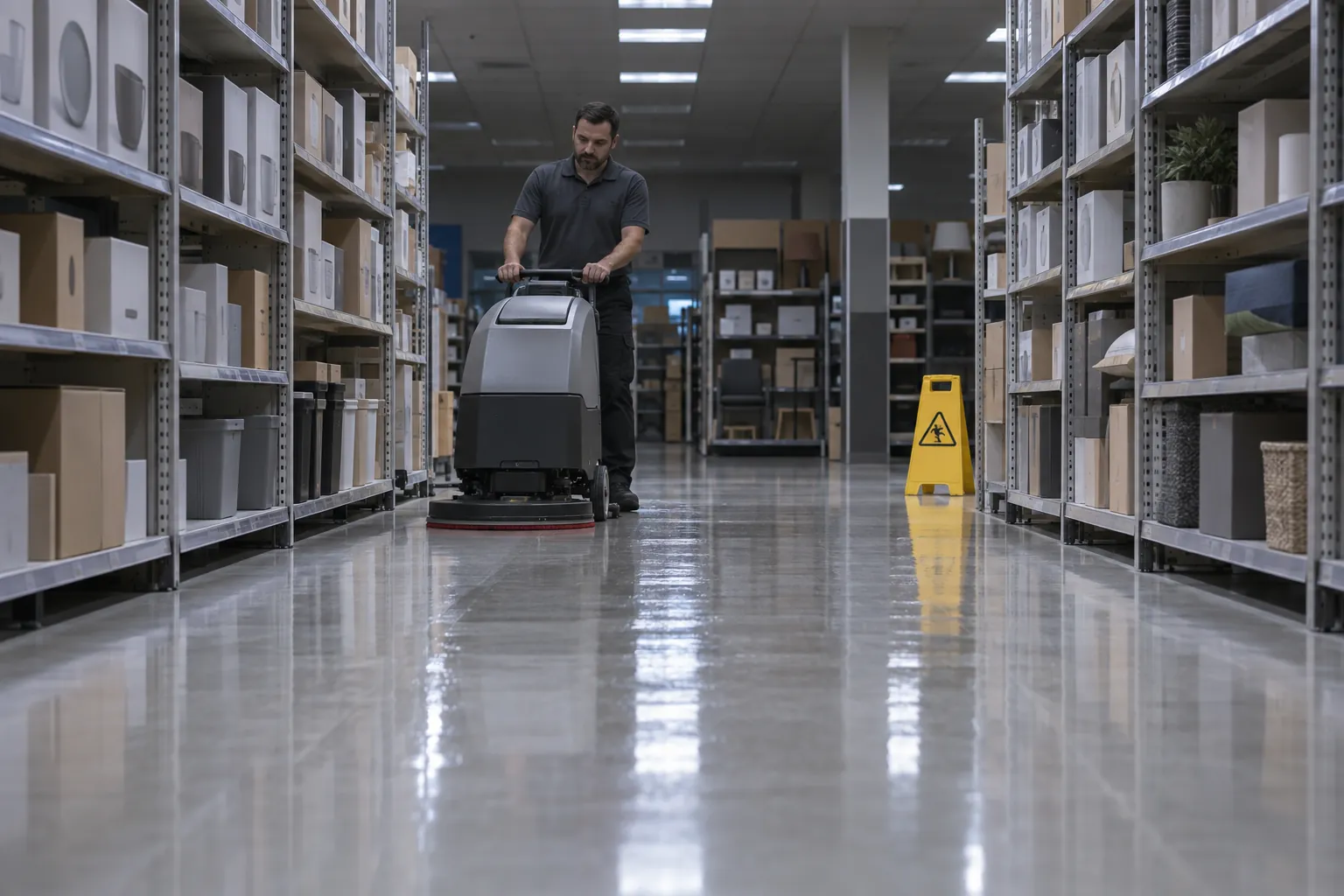
A store has to be cleaned around its customers. The sales floor is walked all day, spills happen while the doors are open, and a wet vestibule on a rainy Saturday is a slip hazard as much as a cleaning job. This guide sets out a retail cleaning checklist for before opening, during store hours and after close, including the back room and the areas shoppers never see, and what OSHA's housekeeping rules ask of the employer.
01
The rules behind a retail cleaning checklist
No federal rule hands a store a cleaning checklist. What the law sets is the outcome, and for employees in a private-sector store the starting point is OSHA's walking-working surfaces standard. 29 CFR 1910.22 says that "all places of employment, passageways, storerooms, service rooms, and walking-working surfaces are kept in a clean, orderly, and sanitary condition", that the floor of each workroom is maintained "in a clean and, to the extent feasible, in a dry condition", and that walking-working surfaces are kept free of hazards "such as sharp or protruding objects, loose boards, corrosion, leaks, spills, snow, and ice."
The same section adds the two sentences a retail cleaning checklist is really built on. Walking-working surfaces must be "inspected, regularly and as necessary, and maintained in a safe condition", and a hazardous condition must be corrected or repaired before an employee uses the surface again; if it cannot be fixed at once, it "must be guarded to prevent employees from using the walking-working surface until the hazard is corrected or repaired." In a store, that is the floor walk, the spill response and the cone or barrier left until the floor is dry.
Other federal OSHA standards touch the cleaning of a store:
- Sanitation: 29 CFR 1910.141 requires workplaces to be "kept clean to the extent that the nature of the work allows", receptacles for putrescible waste or refuse that do not leak and can be thoroughly cleaned and kept sanitary, and a workplace maintained to keep out rodents, insects and other vermin. It also covers employee restrooms.
- Exit routes: 29 CFR 1910.37 says exit routes "must be free and unobstructed" and that no materials or equipment may be placed in them, "either permanently or temporarily." Flattened cardboard, stocking carts, pallets and floor machines parked in a back corridor are among the most common problems.
- Cleaning chemicals: the Hazard Communication Standard, 29 CFR 1910.1200, covers hazardous chemicals employees use, with safety data sheets, labels and training. It exempts consumer products used as the manufacturer intended at no more than consumer-level exposure, but concentrates, floor strippers and degreasers used daily by a janitorial crew are unlikely to meet that test.
Two traps. First, federal OSHA is not the whole story: OSHA's State Plans page lists 22 State Plans covering private-sector and state and local government workers, and seven covering only public employees, so a store in California, Washington or Michigan, for example, works under its state program and should check that program's own rules. Second, OSHA protects employees, not shoppers. A shopper who slips is a matter of state premises liability law, where the usual question is whether the store knew or should have known of the hazard and acted reasonably. Food areas are different again: a store with a deli, bakery, coffee bar or unwrapped food answers to the state or local health department's food code, usually adopted from the FDA Food Code, which FDA publishes as a model for jurisdictions to adopt rather than as federal law.
02
What a retail cleaning checklist covers
A boutique on Main Street, a big-box store and a grocery supercenter have different lists, and a downloaded template or PDF is only a starting point. Most retail store cleaning checklists still cover the same essential areas:
- Entrance and vestibule: doors and door glass, walk-off mats, the vestibule floor, and the cart corral or basket stand.
- Sales floor: aisles and main walkways, shelves and gondolas, end caps, fixtures, product displays, mirrors and glass display cases.
- Checkout area: counters, POS screens, card readers and PIN pads, belts, self-checkout stations, bagging areas and queue stanchions.
- Fitting rooms: floors, mirrors, benches, hooks, curtains or doors, and the hanger and returns rack.
- Customer restrooms and baby changing stations, where the store has them.
- Food areas: deli, bakery, coffee bar, sampling stations, coolers and freezer cases, each on its own cleaning and sanitizing schedule under the local food code.
- Employee areas: the break room, employee restrooms, lockers and the time clock area.
- Back room and receiving: stockroom floors, racking, the baler or compactor area, the janitor closet and chemical storage, and the emergency exits.
- Exterior: the storefront glass, the sidewalk in front of the doors, and for larger stores the parking lot, cart corrals and trash enclosure.
Split the checklist by area and by time of day. A single list for the whole store, initialed once, tells you nothing about the entrance at 11 a.m. on a wet Saturday.
03
The retail cleaning checklist: before opening, during store hours, after close
Most heavy cleaning happens outside store hours, by the overnight crew or the janitorial contractor, with spot cleaning through the day by associates or a day porter. Keep the daily list in three parts, with weekly and periodic work listed separately, and adjust it to the store's hours, floors and peaks.
Before opening
- Walk the sales floor and back room for spills, debris, leaks and trip hazards left overnight or by the truck delivery.
- Clean the entrance door glass at hand height, lay out walk-off mats, and check the vestibule floor.
- Wipe checkout counters, card readers, belts, baskets and cart handles.
- Check customer restrooms and fitting rooms are clean and stocked with soap, paper and liners.
- Check emergency exits and exit routes in the back room are clear of freight and cardboard.
During store hours
- Regular floor walks at a set interval to find and deal with spills, dropped items and packaging, with more walks at peak times and in food aisles.
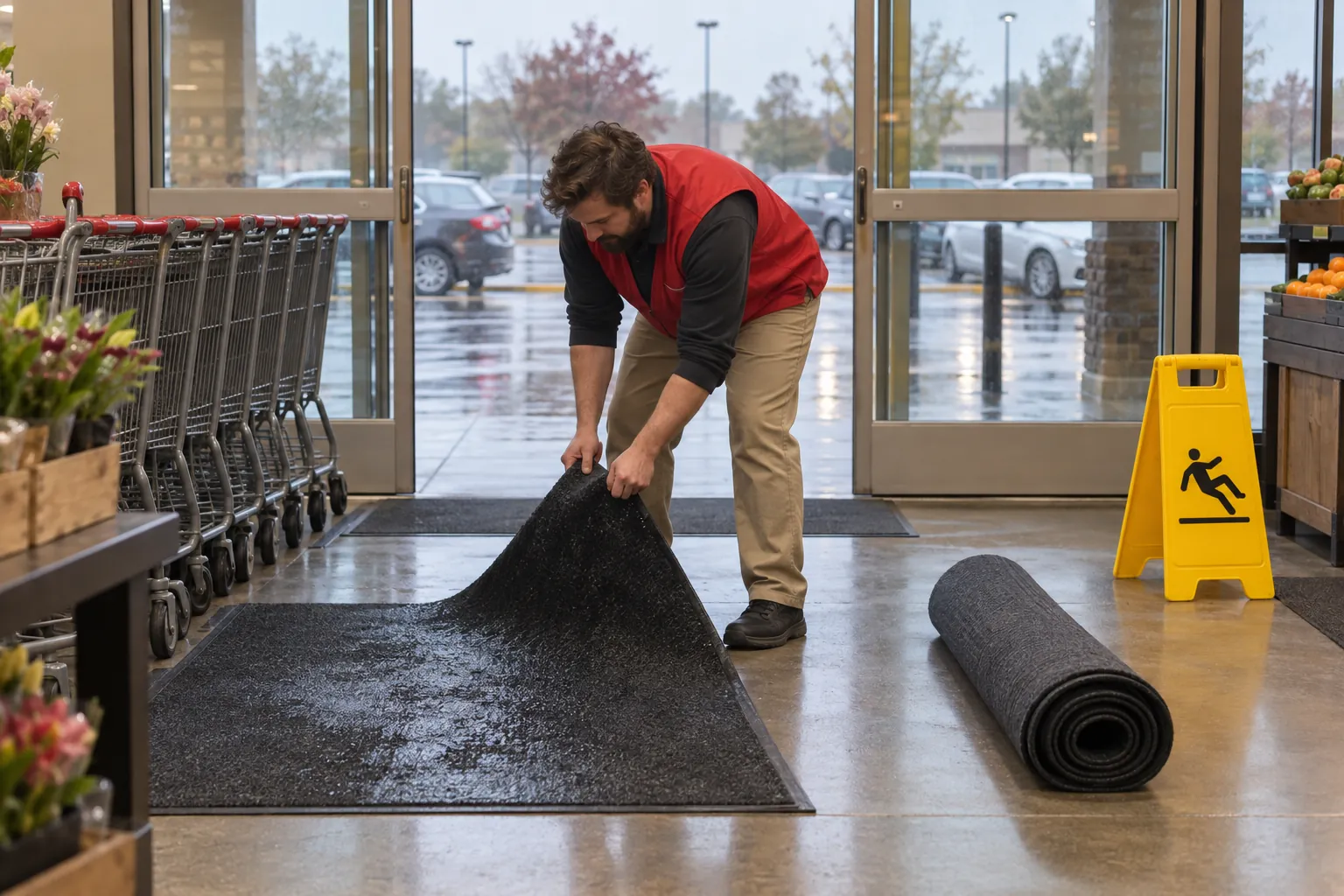
- Check and dry the vestibule in rain or snow, and swap saturated mats for dry ones.
- Recover fitting rooms at busy times: remove hangers, tags and pins, return go-backs to the floor, and check for anything left behind.
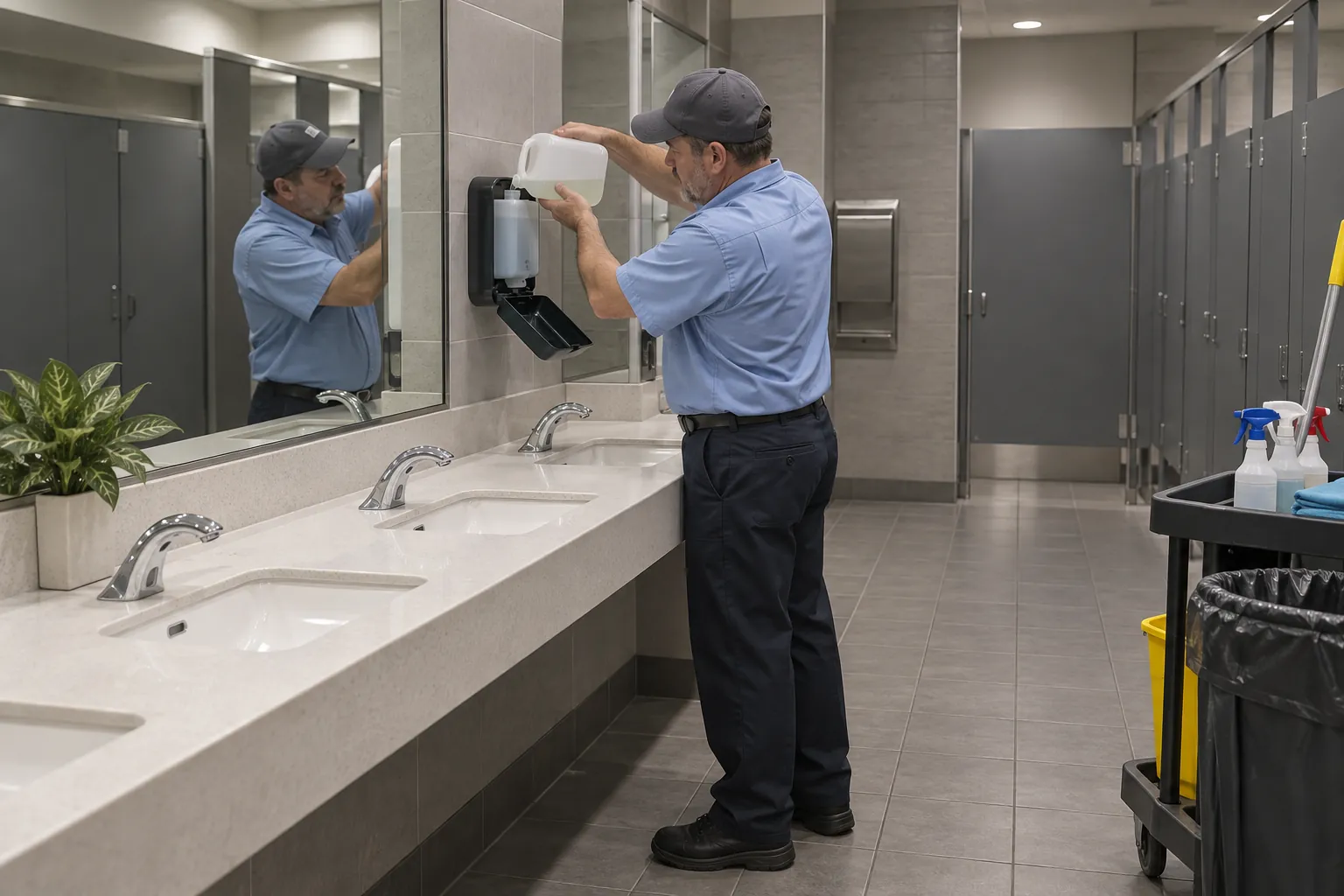
- Check customer restrooms on a schedule that matches traffic; the restroom cleaning log guide covers how.
- Wipe high-touch surfaces at checkout and in employee areas, and empty trash cans before they overflow.
After close
- Clean hard floors with an auto scrubber or by sweeping and damp mopping, burnish where the finish calls for it, and vacuum carpeted areas.
- Dust shelves, fixtures and displays, and clean fingerprints and streaks from glass, mirrors and display cases.
- Clean fitting rooms fully, including mirrors, benches and floors.
- Clean and restock customer and employee restrooms, including toilets, sinks and mirrors, and wipe down the break room tables.
- Empty all trash, and take cardboard to the baler and trash to the compactor or enclosure.
- Clean and sanitize food areas to their own schedule.
Weekly and deep cleaning
- Dust high shelves, sign holders, air vents and light fixtures; report burned-out lamps to maintenance.
- Clean under fixtures and gondolas, behind checkouts and along baseboards.
- Floor care to the floor type: scrub and recoat, or strip and refinish, vinyl composition tile; extract carpet and treat stains.
- Clean the back room floor and racking, the janitor closet and the trash enclosure.
- Wash storefront windows inside and out, often by a window cleaning contractor.
Where cleaning and disinfecting are both on the list, keep them apart. The CDC's page on when and how to clean and disinfect a facility advises cleaning high-touch surfaces regularly, naming counters, shopping carts, door handles, touchpads and restroom fixtures among its examples, and disinfecting where people have obviously been ill. The commercial cleaning checklist guide covers the general areas every building shares.
04
Spills, wet weather and floor care
OSHA's page on its walking-working surfaces rule notes that falls from heights and on the same level "are among the leading causes of serious work-related injuries and deaths." In a store the same floor carries associates and shoppers, so floor cleaning is hazard control as much as appearance, though the two go together: a clean, welcoming store is part of the shopping experience and one of the first things a customer notices. A few principles make most of the difference:
- Find spills quickly. Floor walks at a set interval, more often at peak times, and a store rule that any associate who sees a spill stays with it, or guards it, until it is cleaned up. That is 1910.22's "guarded" in practice.
- Clean them up properly. Stop people walking through, use the right method, and dry the floor. A mop that leaves a wet film simply moves the hazard. Many stores keep spill kits with absorbent pads for spot spills and use an auto scrubber for larger areas.
- Use signs honestly. Put a wet floor sign out while the floor is wet and take it away when it is dry. A sign that stands in the same aisle all day is ignored by shoppers and suggests a system nobody is running.
- Control the entrance. Enough walk-off matting to take water and grit off shoes before they reach hard floors, cleaned and swapped when saturated, with more frequent checks in rain and snow. Keep the sidewalk and parking lot clear of ice where the store is responsible for them.
- Match chemicals to the floor. The wrong cleaner, or too much of it, leaves residue that makes a floor slippery when wet. Follow the floor manufacturer's care instructions and the chemical label's dilution. EPA's page on EPA-registered disinfectants reminds users that disinfectants are pesticides and that the surface should stay visibly wet for the whole contact time on the label.
- Record it. Note floor walks and spills cleaned up, with the time and who did it. If a customer says they slipped at 2:10 p.m., a record of the floor walk at 2:00 and the spill cleaned at 2:05 is what the store's insurer and counsel will ask for.
Freezer and cooler aisles, produce, the entrance and the doors from the dock are the usual problem spots. If one keeps causing trouble, look again at the flooring, the cleaning method and the matting; the slip and fall prevention guide goes further.
05
Who does it, and how the checklist is checked
In most stores, associates handle floor walks, spot cleaning and fitting room recovery during store hours, and an in-house overnight crew or a janitorial contractor does the main clean and floor care before opening or after close. Larger stores, malls and supercenters often have a day porter or custodian on the floor all day. Whatever the split, the retail cleaning checklist should say who owns each task, because a spill that everyone assumes is someone else's job is the one that ends in a claim.
- Store managers set the standard, walk the store at opening and before peak periods, and handle customer complaints.
- Associates handle floor walks, spills, fitting rooms and recovery during store hours, and report anything they cannot fix.
- The cleaning crew, in-house or contracted, does the scheduled cleans, the overnight work and periodic floor care, under a scope of work that lists each task and its frequency.
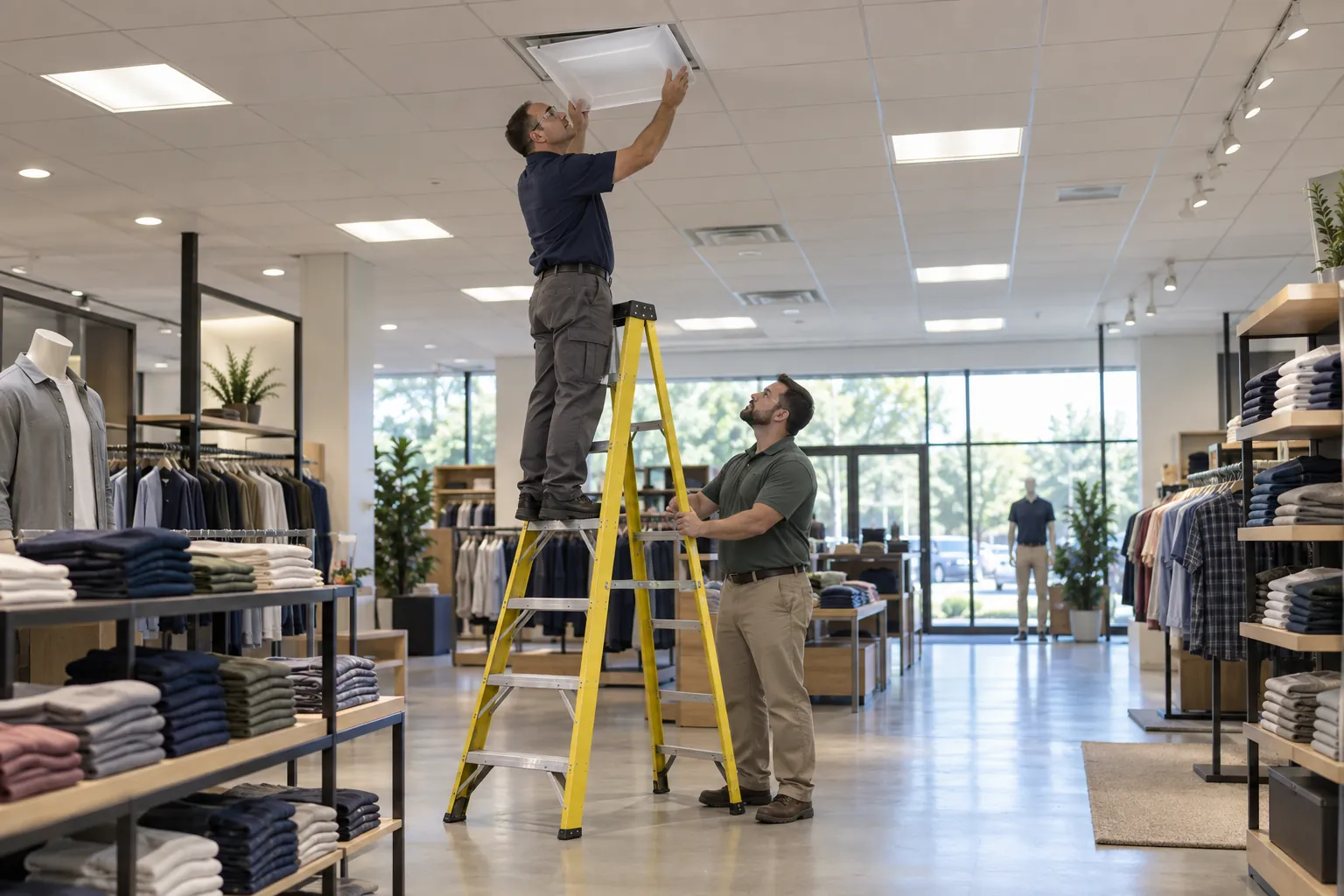
- Facilities and maintenance, often a regional team or a service contractor through a work order, handle lighting, fixtures, leaks, windows at height and floor restoration.
Chemical safety sits with whoever employs the person using the chemical: the store keeps safety data sheets for its associates' products, and a janitorial contractor keeps its own. Keep chemicals labeled in the janitor closet, never in food areas. Disinfectants are pesticides, as EPA's page on EPA-registered disinfectants reminds users, and EPA's introduction to pesticide labels puts the point plainly: "the label is the law."
Plan for peaks. The holidays, Black Friday, back-to-school, clearance events and bad weather bring more shoppers, more merchandise on the floor and more spills. Add floor walks, check restrooms more often and add a midday clean of the entrance, and put the change on the checklist so it actually happens rather than being assumed.
06
Where the retail cleaning record fails, and what SiteClara does about it
Most stores can show a cleaning schedule. Far fewer can show that the floor walk at 2 p.m. actually happened, who did it and what they found. The paper sweep log on the back room wall is initialed at the end of the shift, the janitorial contractor's overnight work is recorded in its own binder, and a district manager who visits every few weeks sees the store on that day only.
SiteClara puts a printed QR poster at each area on the checklist, such as the vestibule, each fitting room, the customer restrooms and the back room, with an optional NFC tag behind it. Staff scan the code or tap the tag with their own phone, with no app to install, see the scheduled checks due there, and mark each one done or explain what stopped them, with a photo when one is asked for. The time and the person are recorded as it happens. A problem found, such as a leaking cooler or a broken fixture, is reported with a photo and stays on the team's list of jobs until someone closes it.
The supervisor or store manager sees what was due, done and missed, and can record why a check was missed. The store and its janitorial contractor can work from the same site. Each day the supervisor approves a report, which goes to nominated management or client contacts at 8 a.m. the next morning: what was reported, what was completed, what is still open, and how the scheduled checks went.
07
Questions people ask
What is a standard cleaning checklist?
There is no single federal standard checklist for a store; a standard cleaning checklist lists each area, the tasks there and how often they are done. The CDC's page on when and how to clean and disinfect a facility gives the basic frequencies: clean high-touch surfaces such as counters, shopping carts, door handles, touchpads and restroom fixtures regularly, clean other surfaces when they are visibly dirty, and consider cleaning high-traffic areas more often. It advises disinfecting, in addition to cleaning, where people have obviously been ill.
What goes on a cleaning checklist for a convenience store?
The same areas as any store, plus the food. For the floors, OSHA's 29 CFR 1910.22 asks that walking-working surfaces be "inspected, regularly and as necessary" and kept free of hazards such as spills, snow and ice. A convenience store with a coffee bar, roller grill or fresh food also answers to its state or local food code, and FDA describes the FDA Food Code as a model that local, state, tribal and federal regulators use to write their own food safety rules, so ask the local health department which cleaning and sanitizing rules apply to those counters.
08
Further reading, and a list to take away
Read the rules at their source: OSHA's 29 CFR 1910.22 for floors and housekeeping, and your state's own program if the store is in a State Plan state. For food areas, ask the local health department which edition of its food code applies. For cleaning and disinfecting, the CDC's facility guidance and each product's EPA-registered label are the references.
Before the next holiday season, check that your retail cleaning checklist:
- is split by area and by before opening, during store hours and after close;
- sets floor walks at an interval that matches traffic, with more in bad weather and at peaks;
- has a spill procedure that guards the spill, ends with a dry floor and takes the sign away;
- covers fitting rooms, customer restrooms and the back room, not only the sales floor;
- keeps exit routes and emergency exits clear of cardboard, freight and equipment;
- names who owns each task, between associates and the cleaning crew;
- keeps chemicals labeled, stored in the janitor closet and covered by safety data sheets;
- records floor walks and spills with the time and the person;
- is audited by someone other than the person who completes it.
Sources
Every document this guide quotes or links to, in the order it first cites them.
- 29 CFR 1910.22 osha.gov
- 29 CFR 1910.141 osha.gov
- 29 CFR 1910.37 osha.gov
- Hazard Communication Standard, 29 CFR 1910.1200 osha.gov
- State Plans page osha.gov
- FDA Food Code fda.gov
- When and how to clean and disinfect a facility cdc.gov
- Walking-working surfaces rule osha.gov
- EPA-registered disinfectants epa.gov
- Introduction to pesticide labels epa.gov
Related guides
 CleaningCommercial cleaning checklist: area by area, and how to use itA commercial cleaning checklist for offices, lobbies, restrooms and shared areas, area by area, with the OSHA rules behind it and how a supervisor checks the work.
 Premises and facilities managementSlip, trip, and fall prevention: keeping floors, stairs, and walkways safe every daySlip, trip, and fall prevention in a commercial building: what OSHA 1910.22 requires, where people fall, the controls that work, and how to check and record them.
 CleaningRestroom cleaning log: what to record, and how to make it believableWhat a restroom cleaning log should record, how often to check, the OSHA and Food Code rules behind it, and how to keep a log a client or inspector will believe.
 Premises and facilities managementRetail store maintenance checklist: what to check, how often, and who owns itA retail store maintenance checklist for US stores: doors, lighting, exits, fire extinguishers, ADA features, HVAC and the parking lot, with who owns each check.