Cleaning
Retail cleaning checklist: what a New Zealand shop cleans, when, and how it shows it
Retail cleaning is the cleaning of a shop around its trading hours and its customers: the entrance, shop floor, checkouts, fitting rooms, toilets and stockroom, cleaned before opening, during trading and after close.
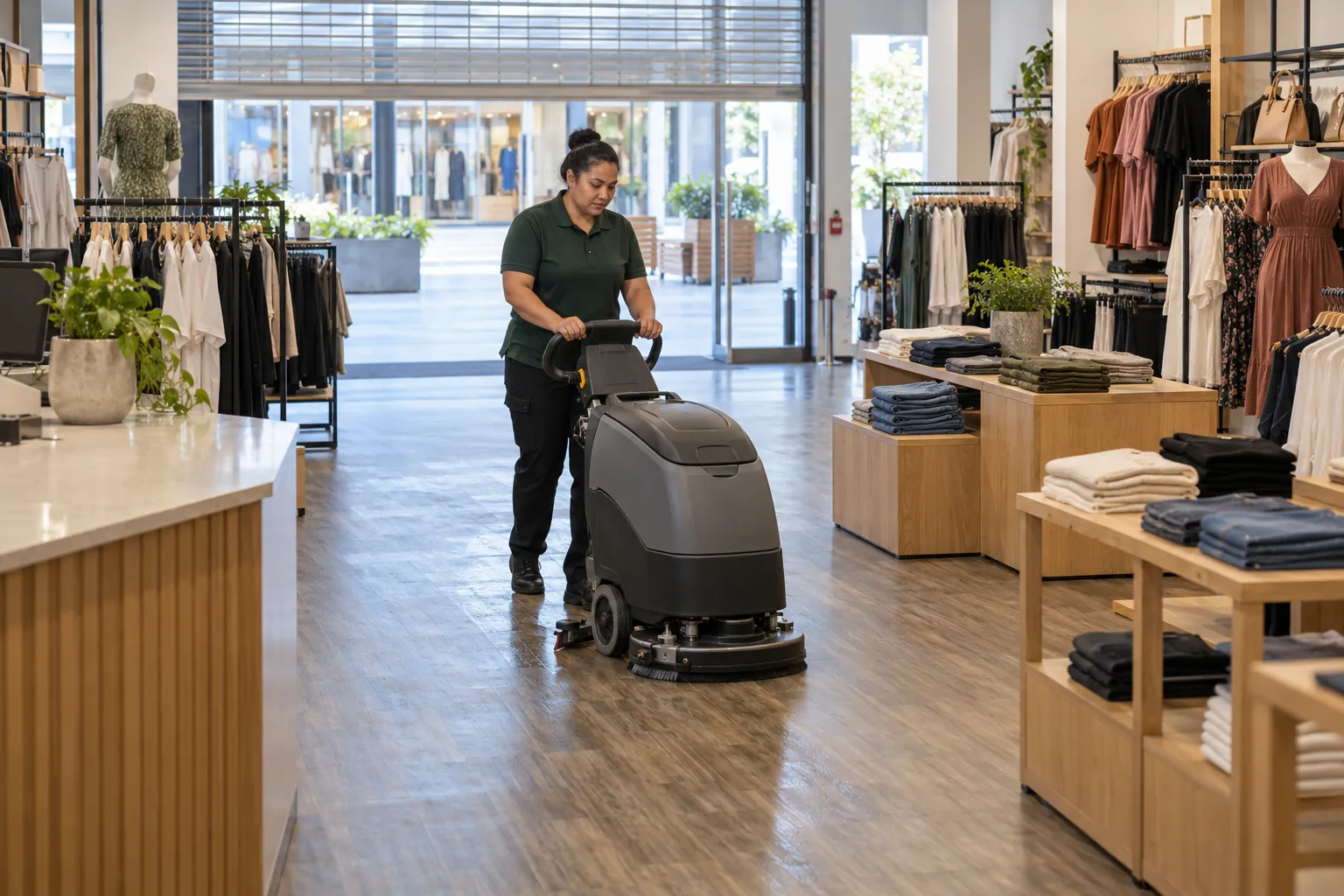
The floor is walked all day, spills happen mid-trading, and a wet entrance on a rainy Saturday is a slip hazard as much as a cleaning job. Under the Health and Safety at Work Act 2015, the business running the store owes its duty to shoppers as well as staff. This guide sets out a retail cleaning checklist for before opening, during trading and after close, the areas customers never see, and how a store shows the routine actually happened.
01
The duty behind a retail cleaning checklist
There is no New Zealand law called a retail cleaning standard. A shop's cleaning duties sit inside the general duties of the Health and Safety at Work Act 2015 (HSWA), which falls on the PCBU (person conducting a business or undertaking): the retailer, and also the contract cleaning company and, in a mall, the centre's owner or manager. Two sections do most of the work.
- The primary duty of care (section 36). WorkSafe's Introduction to the Health and Safety at Work Act 2015 special guide summarises it: a PCBU must ensure, "so far as is reasonably practicable, the health and safety of workers, and that other people are not put at risk by its work." That includes providing and maintaining "a work environment that is without risks to health and safety" and "adequate facilities for the welfare at work of workers". In a shop, the other people are the customers.
- The duty of the PCBU who manages or controls a workplace (section 37). The same special guide says that PCBU must ensure, so far as is reasonably practicable, "the workplace, the means of entering and exiting the workplace, and anything else arising from the workplace are without health and safety risks to any person." The shop entrance, the aisles and the fire exits are all inside that sentence.
The Health and Safety at Work (General Risk and Workplace Management) Regulations 2016 add the detail. WorkSafe's guidelines on General risk and workplace management – part 1 explain regulation 10: the layout must allow people to enter, exit and move around without risk, surfaces must be "designed, installed, and maintained to allow work to be carried out without" risk, and lighting must be suitable and sufficient. For staff toilets, hand basins, the lunchroom and drinking water, the same guidelines say PCBUs must ensure, so far as is reasonably practicable, "the facilities are sufficient in number and maintained to be in good working order, and clean, safe, and accessible."
Other rules touch cleaning in particular parts of a shop:
- Cleaning chemicals. WorkSafe's page on safety data sheets says "It is mandatory to have a current safety data sheet for each of the hazardous substances in your workplace regardless of the quantity you hold", readily accessible to the people who handle them. Consumer products used in household quantities, and sealed stock held only for resale, are exempt from the SDS, but safe-use information must still be available to workers.
- Food. A shop that makes or sells higher-risk food, such as a deli, bakery counter or café, works under the Food Act 2014. The Ministry for Primary Industries explains that a food control plan "sets out what steps a business making or selling higher-risk foods needs to take to make safe food", and that most food retailers can use the Simply Safe & Suitable template. Cleaning in those areas follows the plan and its records.
- Escape routes. Regulation 10 covers moving through the workplace "both under normal working conditions and in an emergency". A building with an approved evacuation scheme must also keep it current; Fire and Emergency New Zealand warns on maintain your evacuation scheme that "Failure to maintain an approved evacuation scheme can lead to the closure of the building". Cardboard, stock cages and cleaning trolleys parked in exit corridors are among the commonest problems a walk-round finds.
02
What a retail cleaning checklist covers
Every shop is different, from a suburban dairy to a large-format supermarket or a clothing store in a shopping centre. Most retail cleaning checklists cover the same areas:
- Entrance: automatic or swing doors, entrance matting, the lobby floor, trolley and basket bays.
- Shop floor: aisles and walkways, shelving and gondola ends, fixtures and displays, mirrors and glass.
- Checkouts: counters, EFTPOS terminals and screens, conveyor belts, self-checkouts and queue barriers.
- Fitting rooms: floors, mirrors, seats, hooks, curtains or doors.
- Toilets and parents' rooms, where the store provides them to customers.
- Food areas: bakery, deli, café, chillers and freezers, cleaned to the food control plan.
- Staff areas: the smoko room or lunchroom, kitchen, staff toilets and lockers.
- Back of house: stockroom floors and racking, goods-in, the cardboard baler or compactor, the cleaners' cupboard and the fire exits.
- Outside: the shopfront, street-level windows, the footpath at the door and, for larger stores, the carpark, trolley bays and bin enclosure.
Split the checklist by area and by time of day, with more attention where foot traffic is heaviest and where hygiene matters most: checkouts, toilets and food areas. One list for the whole store, ticked once, says little about the entrance at 11am on a wet Saturday. In a mall, agree in writing which areas are the store's and which the centre's; the service corridor and loading dock are where cleaning falls between two contracts.
03
The retail cleaning checklist: before opening, during trading, after close
Heavy cleaning happens outside trading hours, lighter tasks through the day. A daily retail cleaning checklist in three parts, with weekly and periodic work listed separately, fits most stores.
Before opening
- Walk the shop floor for spills, packaging and trip hazards left by the overnight delivery or restock.
- Clean entrance doors and glass at hand height; lay out entrance matting and check it is flat.
- Wipe checkout counters, EFTPOS terminals, belts, baskets and trolley handles.
- Check toilets and fitting rooms are clean and stocked with soap, paper and hand towels.
- Check fire exits and escape routes are clear and exit doors open freely.
During trading
- Floor walks at a set interval to find spills, dropped stock and packaging, more often at peak times and in food and chiller aisles.
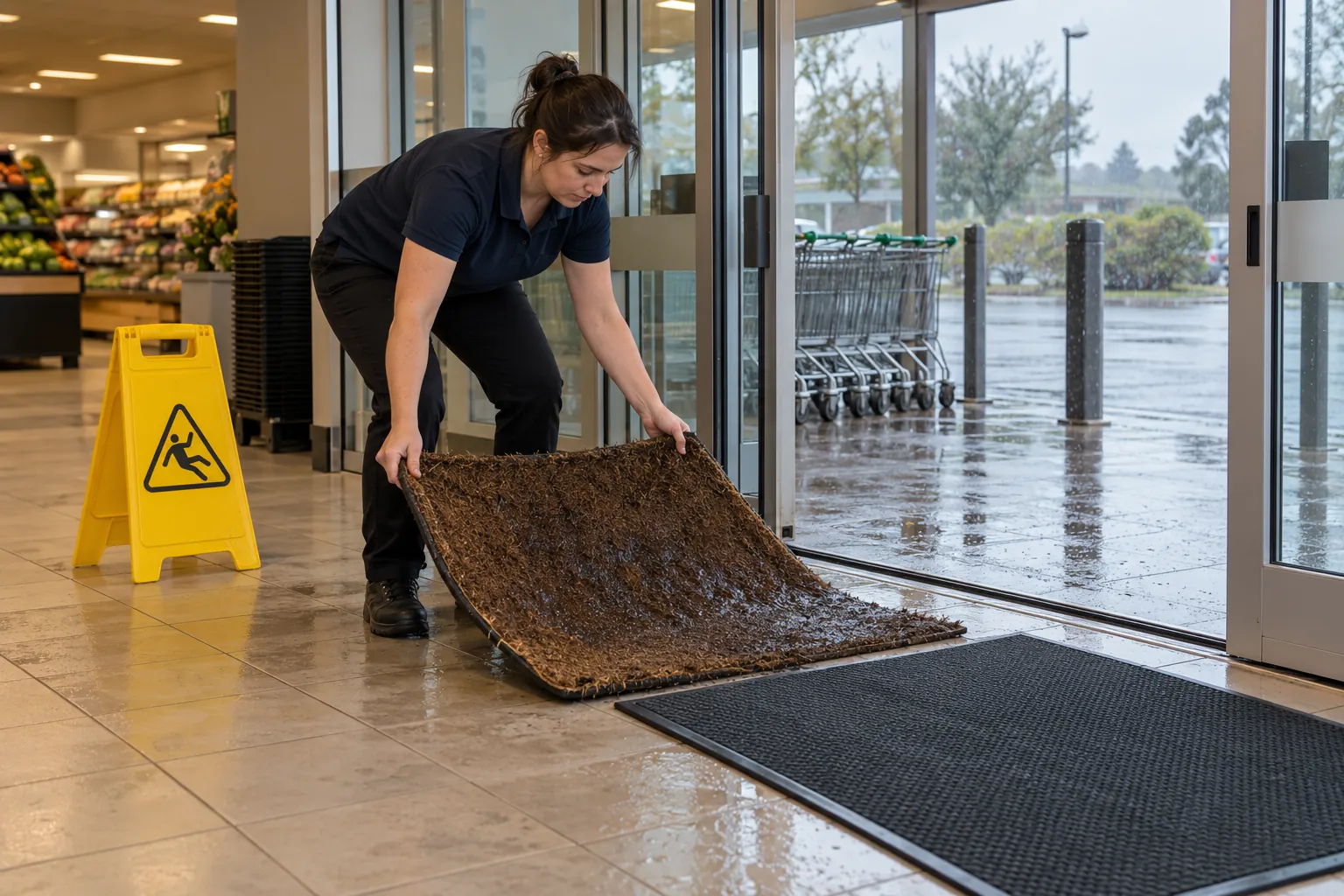
- In wet weather, check and dry the entrance and swap out saturated mats.
- Clear fitting rooms at busy times: hangers, tags, pins and anything left behind.
- Check toilets on a round that matches footfall; see the toilet cleaning checklist.
- Wipe customer touch points at the checkouts at intervals and empty bins before they overflow.
After close
- Sweep and mop hard floors or run a scrubber-dryer; vacuum carpeted areas.
- Dust shelves and fixtures, and clean fingerprints off glass, mirrors and display cabinets.
- Clean fitting rooms fully, including mirrors, seats and floors.
- Full clean of toilets, the lunchroom and staff kitchen.
- Empty bins, and take cardboard and waste to the baler, compactor or collection point.
- Clean food areas to the food control plan's own schedule.
Weekly and periodic
- Dust high shelving, signage frames and light fittings; report failed lights for maintenance.
- Clean under fixtures, behind checkouts and along skirtings.
- Machine scrub hard floors; strip and reseal where the floor needs it; clean carpets and treat stains.
- Clean the stockroom floor and racking, the cleaners' cupboard and the bin enclosure.
- Clean shopfront windows inside and out; above ground floor, that is work at height for a specialist.
04
Spills, wet weather and the shop floor
WorkSafe's page on the risks in a retail store names "slippery floors from water or other liquids" and "uneven or damaged flooring" among the causes of slips, trips and falls, and puts the first controls plainly: "Keep the store tidy – housekeeping is really important in preventing slips, trips and falls" and "Clean up spills promptly." Its wider page on slips, trips and falls adds floors wet "because something is spilt on it, or because of weather conditions or cleaning processes", and trips over "loose carpet, mats, trailing cables, boxes or bags". A few habits make most of the difference:
- Find spills quickly. Floor walks at a set interval, more often at peak times, and a rule that whoever sees a spill stays with it, or guards it, until it is dealt with.
- Clean it properly. Stop people walking through, clean with the right method and dry the floor. A mop that leaves a wet film only moves the hazard; spill kits with absorbent pads suit spot spills, and a scrubber-dryer suits larger areas.
- Use signs honestly. A wet floor sign goes out while the floor is wet and comes away when it is dry. A sign that stands in the same spot all day is ignored.
- Control the entrance. Enough matting to take water off shoes before they reach hard floors, lying flat, and swapped when saturated. Checks at the door go up when the forecast says rain.
- Match the chemical to the floor. The wrong product, or too much of it, leaves a residue that is slippery when wet. Follow the flooring maker's cleaning guidance and check the safety data sheet before changing products.
- Note the time. Record floor walks and spills cleaned with the time. If someone falls at 2:10pm, a floor walk logged at 2pm and a spill cleaned at 2:05pm is how the store shows its control was working.
Under regulations 7 and 8, explained in WorkSafe's General risk and workplace management – part 2, a control must be "maintained so that it remains effective", and PCBUs must review and, as necessary, revise controls, including when a control fails to manage the risk. If the same chiller aisle or entrance keeps causing trouble, look again at the matting, the cleaning method and the flooring, not only the interval between walks. The slips, trips and falls guide covers the wider controls.
05
Who does the cleaning, and how the checklist is checked
In many New Zealand shops, retail staff handle spills, floor walks and fitting rooms through the day and a professional cleaning company under contract, or an in-house team, does the main clean before opening or after close. Supermarkets and malls often have cleaners on the floor all day. Whatever the split, the checklist should name who owns each task, because the spill everyone thinks is someone else's is the one that hurts somebody.
- The store manager or duty manager sets the standard, walks the store at opening and before busy periods, and deals with complaints.
- Retail staff handle floor walks, spills, fitting rooms and tidying during trading, and report what they cannot fix.
- The cleaning contractor or in-house cleaners do the scheduled cleans, the after-hours work and periodic floor care, and supply safety data sheets for their chemicals.
- The mall's centre management, where there is one, cleans the common areas, food court and shared toilets and controls the building's own escape routes.
- Maintenance contractors and specialists handle lighting, fixtures, windows at height and floor restoration.
Each is a PCBU with duties over the same floor. WorkSafe's overlapping duties quick guide says businesses "must so far as is reasonably practicable consult, cooperate and coordinate activities" with each other, and uses a shopping mall as its example. Agreeing who does what is allowed, but it "does not mean they no longer hold any responsibility": they "must still monitor the other business to ensure they follow through on what was agreed." For a retailer, that means checking the cleaner's work, not just paying the invoice.
For a chain, one checklist across all its stores sets the same cleaning standard everywhere and gives a fair basis for comparison. Check it the way you would any quality standard: a scheduled walk-round by the area manager, scored against the specification, and a look at complaints and slip incidents by store.
Plan for peaks. Christmas, Boxing Day sales and a wet winter bring more shoppers and more spills; put the extra floor walks and toilet checks on the list so they actually happen.
06
Where the retail cleaning record fails, and what SiteClara does about it
Most shops can produce a cleaning roster. Far fewer can show that the 2pm floor walk happened, who did it and what they found. The sheet in the staffroom is filled in at the end of the shift, the contract cleaner's night work is recorded in their own folder, and the area manager visiting once a fortnight sees the store on that day only.
SiteClara records those checks where they happen. A printed QR poster, with an optional NFC tag behind it, is placed at each area on the checklist – the entrance, the fitting rooms, the toilets, the stockroom. Staff scan the code or tap the tag with their own phone, with no app to install, see the checks due there, and mark each one done or explain what stopped them. The time and the named person are recorded as it happens, with a photo when the check asks for one. A problem found on the round, such as a leaking chiller or a broken fitting-room hook, goes onto the team's list of open jobs until someone closes it.
The supervisor or store manager sees what is due, done and missed, and records why a check was missed. A store and its cleaning contractor can work from the same site, each seeing its own work. Each morning, the approved report for the day before goes to nominated managers or the client, showing what was reported, completed and still open, and how the scheduled checks went. Where the store works under a food control plan, SiteClara can be the working record the team fills in during the day, but the plan's own records remain the ones the verifier looks at.
07
Questions people ask
How much should I pay a cleaner an hour?
A cleaner you employ must be paid at least the minimum wage. Employment New Zealand's page on minimum wage rates and types gives the adult minimum wage as $23.95 an hour from 1 April 2026, and $19.16 an hour for the starting-out and training rates. If the employment agreement sets a higher rate, the employee "must be paid at least that rate". A store that uses a cleaning company pays that company's price, and the cleaner's pay is set between the cleaner and the company that employs them.
What is the hourly rate for a cleaner in NZ?
No law sets a separate rate for cleaners; the floor is the minimum wage above. One published benchmark is the public service: New Zealand Government Procurement's page on paying a living wage in contracts says every public service department must require in its cleaning, catering and security guard contracts that "workers undertaking these services are paid, at a minimum, the New Zealand Living Wage, with annual increases."
08
Further reading, and a list to take away
WorkSafe New Zealand publishes the retail store risk page, the supermarket risk page and the general risk and workplace management guidelines cited above. The Ministry for Primary Industries publishes the food control plan templates. Fire and Emergency New Zealand covers evacuation schemes for buildings that need one.
Before the next busy season, check that your retail cleaning checklist:
- is split by area, and by before opening, during trading and after close;
- sets floor walks at an interval that matches foot traffic, with more in wet weather and at peaks;
- has a spill routine that ends with a dry floor and the sign taken away;
- covers fitting rooms, toilets, the lunchroom and the stockroom, not only the shop floor;
- keeps fire exits and escape routes clear of cardboard, cages and trolleys;
- names who owns each task between retail staff, the cleaning contractor and centre management;
- has a current safety data sheet for each commercial cleaning chemical on site;
- records floor walks and spills with the time;
- is checked by someone other than the person who fills it in.
Sources
Every document this guide quotes or links to, in the order it first cites them.
- Health and Safety at Work Act 2015 legislation.govt.nz
- Introduction to the Health and Safety at Work Act 2015 special guide worksafe.govt.nz
- General risk and workplace management – part 1 worksafe.govt.nz
- Safety data sheets worksafe.govt.nz
- Food control plan mpi.govt.nz
- Simply Safe & Suitable template mpi.govt.nz
- Maintain your evacuation scheme fireandemergency.nz
- Its first 50 years acc.co.nz
- What ACC covers acc.co.nz
- Risks in a retail store worksafe.govt.nz
- Slips, trips and falls worksafe.govt.nz
- General risk and workplace management – part 2 worksafe.govt.nz
- Overlapping duties quick guide worksafe.govt.nz
- Minimum wage rates and types employment.govt.nz
- Paying a living wage in contracts procurement.govt.nz
- Supermarket worksafe.govt.nz
Related guides
 Premises and facilities managementSlips, trips and falls: what HSWA expects in a building, and the checks that prevent themSlips, trips and falls in New Zealand buildings: the HSWA duty for floors and access, where they happen, the controls that work, who does what, and the checks.
 CleaningCommercial cleaning checklist: area by area, for New Zealand workplacesA commercial cleaning checklist for New Zealand offices and shared buildings, area by area, with the HSWA duties behind it, how to use it and how it is checked.
 CleaningToilet cleaning checklist: what a New Zealand workplace checks, and how it shows itA toilet cleaning checklist for New Zealand workplaces: the HSWA facilities duty, what to check, how often, checks against cleans, and a record people believe.
 CleaningHazardous substances inventory: what it must hold, and how to keep it trueWhat a hazardous substances inventory must contain in New Zealand, who keeps one in a shared building, when to update it, and how it sits with SDSs and labels.