Fire and water checks
Fire door inspection: the NFPA 80 annual check, the checklist, and the record
A fire door inspection is the check, at least once a year under NFPA 80 wherever a jurisdiction has adopted it, that each fire door assembly still closes, latches and has no damage or alterations, carried out by a qualified person who signs a written record kept for the authority having jurisdiction.
Also written for United Kingdom · Ireland · Canada · Australia · New Zealand
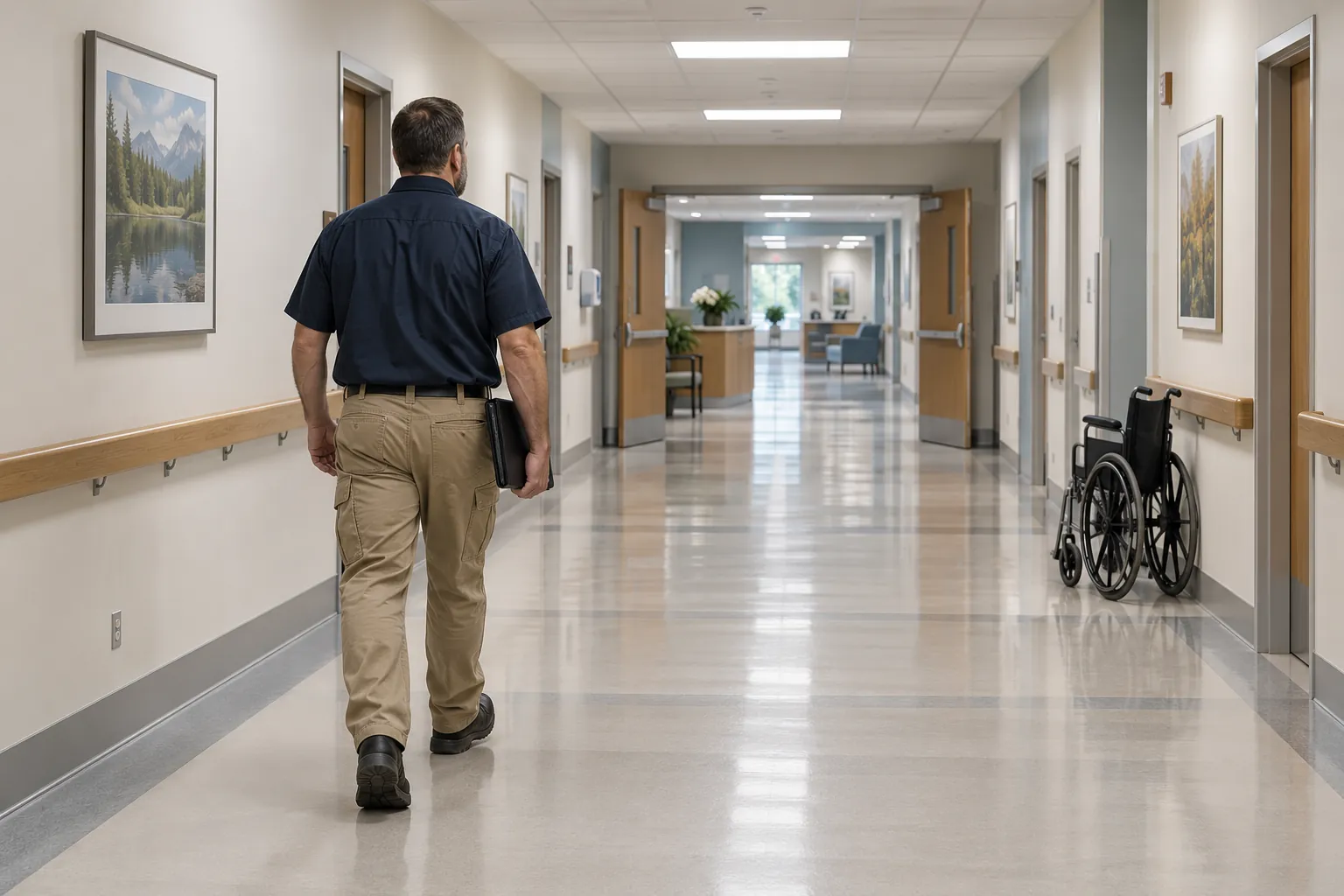
Fire doors are part of a building's fire protection, holding back fire and smoke so building occupants can get out safely, but only if every part of the assembly still works as it was labeled, and a door wedged open or a closer disconnected undoes that in a moment. This guide covers where the duty comes from in the United States, what the annual inspection checks, who may carry it out, what the record should show, and the building's own checks in between.
01
Where the duty to inspect fire doors comes from
No single federal rule sets a schedule for fire door inspections for every building in the United States. The duty comes from the fire code your state or city has adopted, the standard that code points to and, for some buildings, federal health care rules. The authority having jurisdiction (AHJ), usually the fire marshal, enforces it.
The standard. NFPA 80, Standard for Fire Doors and Other Opening Protectives sets how fire doors and other opening protectives are installed, inspected, tested and maintained. As the Kansas Office of the State Fire Marshal quotes the 2010 edition on its Fire Door Checklist (Form 817), section 5.2.1 says: "Fire door assemblies shall be inspected and tested not less than annually, and a written record of the inspection shall be signed and kept for inspection by the Authority Having Jurisdiction." The latest edition is 2025, but an NFPA document is a standard until a jurisdiction adopts it, and the edition your AHJ adopted is the one that applies.
The fire code. States and cities adopt a fire code, usually the International Fire Code (IFC) or NFPA 1, with local amendments. The IFC sends fire doors to NFPA 80. In the 2021 Seattle Fire Code, chapter 7, which the city says is made up of the 2021 International Fire Code with Seattle amendments, section 705.2 reads: "Opening protectives in fire-resistance-rated assemblies shall be inspected and maintained in accordance with NFPA 80." It adds that fire doors "shall not be blocked, obstructed, or otherwise made inoperable." Smoke barrier doors also follow NFPA 105.
OSHA. For workplaces under federal OSHA, 29 CFR 1910.37, Maintenance, safeguards, and operational features for exit routes says that "safeguards designed to protect employees during an emergency (e.g., sprinkler systems, alarm systems, fire doors, exit lighting) must be in proper working order at all times." OSHA sets the outcome, not an inspection interval. In a state with its own plan, listed on OSHA's State Plans page, read the state's equivalent rule.
Hospitals and other CMS-certified facilities. Hospitals that take Medicare and Medicaid must meet the Life Safety Code under 42 CFR 482.41, which incorporates the 2012 edition of NFPA 101, Life Safety Code; the same section requires positive latching hardware on corridor doors and prohibits roller latches on them. As NFPA's NFPA Journal article "Mind the Gap" explains, that code references the 2010 edition of NFPA 80, "which includes a requirement for annual inspections of certain fire door assemblies." Surveyors check it under tag K761 of Form CMS-2786R, Fire Safety Survey Report, quoted below.
02
What a fire door inspection checks
The annual inspection process looks at the whole assembly: the door, frame, hinges, closer, latch, glazing, seals and anything fixed to it, with the door operated, not just looked at. The Kansas State Fire Marshal's Fire Door Checklist (Form 817), one form per door, lists the NFPA 80 items for swinging doors with builders hardware or fire door hardware, each marked pass or fail:
- Holes and breaks: "No open holes or breaks exist in surfaces of either the door or frame."
- Glazing: "Glazing, vision light frames, and glazing beads are intact and securely fastened in place, if so equipped."
- The door, frame and hardware: "The door, frame, hinges, hardware, and noncombustible threshold are secured, aligned, and in working order with no visible signs of damage."
- Missing parts: "No parts are missing or broken."
- Clearances: the gaps around the door are within the limits below.
- The closer: "The self-closing device is operational; that is, the active door completely closes when operated from the full open position."
- Pairs of doors: "If a coordinator is installed, the inactive leaf closes before the active leaf."
- The latch: "Latching hardware operates and secures the door when it is in the closed position."
- Added hardware: "Auxiliary hardware items that interfere or prohibit operation are not installed on the door or frame." A kick-down holder that props a fire door open is one.
- Field modifications: "No field modifications to the door assemble [sic] have been performed that void the label."
- Seals: "Gasketing and edge seals, where required, are inspected to verify their presence and integrity."
The gaps. The same form quotes the clearances from NFPA 80: "The clearance under the bottom of a door shall be a maximum of 3/4 in. (19 mm)", and the clearances between the top and vertical edges of the door and the frame, and the meeting edges of a pair, "shall be 1/8 in. ± 1/16 in. (3.18 mm ± 1.59 mm) for steel doors and shall not exceed 1/8 in. (3.18 mm) for wood doors," measured from the pull face. The chair of the NFPA 80 technical committee told the NFPA Journal that oversized gaps are "probably one of the top two deficiencies" inspectors find.
Under section 705.2.1 of the 2021 Seattle Fire Code, a field-applied label, where approved, must follow the requirements of the certification organization that listed the door. Where the fire code official requires signs, section 705.2.2 sets them in letters at least 1 inch high: "FIRE DOOR--DO NOT BLOCK" for doors designed to be kept normally open and "FIRE DOOR--KEEP CLOSED" for doors designed to be kept normally closed.
Under section 705.2.6, "Horizontal and vertical sliding and rolling fire doors shall be inspected and tested annually to confirm proper operation and full closure. Records of inspections and testing shall be maintained."
03
How often, and who may inspect
How often. Where NFPA 80 applies, at least once a year, as section 5.2.1 says. From the 2013 edition, NFPA 80 also requires an inspection and test once installation or maintenance work on a door is complete, such as a repair, rehanging or new hardware. A building whose doors have never been inspected should start with a baseline survey of every rated opening.
Who. For inspecting fire doors, NFPA 80 asks for a qualified person, not a particular license. The Kansas form sets out the NFPA 80 definitions for whoever does the inspection: a qualified person is "a person who, by possession of a recognized degree, certificate, professional standing, or skill, and who, by knowledge, training, and experience, has demonstrated the ability to deal with the subject matter, the work, or the project," and functional testing "shall be performed by individuals with knowledge and understanding of the operating components of the type of door being subject to testing." For hospitals, CMS tag K761 asks that the individuals doing the inspection and testing "have an understanding of the operating components of the doors."
In practice the annual inspection is done by a door hardware contractor, a third-party fire door inspector or trained in-house staff, depending on what the AHJ accepts, and AHJs differ, so check with yours first. Before appointing anyone, ask:
- what training or certification the inspector holds for fire door assemblies, and whether they can show it to the AHJ;
- whether they inspect every rated opening or a sample, and give each door its own record with photos;
- whether they also sell the repairs, and how they keep the inspection independent of the sale.
Smoke barrier doors and corridor doors that are not rated fire doors still need looking after. CMS tag K761 says that "Fire doors that are not located in required fire barriers, including corridor doors to patient rooms and smoke barrier doors, are routinely inspected as part of the facility maintenance program."
04
What the inspection record should show
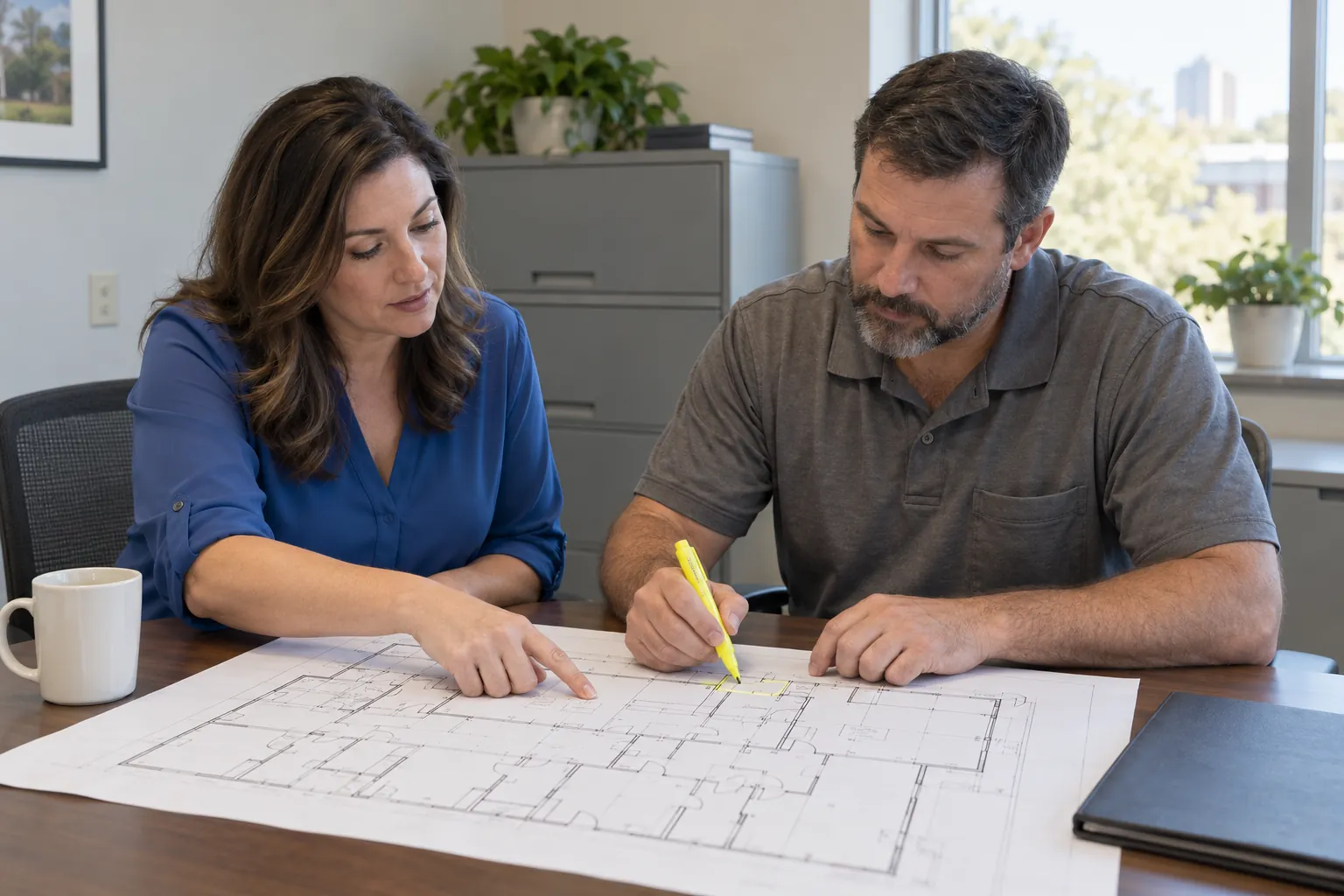
NFPA 80 requires a written record, signed and kept for the AHJ. From the 2013 edition, NFPA 80 (section 5.2.2.4, as iDigHardware's summary of the 2013 changes sets out) lists what the record contains: the date, the facility's name and address, who inspected and their company, the inspector's signature, an individual record of each door by its opening identifier and location, its type, verification of the visual inspection and functional operation, and a listing of deficiencies. Good inspection documentation holds:
- A door schedule: every rated opening with an ID, location, rating and type, matched to the life safety drawings.
- One record per door, each checklist item marked pass or fail, not one line for the building.
- The deficiencies, each with a photo and its priority.
- The repairs: the work order, who did the work, the date, and the reinspection.
Hospitals. Tag K761 on Form CMS-2786R, "Maintenance, Inspection & Testing - Doors", reads: "Fire doors [sic] assemblies are inspected and tested annually in accordance with NFPA 80 Standard for Fire Doors and Other Opening Protectives." It ends: "Written records of inspection and testing are maintained and are available for review." It cites sections 18.7.6, 19.7.6 and 8.3.3.1 of the Life Safety Code and sections 5.2 and 5.2.3 of NFPA 80. The NFPA Journal article reports that when a surveyor finds a gap too large, "a hospital generally has 60 days to fix the problem."
Repairs should be made by someone who understands fire door assemblies, with parts compatible with the label, since section 705.2 of the 2021 Seattle Fire Code says opening protectives "shall not be modified." Where a hold-open device or automatic closer is out of service for repairs, section 705.2.3 of the 2021 Seattle Fire Code requires that "the door it operates shall remain in the closed position."
05
Between inspections: the building's own checks
Annual fire door inspections find what has gone wrong over a year. Most of it happens on an ordinary weekday: a door wedged for a delivery, a closer arm disconnected because the door was heavy, a latch taped over. The fire code requires fire doors to be kept unblocked and working all the time, so the building needs its own routine checks in between. These are not the NFPA 80 inspection; the custodial, engineering or security team can do them on their rounds.
A routine fire door check takes a few seconds a door:
- Is it closed, or released? A door meant to be kept closed is shut. A door on a hold-open device is held only by that device, not by a wedge, a chair or a kick-down holder.
- Does it close and latch? Open it fully and let go. It should close by itself and latch without a push.
- Is anything damaged or missing? Look for holes, broken glass, missing screws, hanging closer arms and torn or painted-over seals.
- Is the path clear? Nothing stored in the swing of the door or in front of it, and nothing hung on it that stops it closing.
- Are the signs there? Where signs are required, they are in place and readable.
- Report it. Anything wrong is reported at the time, with the door's ID and a photo, so it goes to whoever repairs fire doors instead of waiting for next year's inspection.
How often depends on the door. A busy stairwell door or a door on a delivery route may need a daily look or one on every security round; a quiet mechanical room door, monthly. The facility manager decides, and the record should show the checks were done as planned.
Hold-open devices released by the fire alarm, often magnetic holders, are tested with the fire alarm system, so ask the fire alarm contractor to confirm on the test report that every door released and closed. See our guides to the fire inspection checklist and fire alarm testing. Where fire doors are out of service during construction or repair, a health care facility may need interim life safety measures.
06
Where the record fails, and what SiteClara does about it
The annual inspection report arrives as a long list of deficiencies. The urgent ones are fixed, and the rest sit in a spreadsheet. Between inspections the only record of the doors is a tick on a daily activity report that says "fire doors OK". The wedged stairwell door gets mentioned to whoever is passing, then forgotten, and next year the inspector finds it again.
SiteClara records the routine checks between inspections, and the faults they find, as they happen. A printed QR poster, with an optional NFC tag behind it, goes by each fire door or group of doors, such as a stairwell landing or a cross-corridor pair. Staff scan the code or tap the tag on their own phone, with no app to install, see the checks due there, such as the daily door check on that floor, and mark each one done, or say what stopped them. The time and the named person are recorded as it happens, with a photo when one is asked for. A fault, such as a damaged seal, a closer that no longer latches or a door wedged open, is reported there with a photo and goes onto the team's list of jobs until someone closes it.
The supervisor sees what is due, done and missed across the building and can record why a check was missed. Each day the supervisor reviews and approves a report that goes to nominated management or client contacts at 8 a.m. the next morning, showing what was reported, completed and still open, and how the scheduled checks went, for example 12 of 12 completed.
07
Questions people ask
How often are fire doors required to be inspected?
At least once a year wherever NFPA 80 applies: section 5.2.1, as quoted on the Kansas State Fire Marshal's Fire Door Checklist (Form 817), says fire door assemblies "shall be inspected and tested not less than annually." The fire code your AHJ enforces decides whether NFPA 80 applies to your building, and hospitals surveyed by CMS are checked for an annual inspection under tag K761.
Do fire doors need to be inspected by law?
Yes, wherever the adopted fire code requires it, and the International Fire Code does so by pointing to NFPA 80. In the IFC-based 2021 Seattle Fire Code, section 705.2 requires opening protectives in fire-resistance-rated assemblies to be "inspected and maintained in accordance with NFPA 80." For employers, 29 CFR 1910.37 requires fire doors to be "in proper working order at all times," without setting an interval.
How do you perform a fire door inspection?
Operate each door, not just look at it, and mark every item pass or fail on a record for that door. The Kansas State Fire Marshal's Fire Door Checklist (Form 817), one form per door, checks the door and frame for holes or breaks, the glazing, the hinges and hardware, missing or broken parts and the NFPA 80 clearances, then that "the active door completely closes when operated from the full open position," that the latch secures the door, and that gasketing and edge seals, where required, are present and intact, before the inspector signs and dates it.
Can a fire door be propped open?
Not with a wedge, a chair or a kick-down holder. Section 705.2 of the IFC-based 2021 Seattle Fire Code says fire doors "shall not be blocked, obstructed, or otherwise made inoperable." Where a door is meant to stand open, that should be by a hold-open device that releases it to close. Section 705.2.3 requires hold-open devices and automatic closers, where provided, to be maintained, and the door to stay closed while such a device is out of service for repairs.
08
Further reading, and a list to take away
Start with the code your AHJ enforces: ask the fire marshal's office which fire code and which edition of NFPA 80 apply to your building, with any local amendments. NFPA offers read-only access to many of its codes and standards through its free access NFPA codes and standards page. For a working form, see the Kansas State Fire Marshal's Fire Door Checklist (Form 817). For the workplace rule, read 29 CFR 1910.37, or your state plan's equivalent. Hospitals should read tag K761 on Form CMS-2786R. See also our guide to exit route requirements.
Before the next fire door inspection, check that:
- you know which fire code and edition of NFPA 80 your AHJ enforces;
- every rated opening is on a door schedule with an ID, a location and a rating;
- the inspection is booked at least once a year, by a qualified person;
- every door has its own record, and every deficiency a repair and a reinspection;
- the signed record is kept where the AHJ or surveyor can see it;
- the routine checks between inspections are recorded door by door;
- nobody holds a fire door open with anything but an approved hold-open device.
Sources
Every document this guide quotes or links to, in the order it first cites them.
- NFPA 80, Standard for Fire Doors and Other Opening Protectives nfpa.org
- Fire Door Checklist (Form 817) firemarshal.ks.gov
- 2021 Seattle Fire Code, chapter 7 seattle.gov
- 29 CFR 1910.37, Maintenance, safeguards, and operational features for exit routes osha.gov
- OSHA's State Plans page osha.gov
- 42 CFR 482.41 ecfr.gov
- NFPA 101, Life Safety Code nfpa.org
- NFPA Journal article "Mind the Gap" nfpa.org
- Form CMS-2786R, Fire Safety Survey Report cms.gov
- IDigHardware's summary of the 2013 changes idighardware.com
- Free access NFPA codes and standards nfpa.org
Related guides
 Fire and water checksFire inspection checklist: what the fire marshal looks at, and how to be readyA fire inspection checklist for US businesses: what the fire marshal checks, the records to have ready, who prepares what, and how to stay ready between visits.
 Fire and water checksOSHA exit sign and exit route requirements, and how to keep every route clearWhat OSHA 1910.36 and 1910.37 require of exit routes, exit doors and exit signs, how the fire code fits in, and how to check and record that routes stay clear.
 Fire and water checksInterim life safety measures: keeping a healthcare building safe while its fire protection is compromisedWhat The Joint Commission's LS.01.02.01 asks of an ILSM policy, when a fire watch is required, and how to run and record the daily rounds behind the measures.
 Fire and water checksWorkplace fire safety checklist: what to check, how often, and who does itA fire safety checklist for a US workplace: the daily, monthly and annual checks behind OSHA Subparts E and L and the local fire code, who does each, and the record.
 Fire and water checksFire alarm testing: who does what, and what the record should showFire alarm testing in the US: what NFPA 72 and OSHA ask of the owner, what gets tested, how to run a test day, and what the building's own record should show.