Fire and water checks
Fire door inspection: what the inspector checks, and what happens next
A fire door inspection is a door-by-door survey by a competent inspector, looking at whether each door will still hold back fire and smoke as it was designed to.
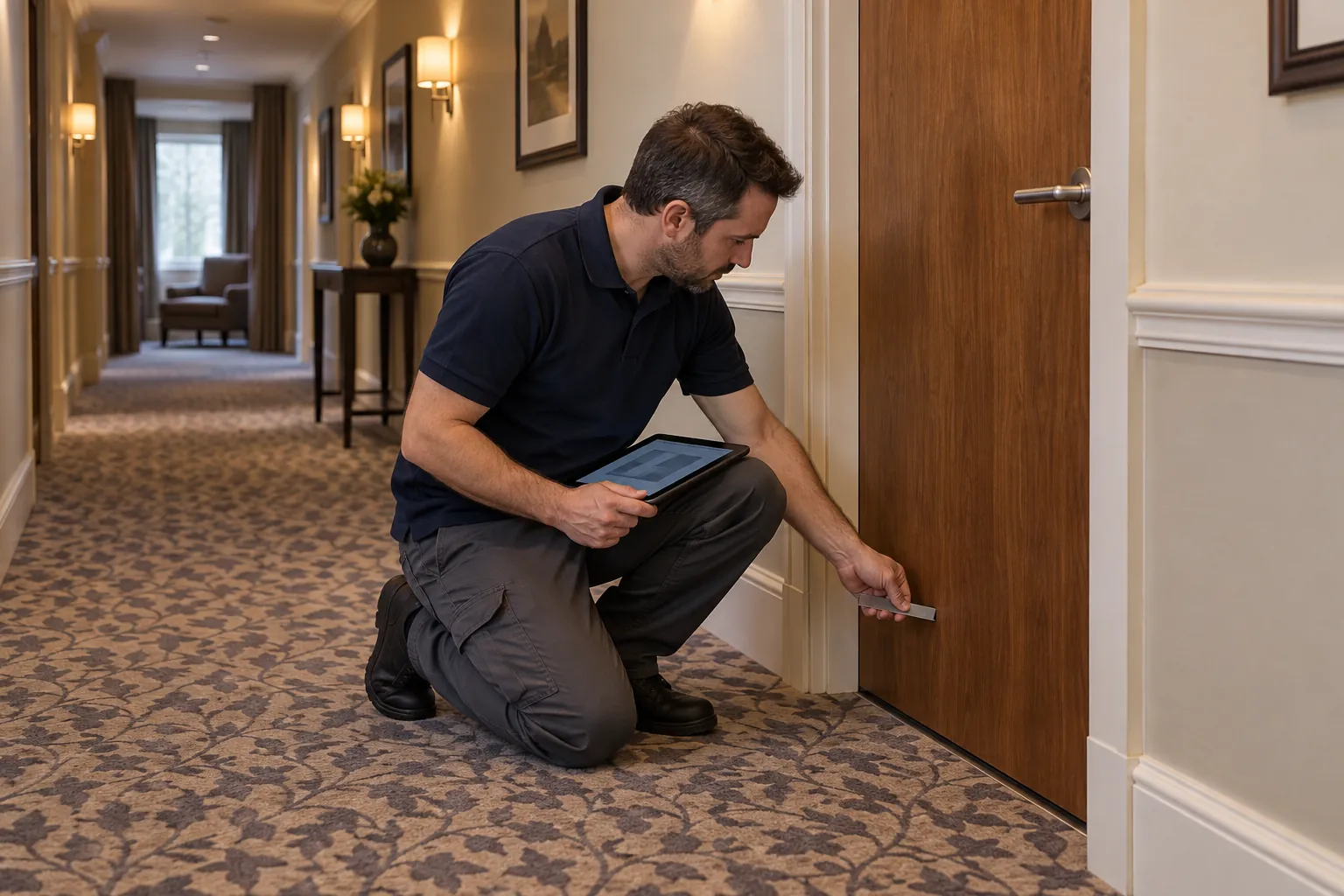
It is different from the routine checks staff carry out between surveys. This guide covers what an inspection involves, how often to arrange one, how to choose an inspector, and what to do with the report.
01
What a fire door inspection is, and the duty behind it
In England and Wales, article 17 of the Regulatory Reform (Fire Safety) Order 2005 requires the responsible person to keep the premises and the fire safety facilities, equipment and devices in them, fire doors included, subject to a suitable system of maintenance and maintained in an efficient state, in efficient working order and in good repair. The fire risk assessment should identify fire doors, what they are for and whether they need attention, as part of the building's wider fire safety management. Scotland and Northern Ireland have equivalent duties under their own fire safety law.
Fire doors are a central part of a building's passive fire protection. With the walls and floors around them, they divide a building into compartments and protect escape routes, to contain fire and smoke and limit the spread of fire and smoke, so that in the event of a fire it is held back long enough for occupants to leave and for firefighters to work. A fire door does that only if all its key components work together: the door leaf, frame, hinges, closer, latch, seals, glazing and the gap around it, installed as they were tested and certified.
Maintaining fire doors takes two kinds of work:
- Routine checks by trained staff, looking for obvious damage and misuse: doors wedged open, closers not working, seals missing. Our guide to fire door checks covers these.
- A fire door inspection, sometimes called a fire door survey, by a competent person, looking at whether each door is a correctly specified and installed fire door assembly that will perform as its rating says. That is the subject of this guide.
In blocks of flats in England, regulation 10 of the Fire Safety (England) Regulations 2022 adds specific duties: in a building over 11 metres, the responsible person must check the fire doors in the communal areas at least every 3 months, and use best endeavours to check flat entrance doors at least every 12 months, in both cases including that the self-closing devices work. The government's fire door guidance says these checks should be simple and basic and should not need a specialist, and our guide to communal fire door checks explains them. The same guidance says the checks are not a substitute for periodic assessment of fire doors by fire safety specialists, so a periodic inspection by a competent inspector is still the way to find out whether the doors meet their certification, and a residential building over 11 metres may need both.
02
What a fire door inspection covers
The fire door inspection process is a systematic visual inspection and physical examination of each door. The inspector works through the door set, recording what they find, and judges the likely performance of each door in a fire. For each door the inspection involves:
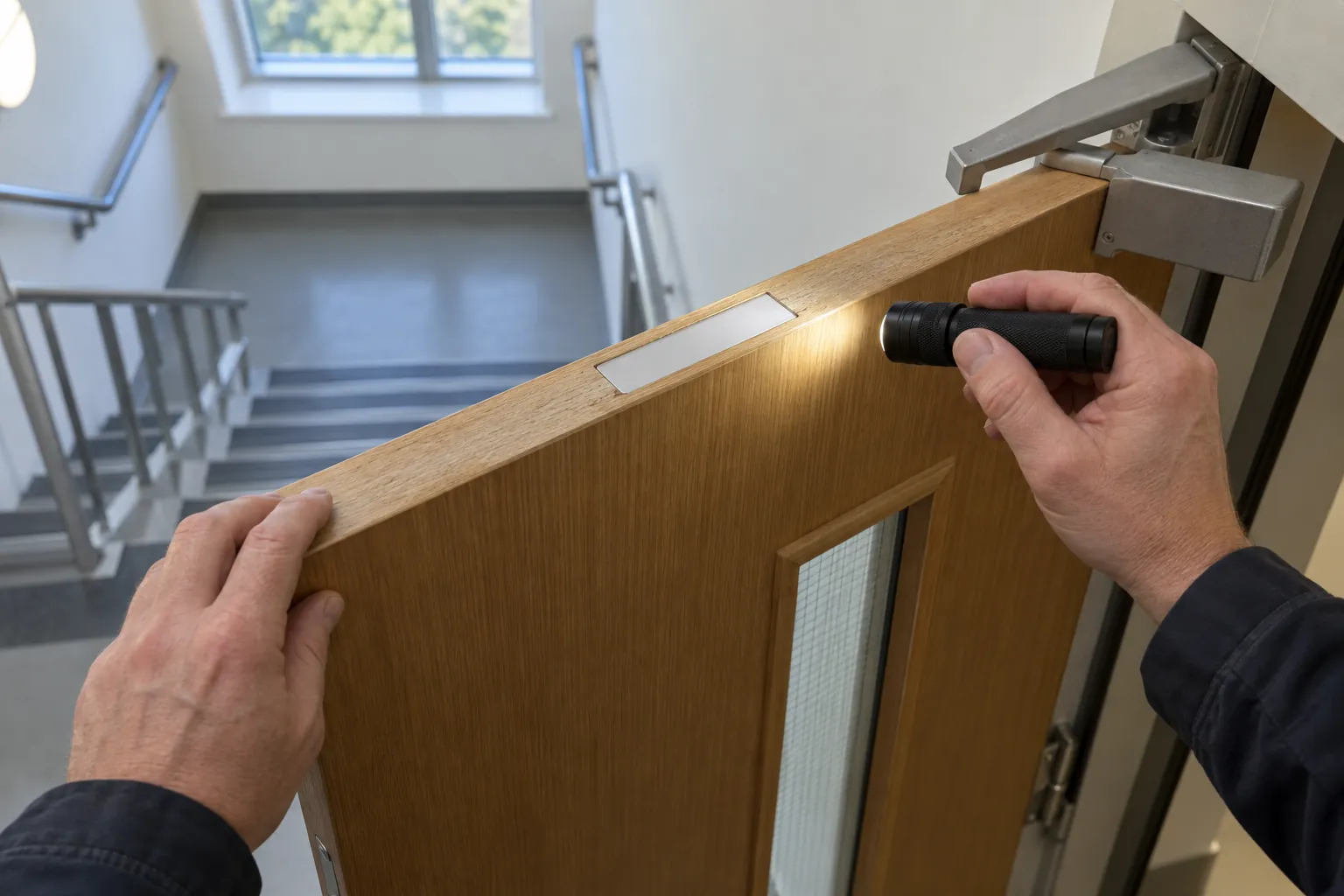
- Identification: whether the door is a fire door at all, and its fire rating, such as FD30 or FD60, with an S where it is also a smoke control door. The inspector looks for fire rating information to identify fire doors and trace them to their certification. Certified doors usually carry a label or a coloured plug, often on the top or hinge edge, that traces them to a certification scheme. A door with no identification can be hard to confirm, and the report will say so.
- The door leaf: damage, splits, warping, holes from removed fittings, and unapproved alterations such as cat flaps, letterboxes or spyholes that were not part of the certified design.
- The frame and its fixing: whether the frame is secure, and whether the gap between the frame and the wall is properly sealed with suitable fire-stopping.
- Gaps: the gaps between the door and the frame at the head and sides, and at the threshold, measured against the tolerances in the door's certification or the manufacturer's instructions. The government's fire door guidance for blocks of flats in England gives the industry standard as a gap of never more than 4 mm, except at the bottom of the door, where the gap should be as small as practicable without the door snagging on the floor. Gaps outside tolerance let smoke and hot gases through before the seals can act, and an uneven gap is often the first sign of a dropped hinge or a moving frame.
- Intumescent and smoke seals: present, continuous, the right type, undamaged and not painted over.
- Hinges: the right number and type, secure, with all screws present and no wear that lets the door drop.
- Self-closing devices: whether the door closes fully and latches from any angle of opening, without slamming, and whether any hold-open or free-swing device releases when the fire alarm operates.
- Locks, latches and other ironmongery: compatible with the door's certification, and fitted without removing too much material or bridging the seals.
- Glazing and vision panels: fire-rated glass, with the correct beads and glazing seals, and no cracks.
- Air transfer grilles, where fitted: of a fire-rated type, and not blocked or damaged.
- Signage: the appropriate "fire door keep shut" or "keep locked" signs, where required.
Inspectors check against the door's certification and the building's fire strategy, not against the general fire safety regulations alone. They also note how the door is used. A door found wedged open, or a closer disconnected because the door was heavy, points to a problem the building's management needs to solve, not just a fault to repair.
03
How often fire doors should be inspected
No single law sets a frequency for fire door inspections in all buildings, so compliance rests on the interval the fire risk assessment sets. That interval depends on how many doors there are, how heavily they are used and how easily they are damaged. For small, low-risk non-domestic premises in England, the Home Office's guide to making small non-domestic premises safe from fire lists a six-monthly check that fire doors remain in good condition, are not damaged and remain a good fit in their frames. Doors in heavy use, such as those on busy corridors, in schools or in buildings with trolleys and deliveries, may need looking at more often. Many buildings combine a full inspection on a longer cycle with more frequent routine checks. Regular inspections help identify wear before it becomes a failure, which is cheaper than finding a whole corridor of doors needing repair or replacement at once.
Arrange an inspection, whatever the cycle, when:
- you take on a building and do not know the condition or history of its doors, when an initial inspection sets the baseline;
- the fire risk assessment recommends it, or cannot confirm whether doors are fire rated;
- routine checks keep finding the same faults, or a door has been damaged or altered;
- the building has been refurbished, or services have been run through fire-resisting walls near doors;
- doors or frames have been repaired or replaced, to confirm the work was done correctly;
- the use of the building changes, altering the escape routes or the number of occupants.
In residential buildings, the responsible person's duties under the 2022 regulations sit alongside this. A block over 11 metres has quarterly communal door checks and best-endeavours annual flat entrance door checks as a legal minimum; a periodic inspection by a competent inspector is how the building shows the doors themselves are sound.
04
Who can carry out a fire door inspection
The law asks for competence, not a particular qualification. A competent fire door inspector has the knowledge of fire door construction, certification, ironmongery and installation to judge whether each door will perform as intended, and the independence to report honestly. In practice, many responsible persons choose an inspector who is certificated or works for a certificated company, because certification gives some assurance of that knowledge. Schemes that exist in the UK include:
- the Fire Door Inspection Scheme (FDIS), which certificates individual fire door inspectors;
- BM TRADA's Q-Mark schemes, including schemes for fire door installation and for fire door maintenance;
- FIRAS, a third-party certification scheme for installers of passive fire protection, including fire doors.
Manufacturers' third-party certification, such as the BWF Fire Door Alliance's scheme, covers the doors themselves rather than inspectors, and is one way an inspector traces a door's rating. The BWF Fire Door Alliance also runs Fire Door Safety Week, an annual campaign with guidance for building owners.
Before appointing an inspector, ask:
- what qualification or certification the inspector holds, and whether their company is certificated;
- whether they carry professional indemnity insurance;
- what the report will look like, and whether it covers every door with photographs;
- whether they also sell repairs and replacements, and if so, how they keep the inspection independent.
A fire risk assessor will look at fire doors as part of the fire risk assessment, but a fire risk assessment is not a fire door survey. The assessor may recommend one where the doors need closer examination.
05
The report, and remedial work
A good fire door inspection ends with a detailed report. It gives each door a reference and a location, so that the report can be matched to the building, and for each door records:
- its identification and rating, or that the rating could not be confirmed;
- each defect found, with a photograph;
- whether the door is compliant with its certification, needs minor adjustment, needs repair, or needs replacing;
- the recommended remedial action, and its priority.
Work through the defects by priority. A door that will not close, or has a hole through it, protecting an escape route needs putting right quickly; worn signage can wait for the next planned visit. Put the remedial work into the building's plan, with dates, and record each defect as closed when it is fixed.
Repairs to fire doors should be carried out by someone competent, using parts compatible with the door's certification. Small repairs, such as adjusting a closer, replacing seals or refitting hinges, can often be done without replacing the door. Larger defects may need a door to be replaced, and a replacement should be a certified fire doorset or assembly, installed in line with the manufacturer's instructions by a competent installer. Planing a sticking door, packing a hinge or filling a hole with the wrong material can reduce fire resistance without anyone noticing.
06
Where the record fails, and what SiteClara does about it
The inspection report arrives as a long document with a schedule of defects. The high-priority repairs get done. The rest sit in a spreadsheet, and between inspections the only record of the doors is a tick in the log for "fire doors checked". The next inspector finds the same defects, and several new ones caused by doors wedged open every day in the months in between.
SiteClara records the routine checks between inspections, and the faults they find, as they happen. A printed QR poster, with an optional NFC tag behind it, goes by each fire door or group of doors. Staff scan the code or tap the tag on their own phone, with no app to install; they are enrolled by text and sign in with a link. They see the checks due there, such as the monthly door check, and mark each one done, or explain what stopped them. A fault, such as a damaged seal, a closer that no longer latches or a door wedged open, is reported there with a photo and goes onto the team's list of jobs until someone closes it, and a supervisor can escalate it to the building manager, who can answer it.
The supervisor sees what is due, done and missed across the building and can record why a check was missed. Each day the supervisor reviews and approves a report that goes to nominated management or client contacts at 8am the next morning, showing what was reported, completed and still open, and how the scheduled checks went, for example 12 of 12 completed. It is priced per building, with no per-person fees.
07
Questions people ask
Is there a legal requirement to inspect fire doors?
Yes, fire doors must be kept in working order by law: in England and Wales, article 17 of the Fire Safety Order requires the responsible person to keep fire safety facilities and equipment, fire doors included, subject to a suitable system of maintenance and in good repair. Article 17 names no frequency, so for most buildings the fire risk assessment sets it. In England, a block of flats over 11 metres must also have its communal fire doors checked at least every 3 months, and its flat entrance doors, on a best endeavours basis, at least every 12 months, under regulation 10 of the Fire Safety (England) Regulations 2022.
What is the new law on fire doors in the UK?
In England, regulation 10 of the Fire Safety (England) Regulations 2022, in force since 23 January 2023, added fire door duties for blocks of flats. The responsible person for any block of flats with common parts that residents would use to escape must tell residents that fire doors should be kept shut, that self-closing devices should not be tampered with and that faults or damage should be reported straight away; in a block over 11 metres they must also check communal fire doors every 3 months and, on a best endeavours basis, flat entrance doors every 12 months.
The regulations apply in England only. Before them, the Fire Safety Act 2021 confirmed that flat entrance doors in blocks of flats are within the scope of the Fire Safety Order.
08
Further reading, and a list to take away
GOV.UK publishes the government's fire safety risk assessment guides, and guidance on the Fire Safety (England) Regulations 2022, including a fact sheet on fire doors. BS 8214, the code of practice for timber-based fire door assemblies, is available from the British Standards Institution. The Fire Door Inspection Scheme, BM TRADA and FIRAS publish details of their certificated inspectors and installers, and the BWF Fire Door Alliance publishes guidance for building owners. Your local fire and rescue service enforces fire safety legislation in most premises and can advise on the fire safety requirements for yours. For higher-risk residential buildings, the Building Safety Regulator publishes guidance on building safety under the Building Safety Act 2022.
Before and after the next fire door inspection, check that:
- every fire door has a reference and is on a schedule;
- the fire risk assessment sets how often the doors are inspected;
- the inspector is competent, and you know how their competence is certificated;
- the report covers every door, with photographs, defects and priorities;
- remedial work is planned, done by someone competent, and recorded as closed;
- repaired and replaced doors are re-inspected;
- routine checks between inspections are recorded door by door, and faults reported;
- the report and repairs are recorded in the fire safety log book.
Sources
Every document this guide quotes or links to, in the order it first cites them.
- Article 17 of the Regulatory Reform (Fire Safety) Order 2005 legislation.gov.uk
- Regulation 10 of the Fire Safety (England) Regulations 2022 legislation.gov.uk
- Fire door guidance gov.uk
- Guide to making small non-domestic premises safe from fire gov.uk
- Fire Safety Act 2021 legislation.gov.uk
- Fire safety risk assessment guides gov.uk
- A fact sheet on fire doors gov.uk
- Building Safety Act 2022 legislation.gov.uk
Related guides
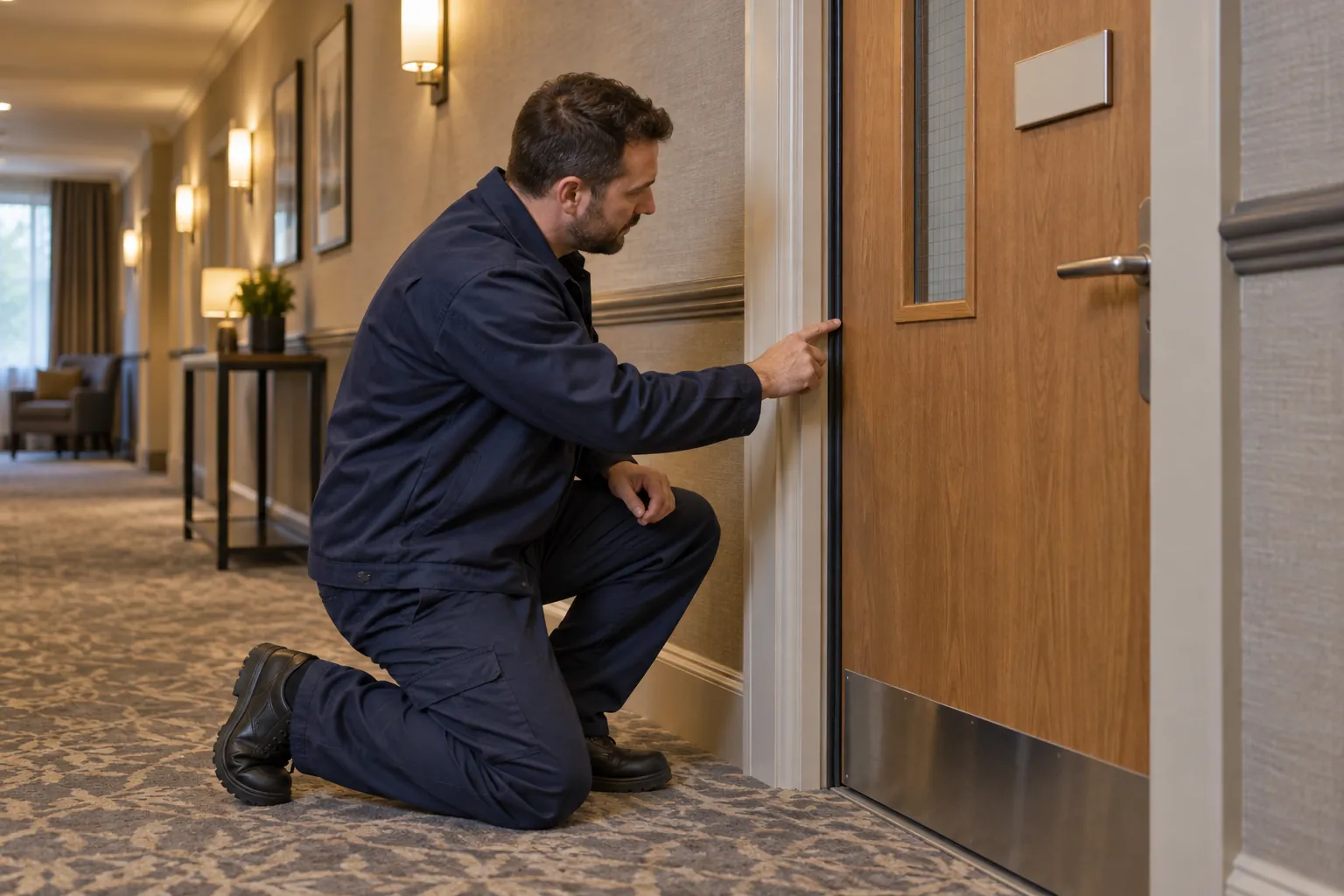 Fire and water checksFire door checks: what a routine check looks atFire door checks in any building: gaps, seals, closers, hinges, glazing and signs, how often to check, and when to call a fire door inspector.
 Fire and water checksCommunal fire door checks in blocks of flatsWhat the Fire Safety (England) Regulations 2022 require of communal fire doors and flat entrance doors, who carries out the checks, and how to record them.
 Fire and water checksFire safety log book: what to record, who keeps it and for how longWhat a fire safety log book should contain, from alarm tests to drills and servicing, who keeps it, how long for, and whether paper or digital is better.
 Fire and water checksThe Fire Safety (England) Regulations 2022: what each building must doFire Safety (England) Regulations 2022 explained: what responsible persons must do in blocks of flats of every height, over 11 metres, and 18 metres or more.