Fire and water checks
Fire door inspection in Canada: what the fire code asks for, and what a good record shows
A fire door inspection checks that each fire-rated door in a fire separation closes on its own, latches and is undamaged.
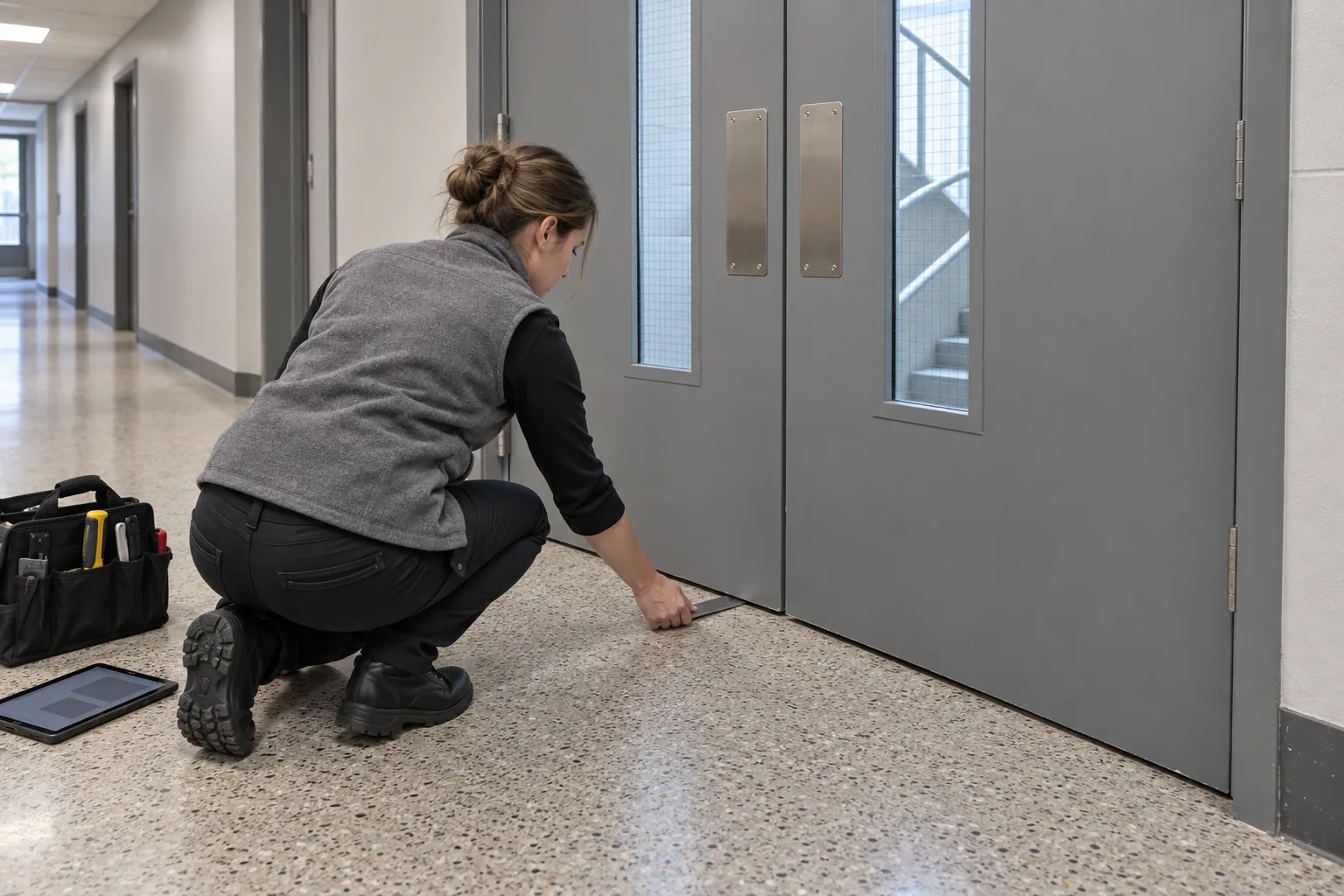
Under the National Fire Code of Canada, self-closing doors in fire separations that are not on hold-open devices are checked at least every 24 hours to make sure they are shut, and every door in a fire separation is operated at least once a month. A fire door holds back flames and smoke only if it is closed, latched and undamaged on the day of a fire. In Canada, keeping it that way is the building owner's duty under the provincial or territorial fire code, which sets short, frequent checks for building staff rather than one big annual event. Many owners add a fuller door-by-door inspection by a qualified inspector, using the American standard the building code installs the doors to, NFPA 80. This guide explains where the duty comes from, what each kind of inspection covers, how often, who can do it, and what the record should show.
01
What a fire door inspection is, and where the duty comes from
Canadian codes rarely say "fire door". They talk about fire separations, the walls and floors that act as a barrier against the spread of fire, and closures, which the National Fire Code of Canada 2020 defines as "a device or assembly for closing an opening through a fire separation or an exterior wall, such as a door, a shutter, wired glass or glass block", including "all components such as hardware, closing devices, frames and anchors." A fire door inspection is a check that those closures still work: that each door closes, latches and holds its rating.
Fire safety in existing buildings is provincial and territorial, and most jurisdictions adopt the National Fire Code as it stands or with amendments. Its door rules sit in Division B, Subsection 2.2.2, Closures:
- Article 2.2.2.1: openings in fire separations are protected with closures that conform to the National Building Code, and replacements must conform too.
- Article 2.2.2.2: where closures are damaged so as to affect the integrity of their fire-protection rating, "they shall be repaired".
- Article 2.2.2.3: protective guarding devices are provided where necessary to prevent damage to the mechanical components of doors in fire separations, without interfering with how the doors work.
- Article 2.2.2.4, Inspection and Maintenance: the working rules, with the daily and monthly intervals set out below, and the plain instruction that closures "shall not be obstructed, blocked, wedged open, or altered in any way that would prevent the intended operation of the closure."
Division C of the same code puts the duty on the owner: "Unless otherwise specified, the owner or the owner's authorized agent shall be responsible for carrying out the provisions of this Code." A property manager, building operator or contractor can do the walk; the duty stays with the owner.
Ontario has its own code, the Ontario Fire Code (O. Reg. 213/07), as consolidated from 1 January 2026, and its door rules are in Subsection 2.2.3 rather than 2.2.2. Article 2.2.3.4 says a door in a fire separation "shall be kept closed when not in use", "shall be checked as frequently as necessary to ensure that the door remains closed" and "shall be inspected monthly", and that the opening and the area around it are kept clear of anything that would interfere with the door. Doors designed to close automatically in a fire emergency, or covered by closing provisions in an approved fire safety plan, are exempt from the keep-closed and check rules, but not from the monthly inspection. Alberta applies the National Fire Code – 2023 Alberta Edition, and the Calgary Fire Department's Fire Safety Maintenance Requirements list its door checks for owners in plain terms.
02
What a fire door inspection covers
In practice a Canadian building has three layers of fire door inspection, and it helps to keep them apart:
- A walk-by check that doors which should be closed are closed: no wedges, no chairs, no fire extinguisher propping a stairwell door on a hot day.
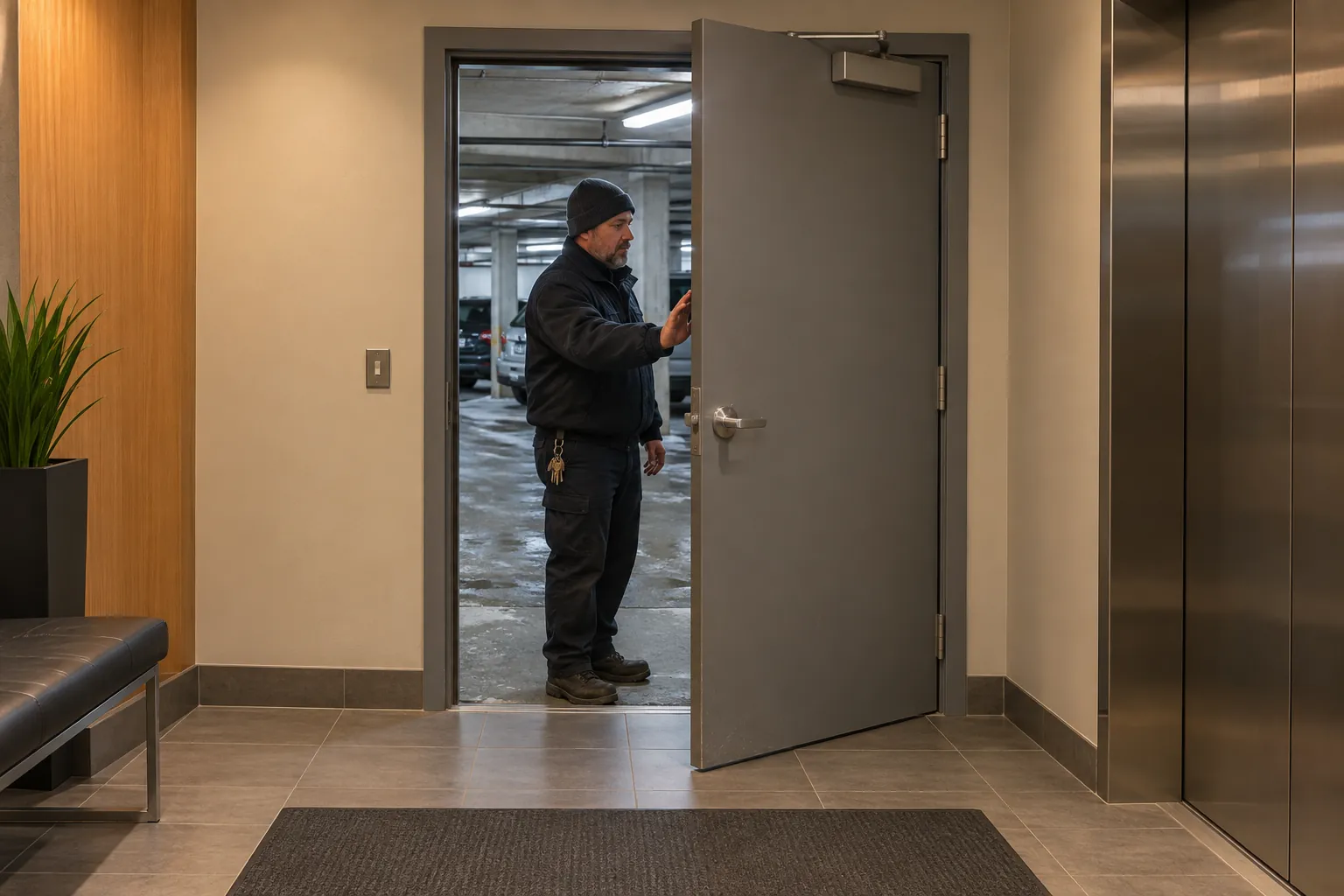
- The monthly operation and inspection of each door by building staff: open it, let it go, and watch it close and latch.
- A periodic door-by-door inspection by a qualified inspector, against the door's listing and NFPA 80, with a report of every defect.
The National Fire Code's Sentence 2.2.2.4.(1) says what the maintenance has to achieve. Defects that interfere with the operation of closures are corrected, and closures are kept operable at all times by:
- keeping fusible links and other heat-actuated devices undamaged and free of paint and dirt;
- keeping guides, bearings and stay rolls clean and lubricated, which matters for rolling and sliding fire doors and shutters;
- making necessary adjustments and repairs to door hardware and accessories "to ensure proper closing and latching";
- repairing or replacing inoperative parts of hold-open devices and automatic releasing devices.
A good monthly inspection of a swinging door therefore looks at:
- Closing: from fully open, the door closes on its own.
- Latching: the latch engages every time. The National Building Code requires a swing-type door in a fire separation to have "a positive latching mechanism designed to hold the door in the closed position after each use", with limited exceptions.
- The leaf and frame: no holes, splits or warping, no hinge screws missing.
- Seals and gaps: seals present and undamaged, gaps even. The building code limits 20-minute doors in Article 3.1.8.12 to 6 mm at the bottom and 3 mm at the sides and top; the door's listing and NFPA 80 set the rest, which is work for the inspector.
- Hold-open devices: a door on a hold-open device releases and closes as the National Building Code requires. In a building with a fire alarm system, that usually means on a signal from the alarm or from a smoke detector connected to it; in a building without one, on smoke alarms on each side of the opening. Some other closures may release on a heat-actuated device instead. Check that each one does.
- Obstructions and labels: nothing in the swing of the door, and the certification label still readable.
The periodic inspection goes further. NFPA's own Frequently Asked Questions About Fire Doors and NFPA 80 says the standard lists 13 items to verify, ranging "from identifying and confirming that labels on the door are visible and legible to checking for damage to the assembly, looking for broken or missing components, checking the clearance around the door, ensuring any signage on the door is compliant, and completing an operational test to ensure the assembly will close and latch under fire conditions."
03
How often fire doors should be inspected
The frequency of fire door inspections comes from the fire code in force where the building is. Under the National Fire Code 2020:
- Every 24 hours: doors in fire separations that are required to have self-closing devices "shall be inspected at intervals not greater than 24 h to ensure that they remain in the closed position when not in use" (Sentence 2.2.2.4.(2)). Doors fitted with hold-open devices that conform to the building code are exempt, because they release and close by themselves in a fire.
- Every month: doors in fire separations "shall be operated at intervals not greater than one month to ensure that they are properly maintained", "as specified in the fire safety plan" (Sentence 2.2.2.4.(3)).
- Every 12 months: fire dampers, smoke dampers, combination dampers and fire stop flaps are inspected to make sure they are in place and not obviously damaged or obstructed, and tested in accordance with NFPA 80 (Sentence 2.2.2.4.(5)).
The Calgary guide sets out the same daily and monthly pattern for Alberta. In Ontario, doors are checked as often as necessary to keep them closed and inspected monthly, and fire dampers and fire stop flaps are inspected annually or on an approved schedule.
The daily check is a walk, often folded into a security officer's rounds or the custodian's opening routine. The monthly inspection is door by door, and needs a list of every door so that none is missed.
For the periodic inspection, NFPA's FAQ says NFPA 80 "requires that fire doors be inspected and tested immediately after the initial installation and then at a minimum annually after that", citing Section 5.2.4 of the 2025 edition. The Canadian fire codes quoted here set their own daily and monthly door checks rather than adopting that annual inspection, so treat it as good practice unless your authority having jurisdiction asks for it.
Whatever the cycle, arrange an inspection when:
- you take on a building and do not know the condition of its doors;
- monthly checks keep finding the same faults on the same doors;
- doors, frames or hardware have been repaired or replaced;
- a renovation has changed corridors and stairs, or run services through fire separations near doors.
04
Who carries out each inspection, and what happens to defects
The daily and monthly checks are usually done by the building's own people: the building operator or superintendent, the custodial team, or security. The National Fire Code ties the monthly operation of doors to the fire safety plan, which also covers "the inspection and maintenance of building facilities provided for the safety of occupants". Put the door checks in the plan, name who does them, and train them.
The detailed inspection needs someone who knows door assemblies. NFPA's FAQ says it "needs to be completed by a qualified person who has knowledge and understanding of the operating components and the type of fire door being tested", who "could be the building owner themselves or a third party, provided their credentials are acceptable to the authority having jurisdiction (AHJ)." The Calgary guide makes the owner's side of that explicit: persons who inspect, test and maintain life safety systems must be qualified for the system, and "owners are responsible for ensuring that the persons they hire are qualified."
Before appointing an inspector, ask what credential they hold for fire door assemblies and whether your fire department accepts it, whether the report covers every door with a photograph of each defect, and, if they also sell repairs, how they keep the inspection independent.
Repairs are where fire doors are most often made worse. The National Fire Code requires damaged closures to be repaired so their integrity is maintained, and replacements to conform to the National Building Code. A door planed to stop it sticking, or a hole from an old lock filled with the wrong material, can take a door out of its rating without anyone noticing.
Labels matter too. NFPA's FAQ says fire door labels "should not be removed, defaced, or made illegible while the door is in service"; where a label is gone, the rating has to be verified through other means acceptable to the authority having jurisdiction. Tell painters to leave labels alone.
05
What the fire door inspection record should show
Division C of the National Fire Code 2020, Article 2.2.1.2, says that where the code requires tests, inspections, maintenance or operational procedures on a fire safety system, "records shall be made and the original or a copy shall be retained at the premises for examination by the authority having jurisdiction." At least the current and the immediately preceding records must be available, and "no record shall be destroyed within two years of having been prepared." The Calgary guide says Alberta's edition keeps five years, and that the Calgary Fire Department requires a printed copy on site, ideally in a binder labelled "Life Safety Records".
Ontario's code, Article 1.1.2.1, requires records "noting what was done and the date and time it was done" where it requires tests and corrective measures or operational procedures, kept at the building for the Chief Fire Official; electronic records that can be made readily available on request are deemed to comply. Article 1.1.2.2 requires any record the code calls for to be kept at the building for at least two years, and long enough that the most recent and the immediately preceding record of a given test or inspection are both kept.
Whether or not your code names the door checks in its records rule, record them the same way: a dated record is the simplest way to show the monthly inspection happened. A useful record shows, for each door:
- a reference and a location that match a list of every door, floor by floor;
- the date and time of each monthly inspection, and who did it;
- what was found: closes and latches, or the fault;
- for each fault, what was done and when it was closed, including the defects in the inspector's report.
06
Where the fire door record fails, and what SiteClara does about it
The monthly fire door inspection is dull and easy to sign for in advance: a sheet in the stairwell shows twelve checkmarks in the same pen. The inspector's defects sit in a spreadsheet until the next report finds them again, and a property manager with several buildings cannot see which did this month's doors until the fire department asks.
SiteClara records checks at the place they are done. A printed QR poster, with an optional NFC tag behind it, goes by each fire door or group of doors, such as a stairwell door on each floor. The person doing the inspection scans the code or taps the tag on their own phone, with no app to install, sees the check due there, such as this month's fire door inspection for that floor, and marks it done or says what stopped them. The named person and the time are recorded as it happens, with a photo when one is asked for. A fault, such as a closer that no longer latches, a torn seal or a door propped open, is reported there with a photo and goes onto the team's list of open jobs until someone closes it, and a supervisor can escalate it to the building manager.
The supervisor sees what is due, done and missed across the building, and records the reason a check was missed. Each day they review and approve a short report that goes to the nominated managers or client contacts the next morning, showing what was reported, completed and still open, and how the scheduled checks went.
07
Questions people ask
Do fire doors need to be inspected?
Yes. The Calgary Fire Department's Fire Safety Maintenance Requirements, written for owners under the National Fire Code – 2023 Alberta Edition, list a daily check of "doors in fire separations to ensure they remain closed, unless equipped with hold-open devices", a monthly duty to "operate all doors in fire separations", and a standing duty to inspect and maintain closures "so closures are operable at all times", all under Article 2.2.2.4. The National Fire Code of Canada 2020 sets the same daily and monthly intervals, and Ontario's code requires a monthly inspection.
How do you perform a fire door inspection?
For the monthly check, open each door fully, let it go, and confirm that it closes and latches, with nothing wedging it or in its swing. For the fuller inspection and testing, NFPA's Frequently Asked Questions About Fire Doors and NFPA 80 says NFPA 80 "contains 13 items that need to be verified during an inspection and test", from labels that are "visible and legible" to damage, broken or missing components, the clearance around the door, signage, and "an operational test to ensure the assembly will close and latch under fire conditions." It adds that this work is done by "a qualified person who has knowledge and understanding of the operating components and the type of fire door being tested."
What are the requirements of a fire door?
A fire door has to carry a rating that matches the wall it sits in, and a label that proves it. NFPA's Frequently Asked Questions About Fire Doors and NFPA 80 says the required rating "is dependent on the rating of the fire-rated assembly that it is installed in", and that NFPA 80 and NFPA 101 require fire doors, frames and door windows to be labelled to show they have been tested and listed by an organization acceptable to the authority having jurisdiction. The label gives the manufacturer's name, the certification agency's mark, the rating and the fire test standard, and it must stay legible while the door is in service.
08
Further reading, and a list to take away
Start with the fire code where your building is. The National Fire Code of Canada 2020 and the National Building Code of Canada 2020 are free from the National Research Council, which says to check with the municipal, provincial or territorial official which edition applies. Ontario owners read the Ontario Fire Code on e-Laws. NFPA 80, Standard for Fire Doors and Other Opening Protectives, is published by the National Fire Protection Association.
Before next month's fire door inspection, check that:
- every door in a fire separation is on one list, floor by floor;
- the fire safety plan names who does the daily check and the monthly inspection;
- each door closes from fully open and latches, and none is wedged or blocked;
- hold-open devices release on the signal they are designed for, such as the fire alarm test;
- faults are reported, repaired with parts and materials that keep the door's rating, and recorded as closed;
- a periodic inspection by a qualified inspector is booked, and its defects tracked to closure;
- records are kept at the building for as long as your code requires: at least two years under the National Fire Code and in Ontario, five in Alberta according to Calgary's guide.
Sources
Every document this guide quotes or links to, in the order it first cites them.
- National Fire Code of Canada 2020 nrc.canada.ca
- Ontario Fire Code (O. Reg. 213/07) ontario.ca
- Calgary Fire Department's Fire Safety Maintenance Requirements calgary.ca
- National Building Code of Canada 2020 nrc.canada.ca
- Frequently Asked Questions About Fire Doors and NFPA 80 nfpa.org
- NFPA 80, Standard for Fire Doors and Other Opening Protectives nfpa.org
Related guides
 Fire and water checksFire log book: what to record, who keeps it and how long, under Canadian fire codesWhat a fire log book should hold under the Ontario Fire Code and the National Fire Code of Canada: the tests, who records them, how long to keep them, and the form.
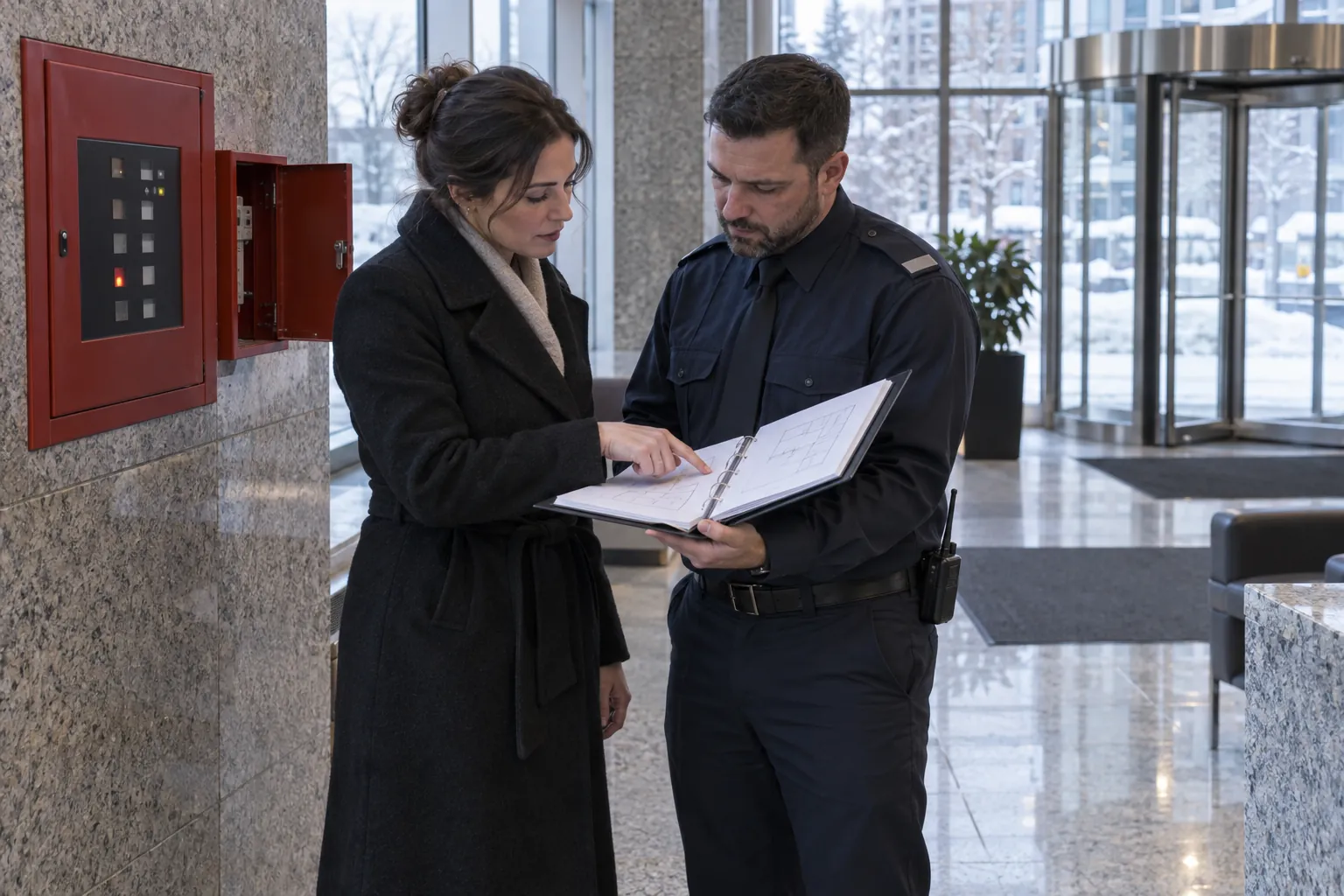 Fire and water checksFire safety plan: what it must contain, who approves it, and how to keep it trueWhat a fire safety plan must contain under the National Fire Code of Canada and the Ontario Fire Code, who approves it, how often it is reviewed, and the records.
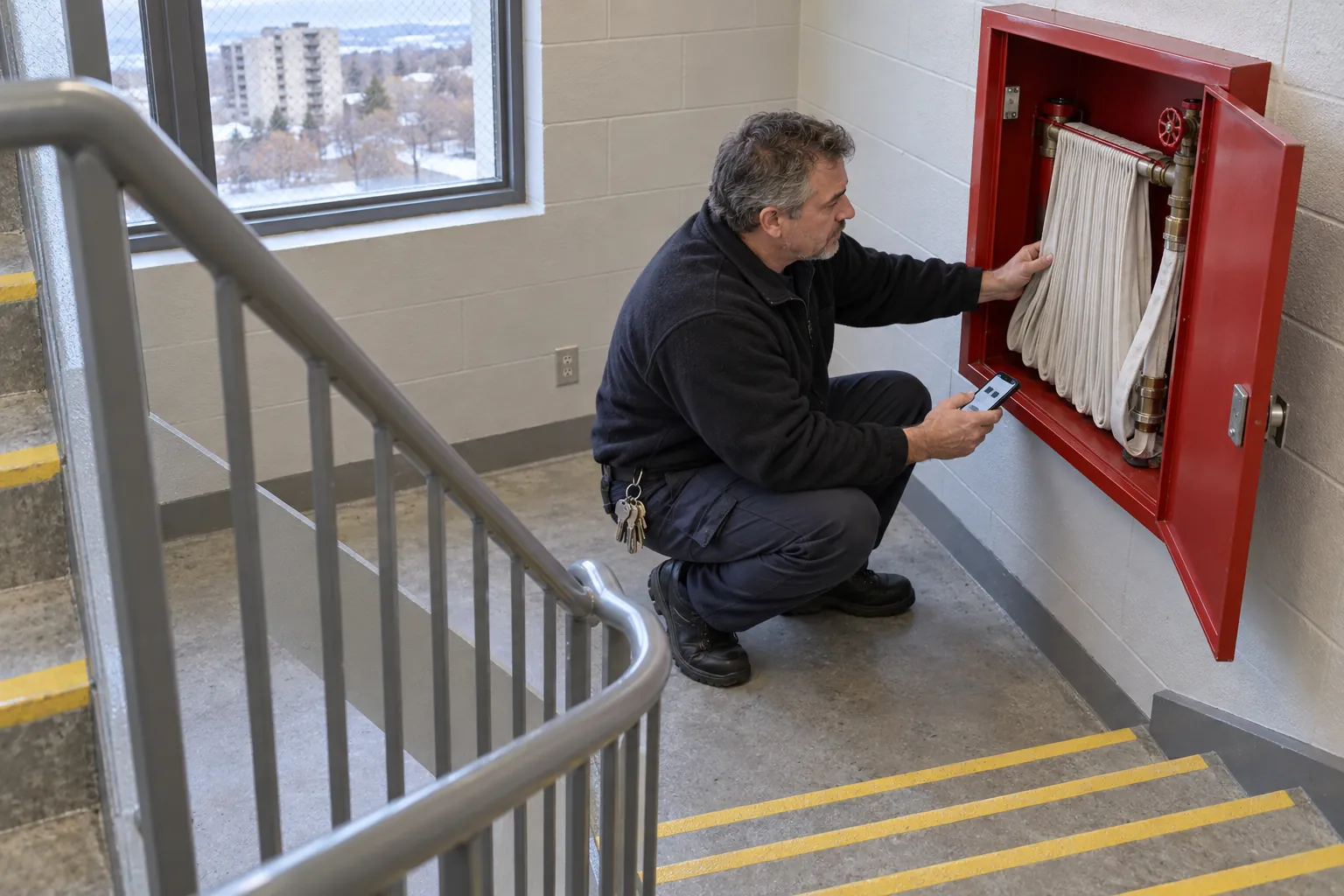 Fire and water checksOntario Fire Code monthly inspections: what is due, who does it, and the recordEvery monthly fire protection and egress inspection the Ontario Fire Code sets, article by article, the checks around them, and what a fire inspector can ask to see.
 Fire and water checksFire alarm testing in Canada: what the owner checks, what the technician tests, and what to recordFire alarm testing in Canada: what the fire codes and CAN/ULC-S536 ask of owners daily and monthly, the annual test by a technician, and what the record must show.