Premises and facilities management
Soft services in facility management: what they cover, how they are bought, how they are measured
Soft services in facilities management are the people-delivered services that make a building clean, safe and usable for the people in it, such as janitorial, security, reception, food service, mail, waste and grounds, as distinct from the hard services that maintain the building and its systems.
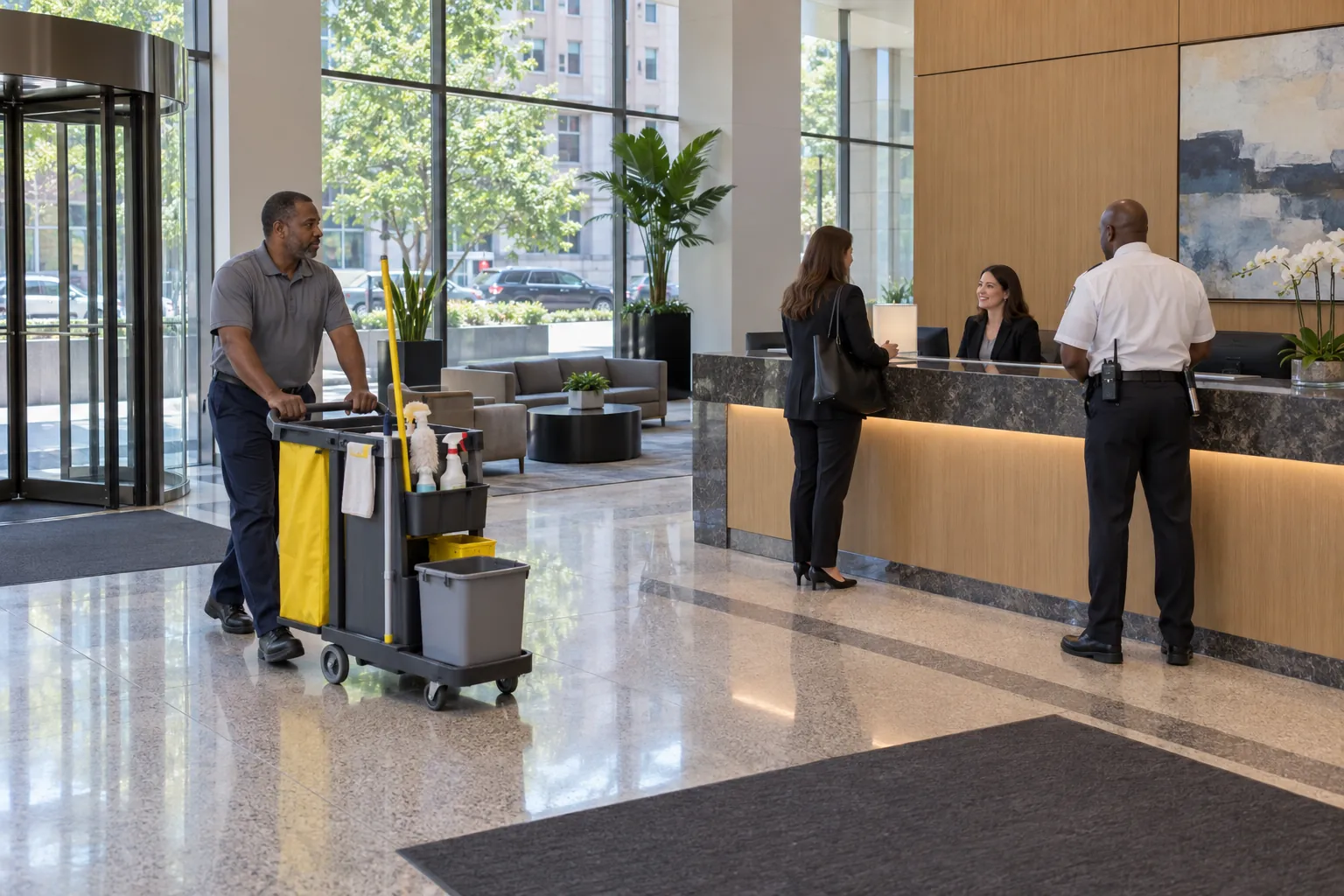
This guide explains what soft services cover in facility management and how they differ from hard services, the federal and state rules that sit behind them, the ways they are contracted in the United States, and how a vendor or an in-house team can show the work is actually being done.
01
What soft services are in facility management
Facility management, which many job titles and RFPs call facilities management, is usually split into two halves. Hard services look after the building itself and its systems: HVAC, electrical, plumbing, elevators and escalators, fire protection, the roof and the structure. Soft services are the services delivered by people in and around the building that keep it clean, safe, welcoming and usable: janitorial and custodial, security officers, reception, food service, the mailroom, waste and recycling, grounds and pest control. American RFPs also call them building services or support services, and the janitorial part cleaning services.
The split is a convention, not a legal definition. The International Facility Management Association's page on what facility management is adopts the ISO definition: facility management is "an organizational function which integrates people, place and process within the built environment with the purpose of improving the quality of life of people and the productivity of the core business." Among the work a facility manager oversees it lists "building operations like cleaning, security, maintenance and grounds management", without dividing them into hard and soft. The international standard for the discipline, ISO 41001, Facility management – Management systems, does not divide them either; it sets out how an organization manages its facilities as a whole.
Soft services are not optional extras. They are essential to a building's daily operations, and several carry legal duties that apply whoever delivers them, and whether the building is served by an in-house team or a vendor:
- Janitorial and custodial: for employers under federal OSHA, 29 CFR 1910.22, General requirements (Walking-Working Surfaces), requires that "all places of employment, passageways, storerooms, service rooms, and walking-working surfaces are kept in a clean, orderly, and sanitary condition", and that surfaces are kept free of hazards such as "leaks, spills, snow, and ice." 29 CFR 1910.141, Sanitation, adds that "all places of employment shall be kept clean to the extent that the nature of the work allows." The chemicals custodians use come under OSHA's Hazard Communication Standard (29 CFR 1910.1200): employers "must have labels and safety data sheets for their exposed workers, and train them to handle the chemicals appropriately."
- Contract security: security officers are licensed by most states, not the federal government, and the rules differ from state to state; a few states leave licensing to cities and counties. In California, for example, the Bureau of Security and Investigative Services security guard fact sheet says power to arrest training "must be completed prior to the issuance of a Security Guard Registration", that 32 hours of training in security officer skills "must be completed within the first six (6) months", and that eight hours of continuing training "must be completed annually."
- Food service: the FDA Food Code is, in the FDA's words, "a model" that "local, state, tribal, and federal regulators use" to write their own food safety rules. A staff cafeteria is inspected against the rules your state or local health department has adopted, not against the model itself.
- Waste: ordinary trash and recycling are regulated locally, but some of what a building throws away is hazardous waste. The EPA's universal waste rules cover batteries, pesticides, mercury-containing equipment, lamps and aerosol cans, and states "may add additional universal wastes" to their own programs.
02
What soft services include
The core soft services in most American commercial buildings, campuses and hospitals are:
- Janitorial and custodial services: nightly cleaning of offices and common areas, restroom checks and restocking of paper, soap and liners, day porters keeping lobbies, restrooms and breakrooms presentable during business hours (see day porter duties), and project work such as floor stripping and refinishing, carpet extraction and window washing. In hospitals this is environmental services (EVS).
- Security services: officers at a lobby desk or post, patrols inside and out, access control and visitor badging, alarm response, key control and incident reporting, all set out in the site's post orders (see our guide to security post orders).
- Front of house: reception, visitor management and conference room setup.
- Food service: the cafeteria, micro markets and vending, pantry and coffee service, and catering for meetings.
- Mail and shipping: the mailroom, package receiving, shipping and receiving at the loading dock, and internal delivery.
- Waste and recycling: trash removal, recycling and composting, dumpster and compactor areas, and the paperwork for universal and hazardous waste.
- Grounds: landscaping and irrigation, parking lots and sidewalks, and snow and ice removal in the winter.
- Pest control: prevention, monitoring and treatment, usually by a state-licensed applicator.
- Moves, adds and changes: furniture moves, office reconfigurations and porter work.
- The facilities help desk: taking requests and complaints from occupants and turning them into work orders, which sits between soft and hard services.
Hard services, by contrast, cover preventive maintenance of equipment and systems (see our preventive maintenance checklist), reactive repairs through work orders, the inspections and tests that codes require, and the building envelope. Some items move between the two depending on the contract: pest control, window washing, restroom fixtures, light bulb replacement and handyman work are soft in some buildings and hard in others. What matters is that the scope of work says which is which, so that nothing falls between two vendors.
03
The difference between hard and soft services in practice
Hard and soft services also differ in how they are specified, staffed and checked:
- Specification. Hard services are specified by asset and task, from the manufacturer's instructions and the codes your authority having jurisdiction (AHJ) has adopted. Soft services are specified by area, frequency and outcome: which rooms are cleaned nightly and which weekly, which posts are staffed and when, what a clean restroom or a staffed lobby looks like.
- Workforce. Soft services are labor-intensive, with large teams on night shifts, split shifts and weekends, often employed by a vendor rather than the building owner, and turnover is a constant.
- Evidence. Hard services have long-established records: work orders, inspection and test reports, tags on equipment and logs in a CMMS. The soft services record is thinner and more scattered: a sign-off sheet on the restroom door, a security daily activity report, a monthly inspection score and a folder of complaints.
- Visibility. Occupants rarely notice hard services until something breaks. They notice soft services every day: the state of the restrooms, the welcome at the front desk, the line in the cafeteria, the trash cans by the entrance.
Neither half works alone. A custodian who notices a leaking faucet, or a security officer who finds a dead light fixture in the parking garage on patrol, is soft services feeding hard services. The handoff between the two, and whether the problem reported at 10 p.m. becomes a work order that someone closes, is one of the best tests of a facilities team.
04
How soft services are contracted in the United States
There are four common models, and many organizations mix them:
- Self-performed: the organization employs its own custodians, security officers and reception staff. Direct control, but the organization carries recruiting, training, covering absences and supervision.
- Single-service contracts: a separate vendor for each service, such as a janitorial contract with one company and a security services contract with another. Specialist expertise, but more contracts and more boundaries between vendors.
- Bundled services: two or more soft services with one vendor, such as janitorial and day porter, or security and reception. Fewer contracts and shared supervision, while the scope stays manageable.
- Integrated facility management (IFM): one provider responsible for hard and soft services together, delivering some itself and subcontracting the rest under a single facilities management contract. One point of accountability, but a single large contract is harder to change, and the client depends on the provider's weakest service.
Two things in American law change how soft services contracts work, depending on who is buying and where.
Federal contracts. The Department of Labor's McNamara-O'Hara Service Contract Act page says the Act requires "contractors and subcontractors performing services on prime contracts in excess of $2,500 to pay service employees in various classes no less than the wage rates and fringe benefits found prevailing in the locality." The illustrative list of covered services in 29 CFR 4.130 includes "cafeteria and food service", "custodial, janitorial, and housekeeping services", "guard and watchman security service", landscaping, laundry, pest control, snow removal, and trash and garbage removal: most of soft services. The DOL's Fact Sheet #67 on the Service Contract Act also notes that a successor may have to pay the "rates (including prospective increases) contained in a predecessor contractor's collective bargaining agreement."
Changes of vendor. There is no general federal rule that moves cleaning or security staff from one vendor to the next, but some states and cities have one for particular services. California's Displaced Janitor Opportunity Act (Labor Code sections 1060 to 1065) requires a successor contractor for janitorial or building maintenance services to retain the outgoing contractor's employees at the site who worked there for the preceding four months or longer, for a "60-day transition employment period", unless it has "reasonable and substantiated cause not to hire a particular employee based on that employee's performance or conduct." The outgoing contractor must give the successor each employee's name, date of hire and job classification.
Outsourcing moves the work, not all of the responsibility. OSHA's Multi-Employer Citation Policy (CPL 2-0.124) says that "on multi-employer worksites (in all industry sectors), more than one employer may be citable for a hazardous condition that violates an OSHA standard." A controlling employer, one with "general supervisory authority over the worksite", "must exercise reasonable care to prevent and detect violations on the site", although less than it owes its own employees. For a building owner or facility manager, that means checking vendors at intervals that fit the risk, and acting on what the checks find.
Whatever the model, write down the scope of work for each service, the boundaries between vendors, and who owns each kind of reported problem. Our guide to the facility management SLA covers how the service levels are written.

05
How soft services performance is shown
Soft services performance is usually managed through a service level agreement and a handful of key performance indicators for each service, reviewed at a monthly or quarterly business review. The measures that work best combine three kinds of evidence:
- Delivery: did the scheduled work happen? Restroom checks completed against those scheduled, patrol rounds completed, the lobby post staffed on time, trash and recycling pulled, snow cleared before opening.
- Quality: was it done well? Janitorial inspection scores, joint walk-throughs with the client, mystery visits, and occupant satisfaction surveys.
- Response: were problems fixed? Help desk tickets and reported issues closed within the agreed time, and repeat complaints about the same place.
Many contracts measure quality well and delivery poorly: inspections are scored, while nightly work is recorded on paper, if at all. The monthly report then leans on inspection scores and complaint counts, and a service can look fine on paper while the work slips between inspections. Cleaning vendors that want an outside check of their management system can look to ISSA's Cleaning Industry Management Standard; see our guide to CIMS certification. For the measures themselves, see facility management KPIs and the facility management report.
06
Where the soft services record fails, and where SiteClara fits
Soft services are visible every day and reported once a month. The restroom that ran out of paper towels at 11 a.m., the patrol point nobody reached, the spill mentioned to whoever was at the front desk: these rarely reach the monthly review except as a complaint.
SiteClara records the daily delivery of soft services at the place it happens. A printed QR poster at each location, such as a restroom, lobby, breakroom, stairwell or dumpster enclosure, with an optional NFC tag behind it, lets custodians, day porters or security officers scan the code or tap the tag on their own phone, with no app to install. They see the scheduled checks due there and mark each one done, or say what stopped them, with a photo when one is asked for. A problem found there goes onto the team's list of jobs until someone closes it, and a supervisor can escalate a job to the building manager, who can answer it. Two companies can share a building, for example a janitorial vendor and a security vendor, each with its own staff, forms and approval.
Each day a supervisor reviews the day's checks and photos, gives a reason for any check that was missed, and approves the report, which goes to the facility manager and other nominated contacts at 8 a.m. the next morning by default, showing what was reported, completed and still open, and how the scheduled checks went.
07
Questions people ask
What are examples of soft services?
Janitorial and custodial cleaning, security officers, reception, food service, the mailroom, waste and recycling, landscaping, snow removal and pest control are the usual examples. Many of them appear in the Department of Labor's list of types of covered service contracts in 29 CFR 4.130, which includes "cafeteria and food service", "custodial, janitorial, and housekeeping services", "guard and watchman security service", pest control, snow removal, and trash and garbage removal.
What are soft and hard services in facility management?
Hard services maintain the building and its systems, such as HVAC, electrical, plumbing, elevators and fire protection. Soft services are delivered by people for the people in the building, such as cleaning, security, reception and food service. The split is an industry convention rather than a formal definition: the International Facility Management Association's page on what facility management is lists "building operations like cleaning, security, maintenance and grounds management" together, without dividing them into hard and soft.
What does a soft services manager do?
A soft services manager plans, staffs and checks the people-delivered services in a building or portfolio, whether they are self-performed or bought from vendors, and answers for them at the business review. The Bureau of Labor Statistics does not track soft services managers separately, but its Occupational Outlook Handbook entry for administrative services and facilities managers says facilities managers "continually monitor facilities to ensure that the premises are safe, secure, and well maintained" and "direct staff, including grounds maintenance workers, janitors and building cleaners, and general maintenance and repair workers."
What is the average salary for a facilities manager in the US?
The Bureau of Labor Statistics gives the median, the middle of the range, rather than the average. Its Occupational Outlook Handbook entry for administrative services and facilities managers says "the median annual wage for facilities managers was $106,660 in May 2025."
08
Further reading, and a list to take away
OSHA publishes the general industry standards for walking-working surfaces, sanitation and hazard communication, and a state plan publishes its own. The Department of Labor's Wage and Hour Division covers the Service Contract Act for federal contracts. Your state licensing board covers security officers, your health department the food rules it adopted from the FDA Food Code, and your state environmental agency universal waste. For the people who lead soft services, see our guide to facility manager duties.
Before you bid, buy or review soft services, check that:
- every service is listed, and the line between hard and soft services is written down;
- the legal duties behind each service are known and owned, including state licensing and local rules;
- you know whether the Service Contract Act or a state or city worker retention law applies to the contract;
- the contracting model fits the strength of your in-house facilities team;
- the boundaries between vendors, and who owns each reported problem, are clear;
- each service has a few KPIs, covering delivery, quality and response;
- daily delivery is recorded as it happens, not reconstructed for the monthly review;
- problems reported by custodians and officers reach the maintenance team as work orders, and are closed.
Sources
Every document this guide quotes or links to, in the order it first cites them.
- International Facility Management Association's page on what facility management is ifma.org
- 29 CFR 1910.22, General requirements (Walking-Working Surfaces) osha.gov
- 29 CFR 1910.141, Sanitation osha.gov
- Hazard Communication Standard (29 CFR 1910.1200) osha.gov
- Bureau of Security and Investigative Services security guard fact sheet bsis.ca.gov
- FDA Food Code fda.gov
- Universal waste epa.gov
- OSHA-approved State Plans osha.gov
- McNamara-O'Hara Service Contract Act dol.gov
- 29 CFR 4.130 ecfr.gov
- Fact Sheet #67 on the Service Contract Act dol.gov
- Displaced Janitor Opportunity Act (Labor Code sections 1060 to 1065) leginfo.legislature.ca.gov
- Multi-Employer Citation Policy (CPL 2-0.124) osha.gov
- Occupational Outlook Handbook entry for administrative services and facilities managers bls.gov
Related guides
 Premises and facilities managementFacility management KPIs: how to choose them, and how to keep them honestHow to choose facility management KPIs: examples from FCI to EUI and work order metrics, input and outcome measures, data sources, definitions and gaming.
 Premises and facilities managementFacilities management contract: what to put in it, and how to make it workWhat a US facilities management contract should cover: scope, pricing, performance standards and inspection, worker transition rules, safety, and exit.
 Premises and facilities managementFacility management SLA: setting service levels you can actually checkHow to write a facility management SLA: help desk and work order priorities, PM, janitorial and security service levels, credits, and the records behind them.
 Premises and facilities managementFacility manager duties: what the job covers, and how to show it is doneFacility manager duties across buildings and vendors: OSHA's General Duty Clause, exits, lockout, contractors, the inspection calendar and a record you can show.