Premises and facilities management
Soft services in facilities management: what they are, the law behind them, and how delivery is shown
Soft services in facilities management are the people-delivered services that keep a building clean, safe, hygienic and welcoming for the people who use it – contract cleaning and hygiene services, guarding and access control, reception, catering, waste, gardens and pest control – as opposed to hard services, which maintain the building's structure, plant and systems.
Also written for United Kingdom · United States
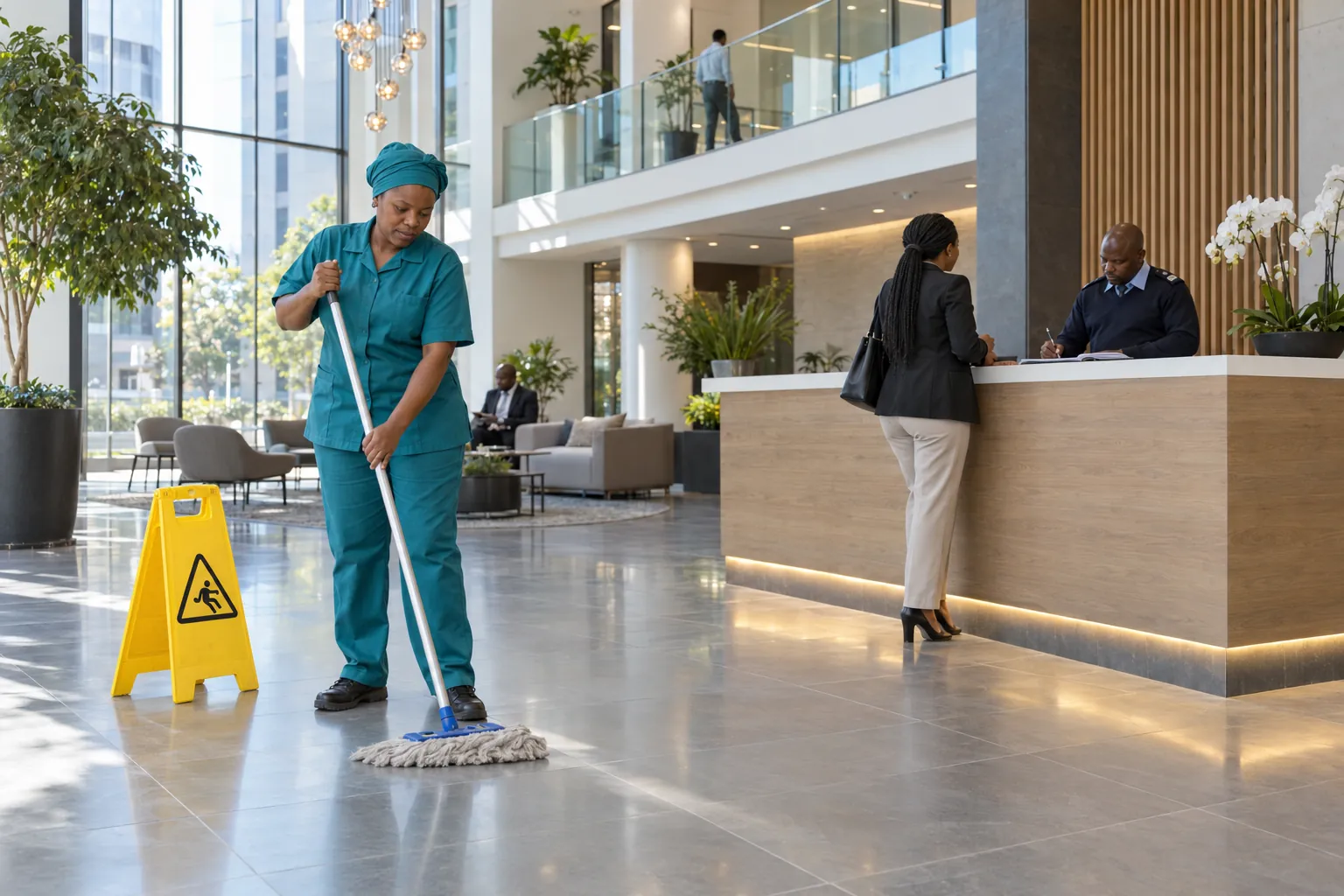
In South Africa many of them carry legal duties of their own: the Facilities Regulations, 2004 for ablutions, the Private Security Industry Regulation Act 56 of 2001 for guarding, and the food hygiene regulations for a staff canteen. This guide explains what soft services cover, where the line with hard services sits, the law behind each one, how they are contracted, and how a provider or an in-house team can show they were delivered.
01
What soft services are, and where the line with hard services sits
Facilities management in South Africa, as elsewhere, is usually split into two halves. Hard services look after the physical building: the structure and roof, electrical installations, plumbing, HVAC, lifts, fire detection and the standby generator. Soft services are delivered by people, in the workplace and the common spaces around it, and are about the people who use it: whether the offices and ablutions are clean, whether visitors are welcomed and controlled at the gate, whether the canteen is safe to eat in, whether the waste is taken away and the gardens kept. They are the services occupants notice every day, and they shape the comfort, experience and productivity of everyone who works in or visits the building.
The split is a convention, not a definition in any South African law, and organisations draw the line differently. The national standard for the discipline, SANS 41001:2025, Facility management – Management systems – Requirements with guidance for use, the national adoption of ISO 41001 approved on 24 March 2025 by the SABS committee SABS/TC 267, does not divide services into hard and soft; it sets requirements for an organisation to show that it delivers facilities management effectively and efficiently. The same committee's SANS 1752:2017, Strategic Facilities Management System – Requirements, reaffirmed in November 2022, takes the same whole-system view. The professional body is the South African Facilities Management Association (SAFMA).
Soft services are sometimes treated as optional extras, but very few can be stopped: most are essential to the building's daily operations, and many carry legal duties of their own. Behind most of them sits section 8(1) of the Occupational Health and Safety Act 85 of 1993 (the OHS Act): every employer must "provide and maintain, as far as is reasonably practicable, a working environment that is safe and without risk to the health of his employees". Section 9(1) extends the duty to people who are not employees but may be directly affected, such as visitors, tenants' staff and the public.
02
What soft services include in a South African building
The core soft services in most corporate offices, schools, hospitals, shopping centres, office parks and sectional title schemes are:
- Contract cleaning: daily cleaning of offices, passages, staircases and common areas, ablution checks and restocking, floor care, window cleaning, and periodic deep cleans.
- Hygiene services: sanitary bins, hand dryers and soap dispensers, air fresheners and washroom consumables, often from a specialist hygiene company.
- Guarding and access control: security officers at the gate, in reception and on patrol, usually grade C officers on a site post, with the occurrence book, visitor control, key control and the link to armed response.
- Reception and front of house: welcoming visitors, the visitor register, switchboard and meeting rooms.
- Catering: staff canteens, tea and coffee services, vending and meeting refreshments.
- Waste and recycling: collection from floors to the refuse room, separation of recyclables, and removal and disposal by the municipality or a waste contractor; where the client has sustainability targets, recycling rates and green cleaning products are written into the specification too.
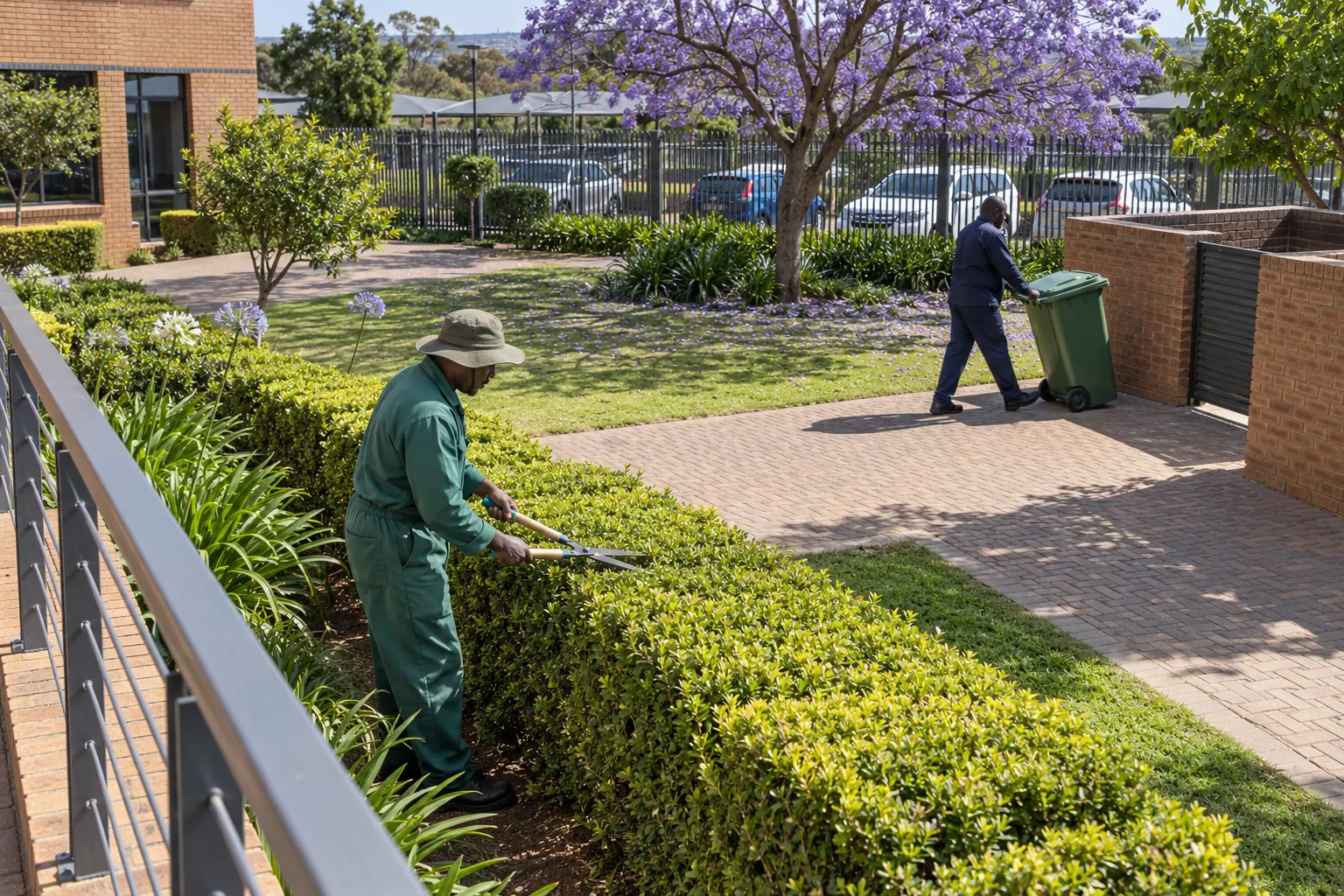
- Gardens and landscaping: lawns, beds, irrigation, paving and parking areas.
- Pest control: inspection, bait stations and treatment, often on a monthly visit, aimed at preventing infestations rather than only reacting to them.
- Support services: post, deliveries, porterage and office moves.
Hard services, by contrast, cover preventative maintenance of plant and systems, breakdown repairs, statutory inspections and certificates, and the building fabric. Some items move between the two depending on the contract: pest control, hygiene services, a handyman, gutter cleaning and fire equipment checks are classed as soft in some buildings and hard in others. What matters is that the contract says which is which, so that nothing falls between two providers.
03
The South African law behind each soft service
Soft services are labour-intensive and are where most of a building's day-to-day legal duties are actually carried out. The main ones are:
- Ablutions and welfare facilities. The Facilities Regulations, 2004 (Government Notice R. 924 of 3 August 2004) require sanitary facilities in accordance with the National Building Regulations (regulation 2(1)), toilet paper and toilet soap or a similar cleansing agent free of charge, and a towel, paper towels, hot air blowers or clean portions of continuous cloth towels at washbasins (regulation 2(3)). Regulation 9 requires every employer to maintain all the rooms and facilities the regulations cover "in a clean, hygienic, safe, whole and leak-free condition, and in a good state of repair".
- Cleaning chemicals. The Regulations for Hazardous Chemical Agents, 2021 (Notice R. 11263 in Government Gazette 44348 of 29 March 2021) require an employer whose work may expose employees to a hazardous chemical agent to give them suitable and sufficient information, instruction and training before they are exposed, including where to find the safety data sheets (regulation 3(1) and (2)). Regulation 3(4) adds that, as contemplated in section 37(2) of the Act, the employer and a mandatary such as a cleaning contractor "must agree in writing" on the arrangements to ensure the contractor meets those training requirements. See hazardous chemical agents.
- Guarding. The Private Security Industry Regulation Act 56 of 2001 defines a security service to include "protecting or safeguarding a person or property in any manner", and section 20(1)(a) says no person may render a security service for remuneration, reward, a fee or benefit unless registered as a security service provider. Section 38(3)(g) makes it an offence to contract for security services contrary to the Act "knowingly or without the exercise of reasonable care". Whoever buys guarding as part of a soft services contract should check PSIRA registration and keep a note that they did.
- Catering. The Regulations governing general hygiene requirements for food premises, the transport of food and related matters (R. 638 of 22 June 2018), made under the Foodstuffs, Cosmetics and Disinfectants Act 54 of 1972, say a person may not handle food, or permit it to be handled, on food premises without a valid certificate of acceptability (regulation 3(1)). Regulation 10 requires the person in charge of food premises to be suitably qualified or adequately trained in food safety and hygiene and to see that everyone working there is too.
- Waste. Section 16(1) of the National Environmental Management: Waste Act 59 of 2008 requires a holder of waste to take all reasonable measures within its power to avoid and minimise waste, to reduce, re-use, recycle and recover it, and to manage it so that it does not endanger health or the environment or cause a nuisance.
None of these duties moves to a contractor simply because a contract exists, which is why the contracting model matters.
04
How soft services are contracted, and who carries the duty
There are four common models, and many organisations mix them:
- In-house: the organisation employs its own cleaners, tea staff or gardeners. Direct control, but it carries recruitment, supervision, leave cover and training.
- Single service contracts: a separate specialist for each service, such as one contract cleaning company, one PSIRA-registered security company and one caterer. More expertise and competition, but more contracts and more boundaries.
- Bundled soft services: two or more soft services with one provider, such as cleaning, gardens and waste. Fewer contracts and shared supervision.
- Integrated or total facilities management: one provider for hard and soft services together, delivering some itself and subcontracting the rest. The labels are used loosely, so define the scope rather than relying on the name.
Whatever the model, the OHS Act decides who answers for a contractor's acts. Section 37(1) presumes an employer to have done an act or omission of its employee that would be an offence for the employer, unless it proves among other things that it took all reasonable steps to prevent it. Section 37(2) applies the same rule to a mandatary, which the Act defines to include "an agent, a contractor or a subcontractor for work", "except if the parties have agreed in writing to the arrangements and procedures between them to ensure compliance by the mandatary with the provisions of this Act". That written agreement is the 37.2 agreement, and every soft services contractor on site should have one. Within the client organisation, section 16(2) lets the chief executive officer assign duties to a person under their control, such as the facilities manager, without derogating from the CEO's own responsibility or liability.
Soft services contracts also change hands more often than most, and the staff often stay on site. Section 197 of the Labour Relations Act 66 of 1995, as substituted by the Labour Relations Amendment Act 12 of 2002, provides that where a business, which includes "the whole or a part of any business, trade, undertaking or service", is transferred as a going concern, the new employer is automatically substituted for the old in respect of all contracts of employment in existence immediately before the transfer, unless otherwise agreed in terms of the section. Whether a change of cleaning or security contractor is such a transfer depends on the facts, so take advice before a contract changes hands rather than after.
05
How soft services performance is specified and shown
Hard services are specified by asset and task. Soft services are specified by area, frequency and outcome: which areas are cleaned and how often, what clean looks like, which posts are manned and when, how often a patrol is walked, how quickly a reported spill is dealt with. The specification, the service level agreement and the provider's own operational processes are where those standards are written down; see the cleaning contract for the cleaning side.
Performance is usually reviewed at a monthly meeting against a handful of measures for each service. The measures that work combine three kinds of evidence:
- Delivery: did the scheduled work happen? Ablution checks done against those scheduled, patrols completed, the gate manned for every shift, the refuse room cleared on collection day.
- Quality: was it done well? Cleaning inspection scores against the agreed cleanliness standards, the supervisor's walk-round findings, complaints and occupant satisfaction surveys.
- Response: were problems put right? Reported spills, blocked toilets, empty dispensers and broken lights dealt with, or passed to hard services, within the agreed time.
Many contracts measure quality well and delivery poorly: inspections are scored, but the daily work is recorded on a sheet behind the ablution door or in the guardhouse book, if at all. The monthly report then rests on inspection scores and complaint counts, and a service can look fine on paper while the day-to-day work slips between inspections. A penalty or a service credit for a missed clean or a missed patrol only works if the miss can be shown.
Good evidence of soft services lets a facilities manager answer, with a record behind each answer:
- Were yesterday's scheduled cleans, checks and patrols done, in every building, by whom and when?
- Where was something missed, and what was the reason?
- Which reported problems are still open, how old are they, and who owns each one?
- Does every contractor have a signed 37.2 agreement, trained staff for the chemicals they use, and, for guarding, current PSIRA registration?
06
Where the soft services record fails, and what SiteClara does about it
Soft services are seen every day and evidenced once a month. The ablution block that ran out of paper towels at 11:00, the patrol point nobody reached during load shedding, the spill mentioned to whoever was passing reception: these rarely reach the monthly meeting except as a complaint, and the cleaning sheet behind the door was signed in advance.
SiteClara records the daily delivery of soft services at the place where the work is done. A printed QR poster at each location, such as an ablution block, a reception desk, a refuse room or a patrol point, with an optional NFC tag behind it, lets cleaning staff and security officers scan or tap with their own phone, with no app to install. They see the checks due there and mark each one done, or explain what stopped them, with a photo when one is asked for. A problem reported there goes onto the team's list of jobs until someone closes it, and a supervisor can escalate a job to the building manager, who can answer it.
Each day the supervisor reviews what was done, gives the reason where a check was missed, and approves a report that reaches nominated management or client contacts the next morning: what was reported, completed and still open, and how the scheduled checks went. Where a cleaning company and a security company share a building, each runs its own staff, forms and approval.
07
Where to read the official guidance, and a list to take away
The OHS Act, the Facilities Regulations, the Private Security Industry Regulation Act, the Waste Act and the Labour Relations Act and its amendments are on gov.za. The Department of Employment and Labour publishes the Regulations for Hazardous Chemical Agents on labour.gov.za, and the Department of Health publishes R. 638 on health.gov.za; certificates of acceptability are issued by your municipality's environmental health practitioners. PSIRA's own site covers registration and the Code of Conduct for security service providers. SANS 41001 and SANS 1752 are sold by the SABS, and SAFMA publishes guidance for the profession. For the hard services side, see preventative maintenance.
Before you buy or review soft services, check that:
- every soft service is listed, and the line between hard and soft is written down for each building;
- the legal duty behind each service is known, and someone owns it;
- every contractor on site has a signed 37.2 agreement, and every security provider is registered with PSIRA;
- cleaning staff are trained for the chemicals they use, and the safety data sheets can be found;
- the canteen holds a valid certificate of acceptability;
- each service has a few measures covering delivery, quality and response;
- daily delivery is recorded as it happens, not reconstructed for the monthly meeting;
- problems found by cleaners and guards reach hard services, and are closed.
Sources
Every document this guide quotes or links to, in the order it first cites them.
- SANS 41001:2025, Facility management – Management systems – Requirements with guidance for use store.sabs.co.za
- SANS 1752:2017, Strategic Facilities Management System – Requirements store.sabs.co.za
- South African Facilities Management Association (SAFMA) safma.co.za
- Occupational Health and Safety Act 85 of 1993 gov.za
- Facilities Regulations, 2004 (Government Notice R. 924 of 3 August 2004) gov.za
- Regulations for Hazardous Chemical Agents, 2021 (Notice R. 11263 in Government Gazette 44348 of 29 March 2021) labour.gov.za
- Private Security Industry Regulation Act 56 of 2001 gov.za
- Regulations governing general hygiene requirements for food premises, the transport of food and related matters (R. 638 of 22 June 2018) health.gov.za
- National Environmental Management: Waste Act 59 of 2008 gov.za
- Labour Relations Amendment Act 12 of 2002 gov.za
Related guides
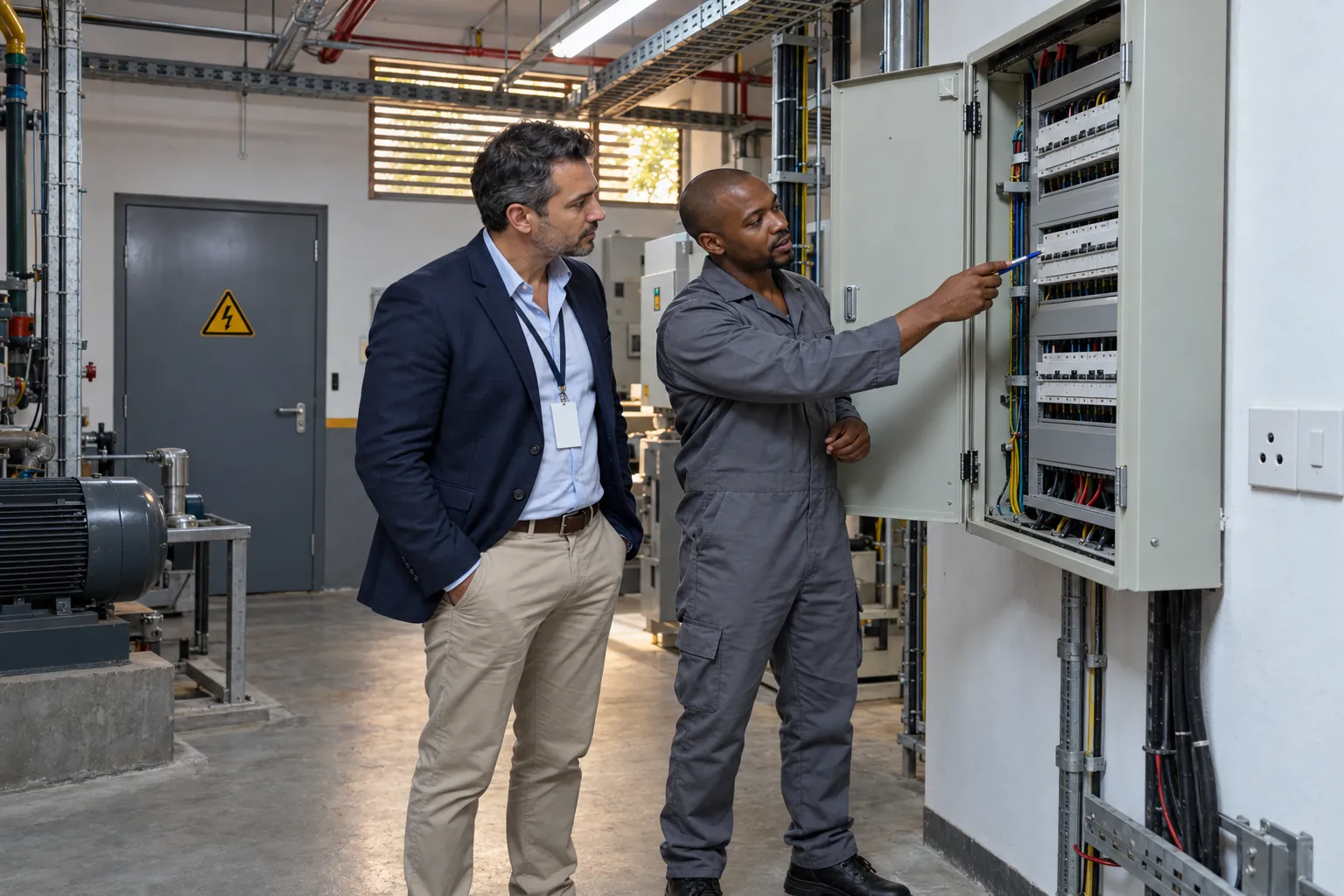 Premises and facilities managementFacilities manager duties: what the job covers under South African law, and how to show it is doneA facilities manager's duties in South Africa: the OHS Act duties they carry, contractors, lifts, electrics, fire and ablutions, and the records that show it.
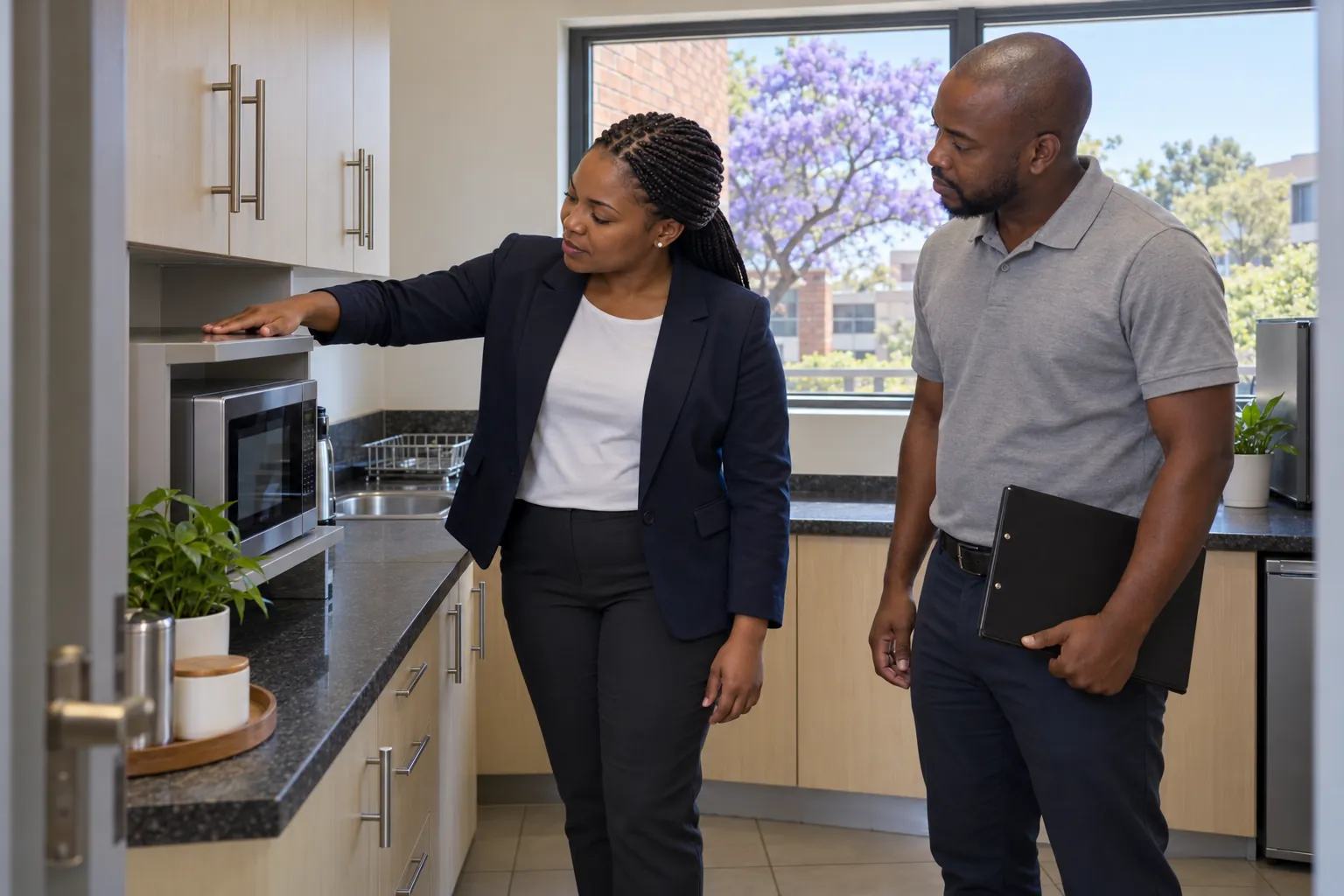 CleaningCleaning contract: what to put in it, and how to show the service was deliveredWhat a contract cleaning agreement in South Africa should include: scope, specification, standards, Sectoral Determination 1 wages, the 37(2) agreement, evidence.
 Premises and facilities managementSection 37(2) agreement: what the mandatary agreement does, and what it cannot doWhat a section 37(2) mandatary agreement under the OHS Act does and does not do, what goes in one for cleaning and security contracts, and how to show it is kept.
 Security patrolsChecking PSIRA registration: how to verify a security company and its officersHow a client checks PSIRA registration: the security company, every officer on site, the letter of good standing, and why section 38(3)(g) makes it the client's job.