Cleaning
Hotel housekeeping checklist: what to clean, who checks it, and how to show it was done
A hotel housekeeping checklist lists the tasks that make each guest room and public area ready for guests, such as stripping and remaking the bed with fresh linens, cleaning the bathroom and surfaces, dusting, vacuuming, removing rubbish, restocking amenities and reporting anything broken, in an order a room attendant can follow and a supervisor can inspect.
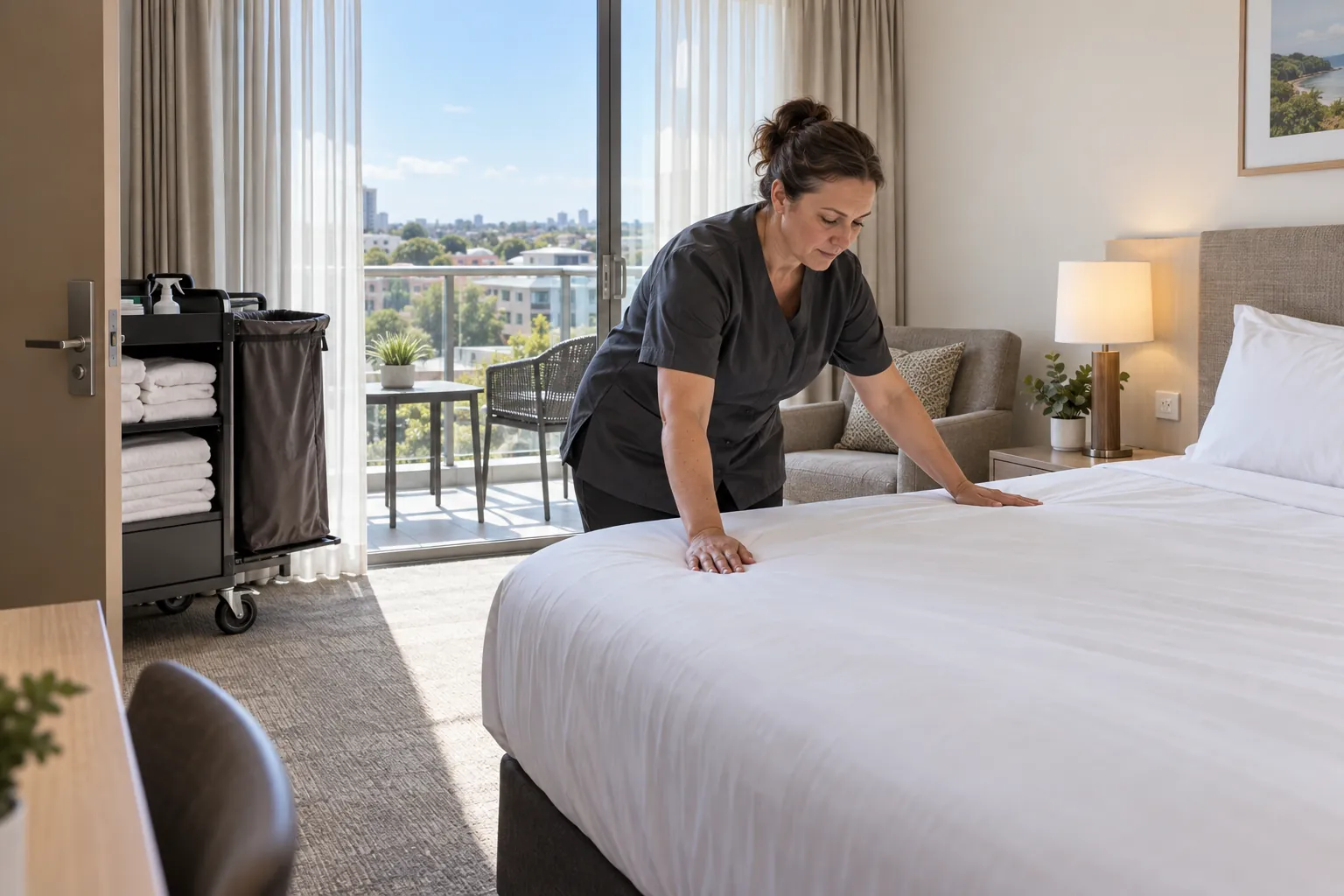
This guide covers what Australian work health and safety law expects of an accommodation business, what belongs on the checklist for a departure room, a stayover and the public areas, how often the deeper tasks come round, who does what, how to keep housekeeping staff safe while they do it, and how to keep a record that shows the work was actually done.
01
What Australian law expects of hotel housekeeping
No Australian law requires a hotel, motel or serviced apartment building to keep a written housekeeping checklist. What the law sets is a duty, and the checklist is how most properties show they are meeting it. Under the harmonised work health and safety laws, section 19 of the Work Health and Safety Act 2011 (Cth) requires a person conducting a business or undertaking (PCBU) to ensure, so far as is reasonably practicable, the health and safety of its workers, and separately "that the health and safety of other persons is not put at risk from work carried out as part of the conduct of the business or undertaking". In a hotel, the other persons include guests.
The Work Health and Safety Regulations 2011 (Cth) add the detail. Regulation 40 requires the PCBU to ensure, so far as is reasonably practicable, that "floors and other surfaces are designed, installed and maintained to allow work to be carried out without risk to health and safety", that lighting lets people move about and evacuate safely, and that the layout allows people "to enter and exit and to move about without risk to health and safety, both under normal working conditions and in an emergency". A wet bathroom floor or a linen trolley parked across a fire stair door is a housekeeping matter. Regulation 60 requires the PCBU to manage the risk of musculoskeletal disorders from hazardous manual tasks, which in housekeeping means bed making, bathroom cleaning, vacuuming and pushing trolleys.
The Commonwealth regulations apply to Commonwealth workplaces. New South Wales, Queensland, South Australia, Western Australia, Tasmania and the two territories each have their own WHS Act and regulations based on the same model, so check your own jurisdiction's version before quoting a regulation number.
Victoria is different. It has not adopted the harmonised laws. The duties come from the Occupational Health and Safety Act 2004 (Vic): an employer must provide and maintain, so far as is reasonably practicable, a working environment that is safe and without risks to health (section 21), and must ensure that people other than employees are not exposed to risks arising from its business (section 23). WorkSafe Victoria's Compliance code: Hazardous manual handling (Edition 2, December 2019) uses hotel housekeeping as its example of varied work, saying of "cleaning hotel rooms where an employee may clean the bathroom, vacuum, and make beds" that "all of these activities make up the employee's work. Employers need to look at the activities together or cumulatively to identify any hazardous manual handling."
Put together, the law expects rooms and public areas that are safe to use, and a way of working that is safe for the people cleaning them. The checklist turns that into tasks.
02
What a hotel housekeeping checklist covers
Most properties need three checklists, because the work is different: the departure room (the guest has checked out and the room is prepared for the next arrival), the stayover (a guest is staying on and the room is serviced around their belongings) and the public areas. A departure room checklist usually runs in the order the attendant works:
- On entry: knock and announce, open the curtains, and look for damage, left property, pests, sharps or anything that needs a manager.
- Strip: remove all bed linen and used towels to the soiled linen bag, empty every bin, and clear the minibar, kitchenette and balcony of rubbish and used crockery.
- Bathroom or ensuite: toilet, shower screen, bath, basin, taps, mirror, tiles and grout, exhaust fan grille, floor; hair removed from drains and plug holes; towels, bath mat and guest toiletries replaced to the property's standard.
- Bedroom: bed made with fresh linen to the property's standard, pillows and bedspread checked for marks, surfaces dusted, high-touch points wiped (light switches, remote control, phone, door handles, safe keypad, air-conditioning controls, kettle and hair dryer), carpet vacuumed including under the bed and behind the door, hard floors mopped.
- Kitchenette in serviced apartments: benchtops, sink, cooktop, microwave, fridge, dishwasher emptied, crockery counted.
- Supplies: tea, coffee, milk, water and in-room information restocked; minibar checked for billing.
- Final check: lights, television, air conditioning and safe working; windows and balcony door locked; room status changed to ready for inspection.
- Report, not fix: anything broken, leaking, stained or unsafe goes to maintenance with the room number, and the room is held out of order if a guest should not use it.
A stayover is lighter: bed made, linen changed on the property's cycle or on request, bathroom and bins done, supplies topped up, the guest's belongings left alone. Do not disturb rooms are logged, not entered, with a rule for when a manager checks a room left unserviced for some time.
The public areas checklist covers the lobby, lifts and lift lobbies, guest corridors, public toilets, the pool and gym if there is one, fire stairs (kept clear) and back of house: linen cupboards, the chemical store and the staff room. Write each item as something someone else can check: "vacuum under the bed" rather than "floors".
Where a hotel has brand standards, they set the detail the checklist must match: how the bed is made, where the amenities go and what a finished room looks like. Keep the daily checklists and the brand standards in step, so a room cleaned to the checklist also passes inspection.
03
Daily servicing, turndown and periodic deep cleaning
Frequencies are set by the property, its brand or owner and its guests, not by law. What matters is that each task has a frequency and someone can tell when it was last done. A typical split:
- Every departure: the full departure checklist, then an inspection before the room is released to front office.
- Every stayover day, or on the cycle the property offers: service as above, with linen changes on the property's schedule or on request.
- Turndown, where offered: an evening visit to tidy, close curtains, turn the bed down and replace used towels.
- Public areas, through the day: lobby, lifts and public toilets, more often at check-out and check-in peaks.
- Periodic deep cleaning, on a room-by-room rota: mattress rotation, curtain and blind cleaning, carpet extraction, high dusting of air-conditioning grilles and light fittings, behind and under heavy furniture, grout and silicone in showers, balcony glass, fridge defrosting in serviced apartments.
- After an event: a badly soiled room, a bodily fluid spill or a pest sighting gets its own clean, with the supervisor told.
The periodic rota is where properties most often lose track: tasks done every three or six months are easy to skip when occupancy is high. Give each room a line on a deep-clean plan with the date each task was last done. Out-of-order rooms need a rule as well: who puts a room out of order, and who checks and cleans it before it is released.
04
Who does what, and how rooms are inspected
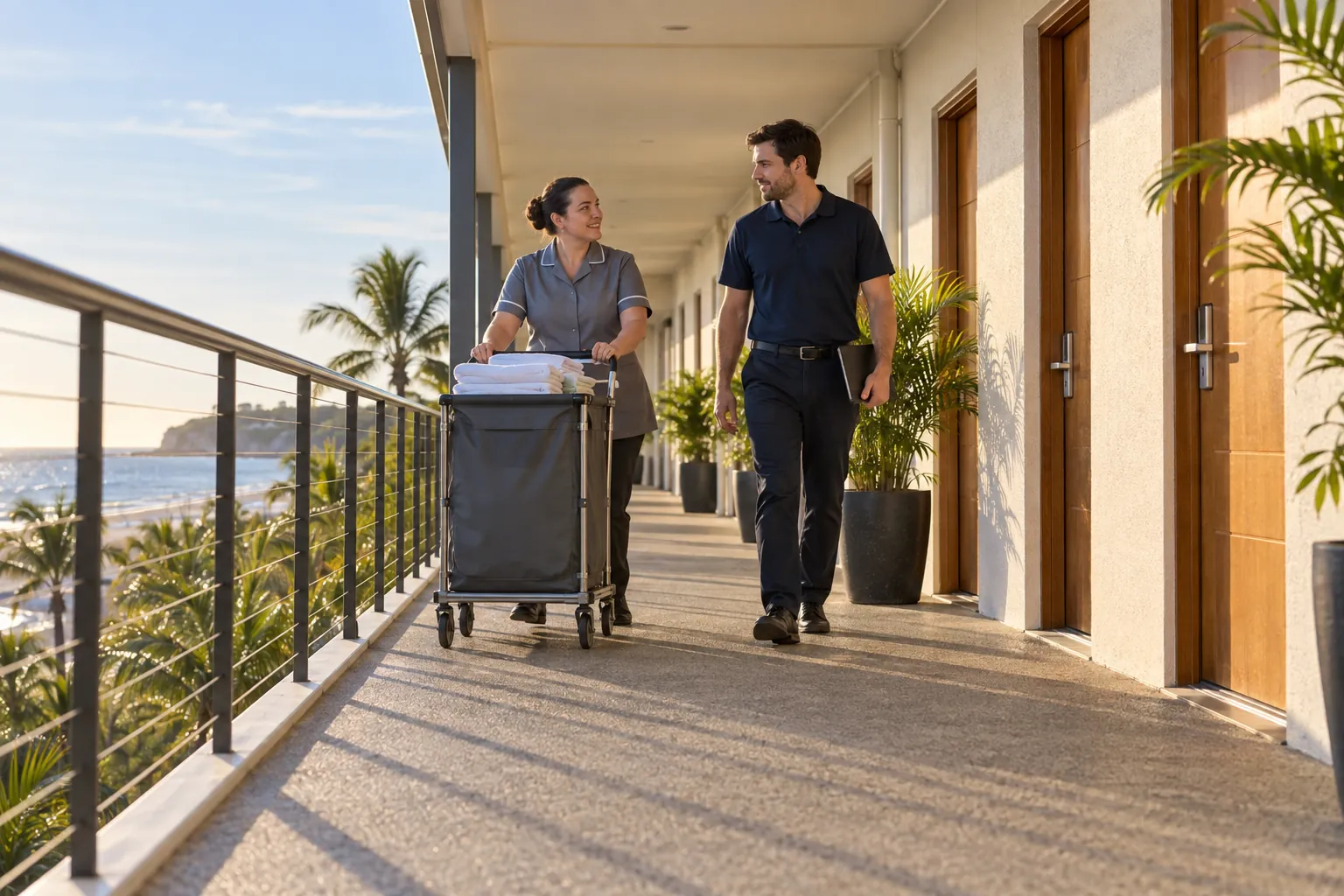
In most Australian hotels the work is split between room attendants, a houseperson or housekeeping porter who moves linen, supplies and rubbish, a public area cleaner, floor or housekeeping supervisors, and an executive housekeeper or housekeeping manager. The Hospitality Industry (General) Award 2020 [MA000009] describes the work in its classifications: "servicing and cleaning accommodation areas" is Guest service grade 2, and a Guest service supervisor has "responsibility for the supervision, training and co-ordination of employees engaged in a housekeeping department". Check the award and the Fair Work Ombudsman for anything to do with pay; this guide is about the work.
Many properties contract housekeeping or public area cleaning out. That does not move the duty. Section 46 of the Work Health and Safety Act says that where more than one person has a duty in relation to the same matter, "each person with the duty must, so far as is reasonably practicable, consult, co-operate and co-ordinate activities with all other persons who have a duty in relation to the same matter". In practice, the hotel and the contractor agree the checklist, who inspects, how faults are reported, how chemicals are managed, and how many rooms a shift is expected to service.
Inspection is what makes the checklist more than a reminder. A good room inspection is done by someone other than the cleaner, against the same checklist, and records the room, the time, the inspector, whether it passed or was returned and why, faults passed to maintenance, and when the room was released.
Where not every departure room can be inspected, inspect a sample chosen by the supervisor, and every room from a new starter until they are signed off. Public areas need their own walk-round. For the supervisor's side of this, see our guide to cleaning supervisor duties.
05
Keeping housekeeping staff safe: manual tasks, chemicals and sharps
Room attendants lift mattress corners, bend over baths, kneel at toilets and push loaded trolleys along carpet all shift. The Hazardous manual tasks code of practice (SafeWork NSW edition, August 2019, based on Safe Work Australia's model code) says a manual task is hazardous if it involves "repetitive or sustained force", "high or sudden force", "repetitive movement", "sustained and/or awkward posture" or "exposure to vibration". Most housekeeping tasks involve at least one.
The code's controls translate directly to a housekeeping department:
- Trolleys: the code says "A trolley can eliminate many of the risks involved in manual handling. However, the load still needs to be manoeuvred onto the trolley and through the workplace." It lists "ensuring hand trucks and trolleys are well maintained" and correctly designed for the load. A trolley with a seized castor is a hazard, so it belongs on a checklist.
- Linen: WorkSafe Victoria's compliance code gives "carrying a laundry bag full of linen" as an example of an unstable load. Smaller bags, bag holders on trolleys and chutes or porters to take linen away reduce the carrying.
- Beds and bathrooms: long-handled tools for baths and showers, and beds that can be moved and made without lifting.
- Work rate: the NSW code says "Workers should not have to work at a rate that is at the limit of their ability. When you establish a work rate, you should consult with the workers affected and their health and safety representatives." A room quota set without that conversation, and without allowing for departures, extra beds and heavily soiled rooms, is a risk to be managed, not only a productivity target.
Chemicals. Housekeeping uses detergents, bathroom cleaners, disinfectants and sometimes stronger products for descaling or drains. The Managing risks of hazardous chemicals in the workplace code of practice (SafeWork NSW edition) says "Containers that have had chemicals transferred into them (decanted) in the workplace, and containers of chemical wastes must be labelled correctly", which covers every spray bottle filled from a bulk drum in the chemical store. Regulation 346 of the WHS Regulations requires a register of hazardous chemicals used, handled or stored, with "the current safety data sheet for each hazardous chemical listed", readily accessible to the workers who use them; the code notes that the safety data sheet requirement does not apply to some consumer products in certain circumstances, so check the products you use.
Sharps and bodily fluids. Needles, broken glass and blood or other bodily fluids turn up in guest rooms. The checklist should tell an attendant to stop, not to pick anything up by hand, and to call the supervisor, who follows the property's procedure. The same applies to pests or a room that looks unsafe to enter.
06
Where the housekeeping record fails, and what SiteClara does about it
Guest rooms usually have a record, because the room status has to change before a room can be sold. The gaps are elsewhere. The public toilet sheet on the back of the door is ticked for the day in one go. The lift lobby on level 6 is on nobody's list. A dripping shower head mentioned to whoever was passing is never written down, and the next guest reports it instead.
SiteClara records checks and reports at the location. A printed QR poster, with an optional NFC tag behind it, goes at each place that needs checking: each floor's service room or linen cupboard, the public toilets, the pool, the gym, the lobby, the chemical store. The attendant or public area cleaner scans the code or taps the tag on their own phone, with no app to install, and sees the scheduled checks due there. They mark each one done, or say what stopped them, and can add a photo when one is asked for. If something needs fixing, they report it on the spot, and it goes onto the team's list of open jobs until someone closes it.
The supervisor sees what is due, done and missed, and can record the reason a check was missed from the company's own list. At the end of the day they review the totals and photos, add a note and approve the report, which goes to the executive housekeeper, the general manager or the owner's representative the next morning, showing what was completed, what is still open and how the scheduled checks went, for example 14 of 15 completed. An unapproved report is held, not sent.
07
Questions people ask
What are the typical housekeeping tasks in a hotel?
The Hospitality Industry (General) Award 2020 [MA000009] lists them in its guest services classifications: Guest service grade 1 covers "performing laundry or linen duties", "collecting and delivering guests’ personal dry cleaning and laundry, linen and associated materials to and from accommodation areas" and "performing general cleaning duties", and grade 2 covers "servicing and cleaning accommodation areas" and "performing cleaning duties using specialised equipment and chemicals". A Guest service supervisor has "responsibility for the supervision, training and co-ordination of employees engaged in a housekeeping department". In practice that means servicing departure and stayover rooms, changing linen and towels, cleaning bathrooms and surfaces, removing rubbish, restocking amenities and keeping the public areas clean.
How many rooms should a housekeeper clean in 8 hours?
No Australian law sets a number, and the Hospitality Industry (General) Award 2020 sets no room quota. The right figure depends on the mix of departures and stayovers, the size of the rooms and how soiled they are. What the law does shape is how the number is set: SafeWork NSW's Hazardous manual tasks code of practice says "Workers should not have to work at a rate that is at the limit of their ability. When you establish a work rate, you should consult with the workers affected and their health and safety representatives." Among its examples of realistic work rates is "ensuring the structure of remuneration does not incentivise workers to exceed their capacity to work safely or avoid taking breaks when required", which is worth checking wherever attendants are paid by the room.
08
Further reading, and a list to take away
Read sections 19 and 46 of your jurisdiction's WHS Act, regulations 40, 60 and 346 of its WHS regulations, and its codes of practice on hazardous manual tasks and hazardous chemicals. In Victoria, read the OHS Act 2004 and WorkSafe Victoria's Compliance code: Hazardous manual handling. For public toilets, see our toilet cleaning checklist.
Before you settle the next version of your hotel housekeeping checklist, check that:
- there is a departure, a stayover and a public areas checklist, each written as tasks someone else can check;
- the departure checklist says what to look for on entry and what to report rather than fix;
- every public area and back-of-house space is on exactly one list, including lift lobbies and fire stairs;
- each periodic task has a frequency and a date last done for each room;
- rooms are inspected by someone other than the cleaner, and returned rooms are recorded;
- trolleys, linen handling and room quotas have been looked at as manual tasks, with the workers consulted;
- every decanted bottle is labelled and the chemical register has current safety data sheets;
- sharps, bodily fluids, pests and do not disturb rooms each have a written procedure;
- any contractor has agreed the checklist, inspections and fault reporting with you;
- you know how completed work and reported faults will be recorded, and who will see the record.
Sources
Every document this guide quotes or links to, in the order it first cites them.
- Work Health and Safety Act 2011 legislation.gov.au
- Work Health and Safety Regulations 2011 legislation.gov.au
- Occupational Health and Safety Act 2004 legislation.vic.gov.au
- Compliance code: Hazardous manual handling worksafe.vic.gov.au
- Hospitality Industry (General) Award 2020 awards.fairwork.gov.au
- Hazardous manual tasks code of practice safework.nsw.gov.au
- Managing risks of hazardous chemicals in the workplace code of practice safework.nsw.gov.au
Related guides
 CleaningCleaning supervisor duties: what the role involves in Australia, and what good looks likeWhat a cleaning supervisor does in Australia: the Cleaning Services Award, WHS duties, a typical shift, managing the team, checking the work and reporting.
 CleaningStudent accommodation cleaning: halls, colleges and the summer changeoverCleaning student accommodation in Australia: shared kitchens and bathrooms, room inspections and entry notice, gastro, and the summer changeover between semesters.
 CleaningToilet cleaning checklist: what to check, how often, and how to make the record believableWhat a toilet cleaning checklist should cover in Australian workplaces, how often to check, the WHS and OHS duties behind it, and how to make the record believable.
 CleaningCleaning log sheet: what to record, who signs it, and what a signature provesWhat a cleaning log sheet should record in Australian workplaces and food businesses, the WHS and food safety rules behind it, and what a signature proves.