Cleaning
Hotel housekeeping checklist: a room ready for the next guest, and the inspection that releases it
A hotel housekeeping checklist is the list of housekeeping tasks a room attendant works through to clean, restock and check a guest bedroom, bathroom or public area to the hotel's own standard, so that a supervisor can inspect the room and release it as ready for the next guest.
Also written for United Kingdom · Ireland · United States · Canada · Australia · New Zealand
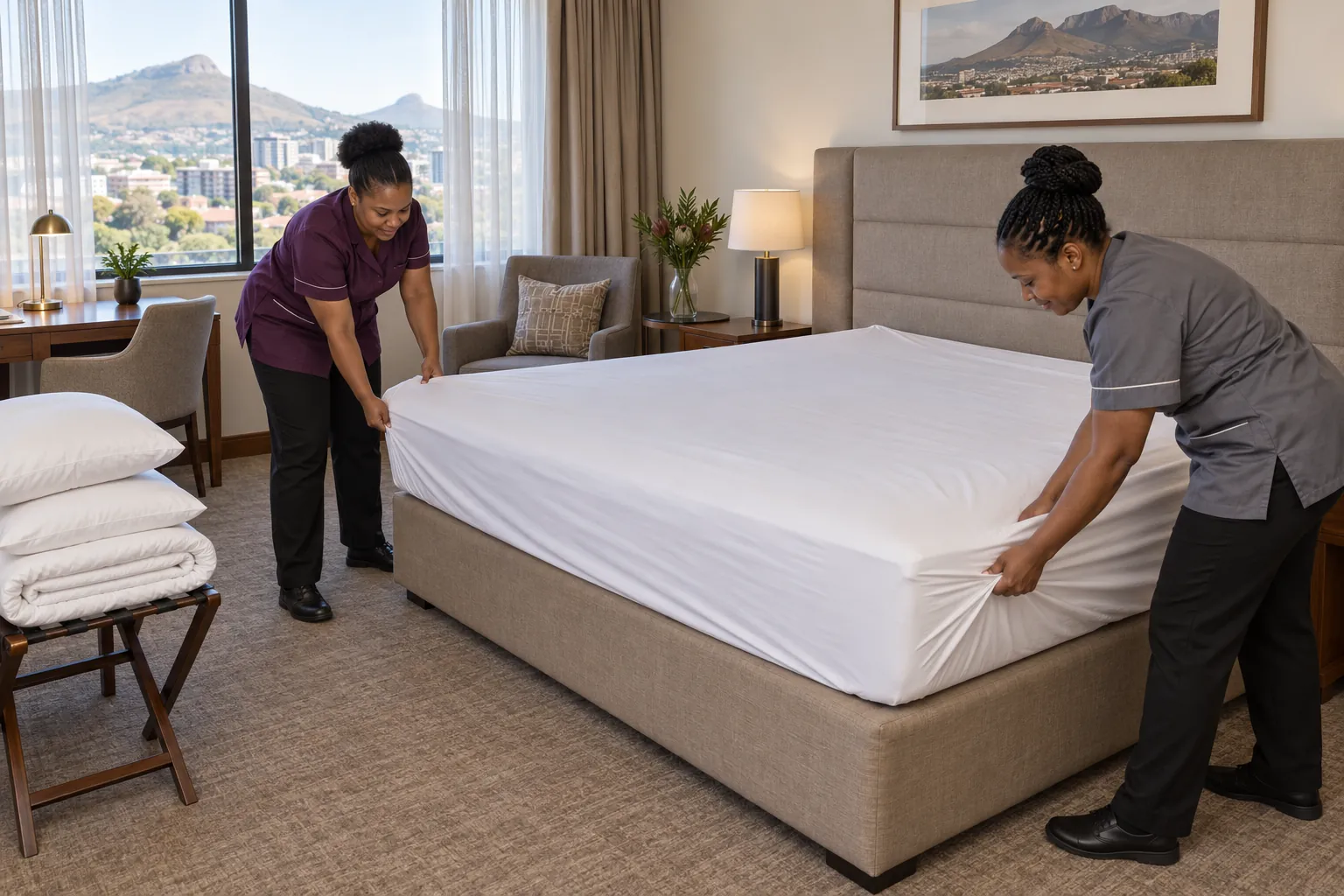
In South Africa no law prescribes the list itself, but the Tourism Grading Council of South Africa's grading criteria set what a graded hotel must provide, such as bedrooms and bathrooms cleaned daily and linen changed for each new guest, and the Occupational Health and Safety Act 85 of 1993 and its regulations govern how the cleaning is done safely. This guide sets out a checkout room checklist, the stayover and public area rounds, the safety duties behind the cleaning trolley, and how a room inspection and its record should work.
01
The standard behind a hotel housekeeping checklist
A room attendant needs a definition of finished before a checklist is any use, and in South Africa it usually starts with the star grading. Section 28 of the Tourism Act 3 of 2014 allows the Minister to develop a national grading system for tourism, run through schemes with membership that can be acquired, continued and ended, and section 30(1) requires the Tourism Grading Council to implement and manage it.
The Council publishes its requirements in the TGCSA Grading Criteria 2019, implemented on 1 April 2019, with separate sub-categories for hotels, small hotels, apartment hotels and boutique hotels. Its housekeeping section for hotels lists, among the criteria that apply by sub-category and star level:
- Housekeeping provision: housekeeping services available during working hours, 18 hours a day or 24 hours a day, with limited services after hours.
- Daily servicing: "All bedrooms and bathrooms cleaned daily" and "All beds made daily".
- Linen changes: all linen, including duvet covers, changed for each new guest, on request or, for long-stay guests, at least every five days, with stricter levels of at least every three days and at least every two days, each with a "No change" option available.
- Turn-down: a comprehensive bedroom and bathroom turn-down service daily on request, or daily.
The criteria also say, at the head of the bedroom section, that "assessment will apply to the room with the lowest rating". For housekeeping that is a practical warning: the tired room at the end of the passage sets the grade, so a high standard in the show rooms is not enough; the checklist and the inspection must reach every room type.
The grading criteria are a quality scheme, not a cleaning law. The legal duties come from the Occupational Health and Safety Act 85 of 1993. Section 8(1) requires every employer to provide and maintain, as far as is reasonably practicable, a working environment that is safe and without risk to the health of its employees, and section 9(1) extends a similar duty to people other than employees, such as guests. Regulation 13H(2)(c) and (d) of the General Safety Regulations, 2025 require every indoor workplace to be kept clean, orderly and free of materials not necessary for the work, and floors, walkways, stairs and passages skid-free and free of obstructions, waste or materials. Neither sets a room-cleaning formula: that belongs in the hotel's own standard operating procedures, and the checklist carries them into the room.
02
A checkout room cleaning checklist
A checkout room, also called a departure, is cleaned in full for a new guest. Work the cleaning process in a fixed order: top to bottom, dry before wet, the floor last, with separate cloths for the toilet. Write each task so an inspector can see whether it was done; "bathroom done" cannot be checked, "toilet seat, lid and base clean, spare roll in place" can.
- Check the status and enter properly. Confirm on the room list that the guest has checked out, knock and announce, and respect a privacy sign. An open door does not mean a vacated room.
- Look before touching. Open the curtains, switch on every light and the air-conditioning, and note lost property, damage, stains, leaks and maintenance issues before anything is moved.
- Strip and clear. Remove used linen and towels into the linen bag on the trolley, never onto the floor of the passage. Empty bins without reaching blindly into them or pressing the contents down by hand.
- Make the bed. Check the mattress, protector and pillows for stains and damage, fit clean linen and finish to the room standard. A stained protector is replaced, not covered.
- Clean the bedroom. Dust high to low; wipe the desk, bedside tables, door handles, light switches, remote control and kettle; clean mirrors; check drawers and under the bed for items left behind.
- Clean the bathroom. Clean and sanitise the basin, taps, vanity, shower or bath, screen or curtain, then the toilet with its own equipment. Check the water runs hot and cold, the drains clear and nothing drips.
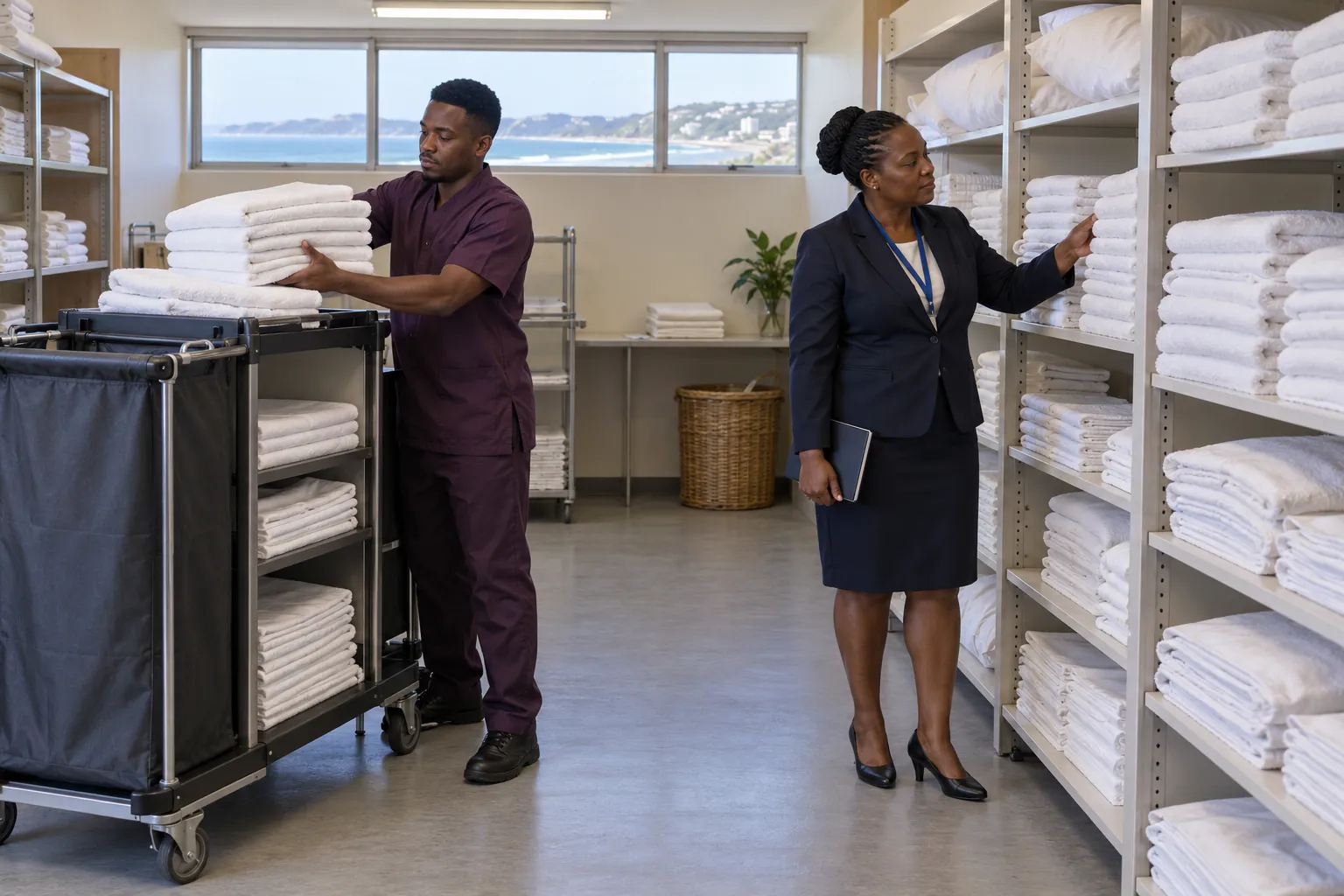
- Restock. Replace towels, the bath mat, soap, shampoo, tissues, toilet paper with a spare roll, cups and glasses, and the tea and coffee tray, to the room type's list.
- Finish. Vacuum carpets and rugs, mop hard floors from the far corner to the door, switch off what should be off, close the curtains to the standard and set the room status to clean, awaiting inspection.
The grading criteria give a useful set of bathroom checks for a graded hotel. They ask for a toilet with seat and lid, a lidded bin (liner bags preferable), double-ply toilet paper and holder "plus a minimum of one spare toilet roll", a closed toilet brush, sealed individually wrapped soap or liquid soap, and clean, absorbent towels per sleeping position. A shower curtain, where the grade allows one, "Must be free of stains, tears, holes and mould", and the criteria note that toilet seat cover and mat sets are not acceptable. Each of those is something a room attendant can see and an inspector can check.
How do I make a housekeeping checklist?
Start from the hotel's room standard and the grading criteria that apply to the hotel's sub-category and star level, then write one list per room type in the order the attendant works the room. The TGCSA Grading Criteria 2019 supply many of the visible items, such as the spare toilet roll, the lidded bin and towels per sleeping position. Add the room's own features, such as a kitchenette or an accessible bathroom with a grab rail, and leave space to record what could not be done and why.
03
Stayover rooms, public areas and periodic tasks
A stayover, or occupied room, is a different job and needs its own checklist. The guest's belongings stay where they are, the bed is made rather than stripped unless linen is due, and towels and linen follow the hotel's change policy and the guest's choice. Where the grading criteria apply, the "No change" option sits beside the minimum change interval, so the checklist should record which applied: changed, not due, or guest declined.
- Stayover service: empty bins, make the bed, clean the bathroom, replace used towels and amenities, tidy without moving the guest's papers or valuables, and record "do not disturb" or service refused rather than leaving the line blank.
- Public areas: reception, the lobby, lifts, passages, stairs and the public ablutions on rounds through the day. The grading criteria require "All toilets regularly cleaned, checked and adequately ventilated" and passages and stairs "free from obstruction".
- Periodic tasks: carpet and rug extraction, mattress turning, curtain cleaning, high dusting and descaling showerheads, on a calendar with a named person or contractor, not squeezed into the daily housekeeping tasks.
Regulation 13J(1)(e)(ii) of the General Safety Regulations, 2025 requires staircases intended as fire escapes to be kept clear of any material or other obstruction. A trolley parked on a fire escape landing, or linen bags left in a stairwell, belong on the public area checklist as things to look for.
Rooms out of sale need a line too: their showers and taps may go unused for weeks. The legionella control guide explains why seldom-used outlets are flushed; put the flush on the housekeeping list only where the hotel's water safety protocol says so.
04
Chemicals, bed-making and the safety duties behind the trolley
Housekeeping is physical work with chemicals, and the room target must leave time to do it safely. Section 8(2)(b) of the OHS Act requires a hazard to be eliminated or mitigated before resorting to personal protective equipment.
The cleaning products on the trolley fall under the Regulations for Hazardous Chemical Agents, 2021 (Government Notice R. 280 of 29 March 2021) where they are hazardous chemical agents:
- Training first. Regulation 3(1) requires information, instruction and training before an employee is exposed, including, under regulation 3(2), how to access the safety data sheets and what each part of the label means.
- Safety data sheets. Regulation 14A(1)(d) requires the employer to obtain the safety data sheet from the manufacturer, importer or supplier and provide it to any person involved in using the product.
- Decanted bottles. Regulation 14B(1)(d)(i) requires every hazardous chemical agent used, handled or stored at the workplace to be correctly labelled, regulation 14B(1)(d)(ii) requires a container labelled for an agent to be used only for that agent, and regulation 14B(1)(d)(iii) requires a container it is decanted into to be correctly labelled, as far as is reasonably practicable. An unlabelled spray bottle on a trolley fails (i), and (iii) where it was filled from a bulk container; a bottle refilled with a different product fails (ii).
- The assessment. Regulation 5(1) requires an assessment of exposure, repeated at intervals not exceeding two years, and regulation 5(3) requires a record of it.
- Contract housekeeping. Where an outside company supplies the room attendants, regulation 3(4) requires the hotel and the contractor to agree in writing how the training duties will be met, as section 37(2) of the Act contemplates. The section 37(2) agreement guide covers that agreement.
Bed-making, lifting mattresses, pushing loaded trolleys and kneeling at baths are ergonomic risks. The Ergonomics Regulations (Government Notice R. 1589 of 6 December 2019) require an ergonomic risk assessment by a competent person before such work begins (regulation 6(1)), repeated at intervals not exceeding two years (regulation 6(2)(a)), and the exposure prevented or adequately controlled through the hierarchy of controls (regulation 7). A room count that can only be met by skipping the safe method is a hazard in itself.
Section 14(d) of the Act requires every employee to report an unsafe or unhealthy situation as soon as practicable, and section 14(e) requires an employee involved in an incident that has injured them, or may affect their health, to report it as soon as practicable and not later than the end of that shift, unless that was not possible. A broken bed base or a used needle in a bin is an unsafe situation of exactly that kind; the injury on duty guide explains what follows an injury.
05
The room inspection and a record worth keeping
Cleaning and inspecting are different acts, done by different people. The room attendant records that the tasks are completed; the floor supervisor or housekeeper inspects against the hotel's room inspection checklist and decides whether the room is released to front office as vacant and ready. Section 8(2)(i) of the Act asks for work to be performed under the general supervision of a person trained to understand the hazards; the cleaning supervisor duties guide describes the role. If only a sample of rooms is inspected, say which, how often, and what triggers a full inspection.
The room inspection checklist is the hotel's checklist to ensure each room meets its standard before front office sells it, and it works best on things that can be seen: hair in the plughole, residue round the taps, dust on the headboard, a stained protector, a missing spare roll, a dripping cistern, a blown bulb. Write the defect and the correction, then recheck it; "room 214 not up to standard" leaves the attendant guessing.
A usable room record has a field for each of these: date, room, service type (checkout, stayover, turn-down), attendant, time finished, outcome, faults found and who they were reported to, inspector, time inspected and the release decision. Give the outcome a few clear values, such as complete, not complete with a reason, re-clean needed, and held for maintenance, rather than a tick that can mean any of them. Keep guest names and personal details out of it; the room number is enough for housekeeping.
Read the records over a month. A defect that keeps appearing in the same rooms usually points to a method, a product, a missing trolley item or a room count that is too high, not to one careless attendant. The cleaning schedule guide sets out how the wider programme's frequencies are written down.
06
Where the room record fails
The paper room list fails in familiar ways. A whole floor is ticked before the first room is entered. A fault is mentioned to whoever passes in the passage and never reaches maintenance, so the room is cleaned twice and still cannot be sold. The inspection sheet shows a signature, but not which rooms were looked at, or when.
SiteClara is built for this kind of record. A printed QR poster, with an optional NFC tag behind it, is put up at each location the team has set up, such as a linen room, a floor's service area or the public ablutions. A member of the team scans the code or taps the tag on their own phone and sees the scheduled checks due there. They mark each one done, or say what stopped them, and can add a photo; the time and the person are recorded as it happens. A fault found on the round, such as a dripping mixer or a broken dispenser, can be reported at that location and goes onto the team's list of open jobs until someone closes it.
The supervisor sees what is due, done and missed, and reviews the day's checks and photos before approving a report that goes to the nominated managers the next morning. A photo should show the condition that matters, never a guest's belongings.
07
Questions people ask
Is a hotel housekeeping checklist a legal requirement in South Africa?
No law prescribes the checklist itself, but the cleaning it records is a legal duty. Regulation 13H(2) of the General Safety Regulations, 2025 requires an employer to keep every indoor workplace clean, orderly and free of materials, tools and similar things not necessary for the work done there (paragraph (c)), and to keep all floors, walkways, stairs, passages and gangways in a good state of repair, skid-free and free of obstructions, waste or materials (paragraph (d)). A written checklist is the usual way a hotel shows how it meets that duty.
Do hotel rooms have to be cleaned every day?
For a graded hotel, yes. The hotel housekeeping section of the TGCSA Grading Criteria 2019 lists "All bedrooms and bathrooms cleaned daily" and "All beds made daily", and the boutique hotel criteria repeat the daily cleaning of bedrooms and bathrooms. These are conditions of the grading scheme rather than a statute, so an ungraded property follows its own standard.
How often should hotel bed linen be changed?
The TGCSA Grading Criteria 2019 require all linen, including duvet covers, to be changed for each new guest, on request or, for long-stay guests, at least every five days. Higher levels in the hotel criteria shorten this to at least every three days or at least every two days, and each level keeps a "No change" option available for the guest.
What training do housekeeping staff need before using cleaning chemicals?
Where a product is a hazardous chemical agent, regulation 3(1) of the Regulations for Hazardous Chemical Agents, 2021 requires suitable and sufficient information, instruction and training before an employee is or may be exposed, repeated at intervals the health and safety committee recommends. Regulation 3(2) says it must include how to access the safety data sheets, what each part of the label on containers means, and the work practices for use, handling, storage, spillage and disposal, as well as for good housekeeping and personal hygiene.
08
Where to read the official text, and a list to take away
The grading requirements are in the TGCSA Grading Criteria 2019, and the grading system's legal footing is Chapter 4 of the Tourism Act 3 of 2014. The safety duties are in the Occupational Health and Safety Act 85 of 1993, the General Safety Regulations, 2025, the Regulations for Hazardous Chemical Agents, 2021 and the Ergonomics Regulations. The hazardous chemical agents guide and the commercial cleaning checklist guide cover the back-of-house areas a hotel shares with any other workplace.
Before the checklist goes onto the trolleys, check that:
- the room standard is written down, with the grading criteria for the hotel's sub-category and star level built in;
- there is a separate list for checkout, stayover, turn-down and each public area round;
- each room type has its own list, including the tired rooms the grade will be judged on;
- every task can be seen by an inspector, and the outcome has more values than a tick;
- faults go to maintenance the same shift and the room is held until they are fixed;
- every bottle on the trolley is labelled and the safety data sheets can be reached;
- the room count leaves time for the safe method, with the ergonomic risk assessment behind it;
- the person who inspects is not the person who cleaned, and the release decision is recorded.
Sources
Every document this guide quotes or links to, in the order it first cites them.
- Tourism Act 3 of 2014 parliament.gov.za
- TGCSA Grading Criteria 2019 tourismgrading.co.za
- Occupational Health and Safety Act 85 of 1993 gov.za
- General Safety Regulations, 2025 gov.za
- Regulations for Hazardous Chemical Agents, 2021 gov.za
- Ergonomics Regulations gov.za
Related guides
 CleaningCommercial cleaning checklist: area by area, and how to use it on shiftA cleaning checklist for offices and other workplaces in South Africa, area by area, with the OHS Act duties behind it, how to use it on shift and how to check it.
 CleaningCleaning supervisor duties: what the role involves, and what good looks likeWhat a cleaning supervisor does in South Africa: the main duties, a typical shift, the OHS Act, managing the team, checking the work and reporting to the client.
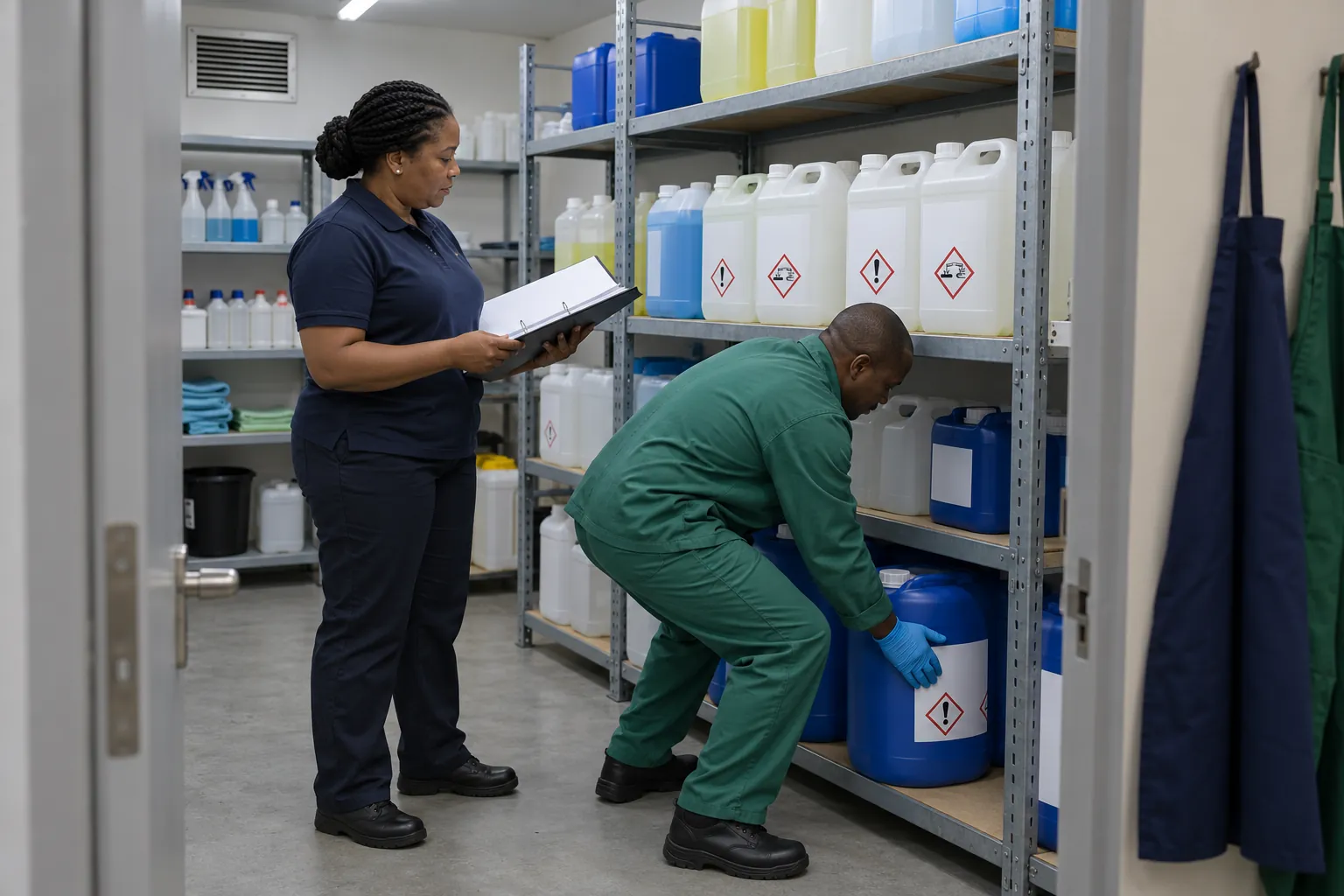 CleaningHazardous chemical agents: what the 2021 regulations mean for cleaning chemicalsWhat the Regulations for Hazardous Chemical Agents, 2021 require of cleaning chemicals: the assessment, the SDS file, labels, the store, training and records.
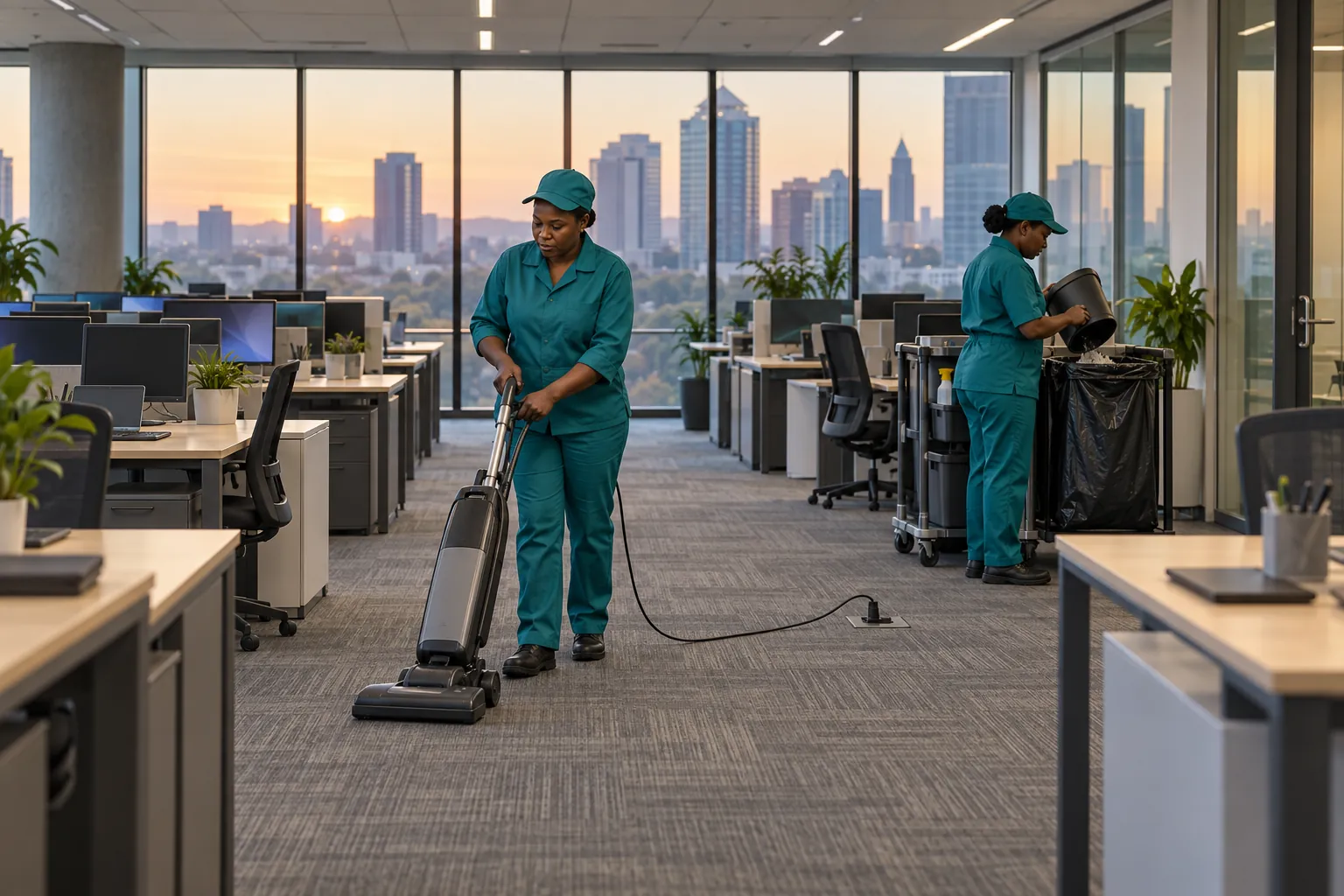 CleaningCleaning schedule: what to clean at work, how often, and how to show it was doneWhat a workplace cleaning schedule should cover in South Africa, which tasks are daily, weekly or monthly, who does what, and how to show the schedule was kept.