Cleaning
Hotel housekeeping checklist: room by room, for Canadian hotels
A hotel housekeeping checklist is the list of tasks a room attendant works through in each guest room, from stripping the linens and sanitizing the bathroom to restocking supplies, and the list a housekeeping supervisor inspects against before the room is released for sale.
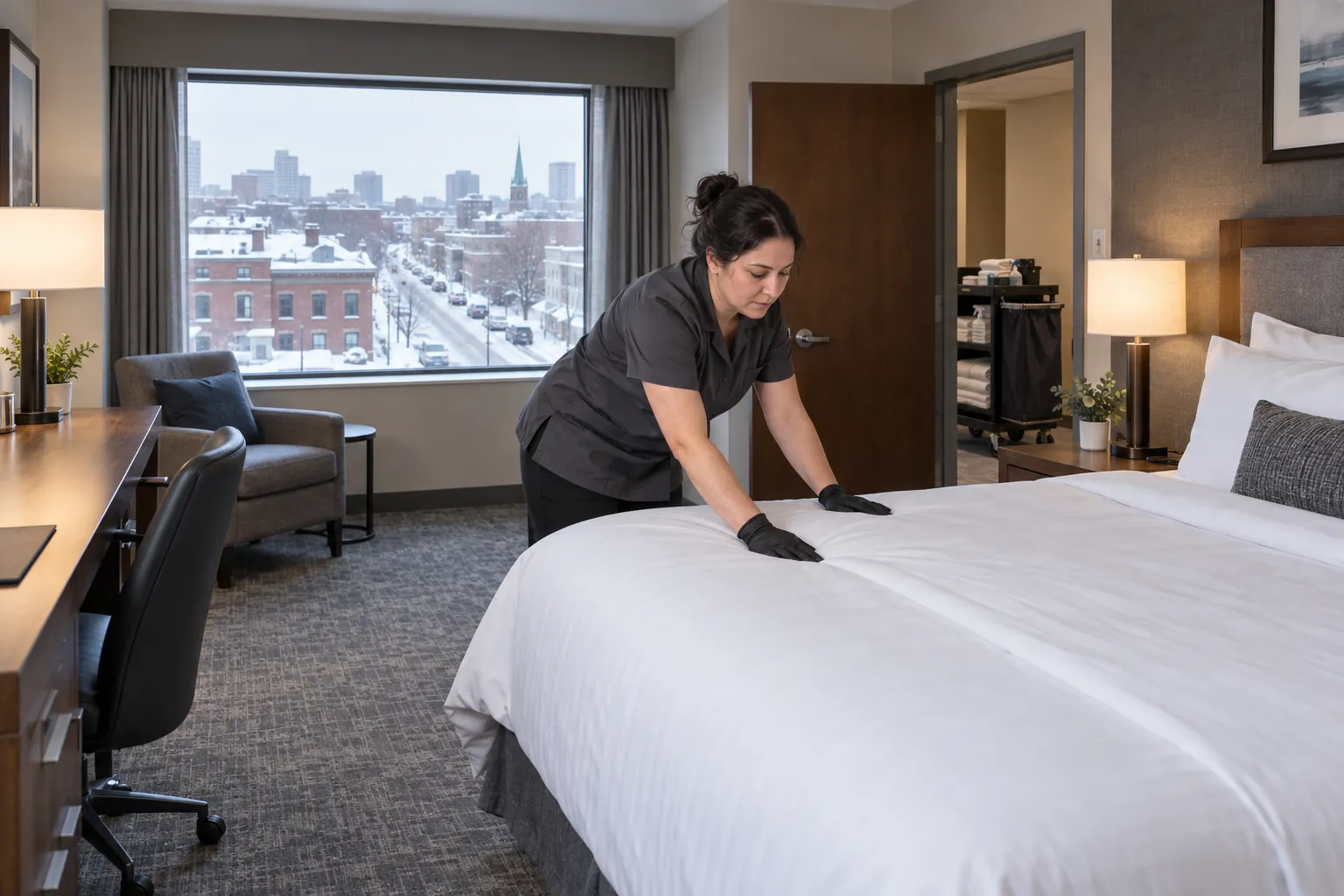
This guide sets out what the checklist should cover, room by room and area by area, the provincial health and safety rules that sit behind it, how to keep room attendants safe while they work through it, and how to check it is being followed.
01
The rules behind a hotel housekeeping checklist in Canada
No Canadian law requires a hotel housekeeping checklist by name. The checklist exists because a hotel sells a clean, safe room every night, and because the people who clean those rooms work under provincial occupational health and safety law like anyone else.
Workplace health and safety in Canada is mostly provincial. Each province and territory has its own act and regulations, and a hotel is almost always provincially regulated; federal rules apply only to federally regulated work, such as banks, airports and interprovincial transport.
Ontario. The Occupational Health and Safety Act defines an industrial establishment as "an office building, factory, arena, shop or office", and a shop as a building "where goods are handled, exposed or offered for sale or where services are offered for sale". A hotel fits that definition, which brings in Regulation 851 (Industrial Establishments). Section 11 requires that a floor or other surface used by any worker be "kept free of" obstructions, hazards and "accumulations of refuse, snow or ice", and not have "any finish or protective material used on it that is likely to make the surface slippery". Corridors lined with carts, soiled linen bags and room service trays are exactly what that section is about.
Ontario has also made cleaning a matter of record for washrooms provided for workers. Since 1 July 2025, section 25.3 of the Act has required an employer to ensure that those washroom facilities "are maintained in a clean and sanitary condition" and to "keep, maintain and make available records of the cleaning of washroom facilities as prescribed". O. Reg. 480/24, in force since 1 January 2026, says the record must include "the date and time of the two most recent cleanings of the washroom facility", posted in a conspicuous place in or near the washroom, or posted electronically where workers can access it, with direction on where and how. In a hotel this covers the staff washrooms and change rooms in the back of house, not the guest rooms.
British Columbia. Part 4 of the WorkSafeBC Occupational Health and Safety Regulation requires floors, stairs and walkways to be "maintained in a state of good repair and kept free of slipping and tripping hazards" (section 4.39) and says "refuse, spills and waste material must not be allowed to accumulate so as to constitute a hazard" (section 4.41). The same Part requires an employer to identify factors in the workplace that may expose workers to a risk of musculoskeletal injury (MSI) and to eliminate that risk or, where that is not practicable, minimize it (sections 4.47 and 4.50), which matters a great deal for room attendants. WorkSafeBC's page on the accommodation industry says that "over 50 percent of injuries in the accommodation industry involve room attendants (housekeeping staff)".
The other provinces and territories have their own acts and regulations with the same broad shape: keep the workplace clean and free of hazards, control the risks of the work, and train the people who do it. Check yours.
02
What a hotel housekeeping checklist covers
Most hotels need more than one list, because one that covers a departure, a stayover and the lobby washrooms is too long to use. Split it by the kind of work, each in the order the work is done:
- Check-out (departure) rooms: the full clean after a guest leaves, with a full linen change, a full bathroom clean and every amenity restocked. This is the list a supervisor inspects before the room goes back to vacant clean.
- Stayover (occupied) rooms: the lighter service for a guest who is staying on, following the hotel's policy on linen and towel changes and respecting a do not disturb sign or a guest's request to decline service.
- Guest bathrooms: often a separate block within each room list, because this is where guests notice first and complain most.
- Public areas: lobby, corridors, stairwells, public washrooms, fitness room, pool deck and breakfast area, usually a houseperson's round through the day.
- Back of house: linen rooms, housekeeping closets on each floor, the laundry, staff washrooms and change rooms, the loading dock and garbage room.
- Deep cleaning: periodic work such as rotating mattresses, washing drapes and shampooing carpets, on a rotation by room number.
Each list also needs a place to record what was found as well as what was done. A dripping faucet, a smoke alarm with its cover off, a torn carpet seam, a stained mattress or signs of pests are things a room attendant sees before anyone else. If the checklist has no line for them, they go unreported until a guest finds them.
03
The checklist, room by room
Adapt these to your brand standard and your rooms. A suite with a kitchenette needs the appliance lines; a limited-service property with no minibar does not. What follows is the core of a check-out room, the lines most hotels share.
- Beds: strip all linen and check the mattress protector, mattress seams and headboard area; remake with clean linen to the brand standard; check under the bed.
- Bathroom: clean and disinfect the toilet inside and out, including the base and hinges; clean the tub or shower, walls, grout, door or curtain and fixtures; clean the vanity, sink and mirror; empty the garbage; replace towels, bath mat, toilet tissue and amenities; clean the floor last, working toward the door.
- High-touch points: wipe and disinfect the surfaces every guest touches: door handles, light switches, the thermostat, telephone, TV remote, the safe keypad, hangers and the kettle or coffee maker. These are missed by a rushed clean.
- Dusting: top to bottom, from headboard and lamps to the desk, closet shelf, windows and window sills, and the heating and cooling unit.
- Glassware: remove used cups and glasses for proper washing, never rinse them in the guest bathroom sink.
- Restock: amenities, stationery, the guest directory and any in-room information the hotel requires; check that the emergency information on the back of the door is in place and legible.
- Floors: vacuum carpet, including edges and under furniture where it can be reached; mop hard floors in the entry and kitchenette.
- Final check: drapes and thermostat to the standard setting, a look from the doorway as a guest would see it, lights off, door locked, room status updated.
For a stayover, the daily service is shorter: bed and linen according to the hotel's program, used towels, bathroom, garbage, amenities and coffee, a tidy that leaves guest belongings where they are, and vacuuming where needed. Record a declined service or a do not disturb sign as a fact, not as a completed room.
For public areas, write the list as a timed round: lobby entrance and mats (several times a shift in winter, for salt and slush), elevator lobbies, corridors, ice and vending areas, stairwells, the fitness room and any pool deck. Lobby washrooms need their own washroom cleaning checklist.
04
Keeping room attendants safe while they work the list
A housekeeping checklist that ignores the physical cost of the work will be followed until the attendant is hurt. The CCOHS guide to hotel housekeeping puts it plainly: "A housekeeper changes body position every three seconds while cleaning a room." It describes the work as "moderately heavy" to "heavy", and lists the hazards: back, neck, shoulder and arm injuries, skin and breathing problems from cleaning products, infection from soiled linen, uncapped needles and body fluids, slips, trips and falls, fatigue, working alone and workplace violence.
Build the controls into the list and the equipment rather than leaving them to a poster in the linen room:
- Order of work. CCOHS advises planning the workload to "do the heavier tasks at the beginning of the workshift, rather than at the end, when fatigue is at its maximum." Where the room assignment allows, put check-outs early.
- Tools. "Use long handled tools such as dusters and mops to avoid bending and stretching." CCOHS also recommends lighter vacuums and service carts with wheels designed for carpeted floors, kept in good repair.
- Workload. The number of rooms per attendant, and the mix of check-outs and stayovers, drives the risk as much as any single task. Under British Columbia's MSI rules the employer has to identify and control the risk factors, and section 4.49 names the organization of work among them, including "work-recovery cycles", "task variability" and "work rate"; a room quota sets the work rate.
- Chemicals. Every cleaning product on the cart needs a supplier label and a safety data sheet under WHMIS, and attendants need training on them. The CCOHS page on working safely with cleaning products says "products containing bleach and ammonia must never be mixed". A hard-surface disinfectant needs a drug identification number; Health Canada's guidance documents on disinfectants say such products "require a pre-market assessment and a drug identification number (DIN)". Put the DIN of the product you use on the checklist.
- Sharps. CCOHS on needlestick injuries warns that, when not disposed of properly, "needles can hide in linen or garbage", and recommends "not carrying garbage or linen bags close to the body". Its hotel housekeeping guide advises having "a sharps disposal container on the cart for needles and sharps". Train attendants never to push down on a garbage bag and to report every needlestick at once.
- Working alone and violence. A room attendant inside a guest room is often out of sight and out of earshot. CCOHS on working alone says "it is important that a check-in procedure be in place". In Ontario, section 32.0.1 of the Act requires written policies on workplace violence and workplace harassment, reviewed at least annually, and section 32.0.2 requires a program that includes "measures and procedures for summoning immediate assistance when workplace violence occurs or is likely to occur". The checklist's rules on entering an occupied room, and on leaving when a guest behaves inappropriately, belong to that program.
05
Inspecting rooms and checking the checklist is followed
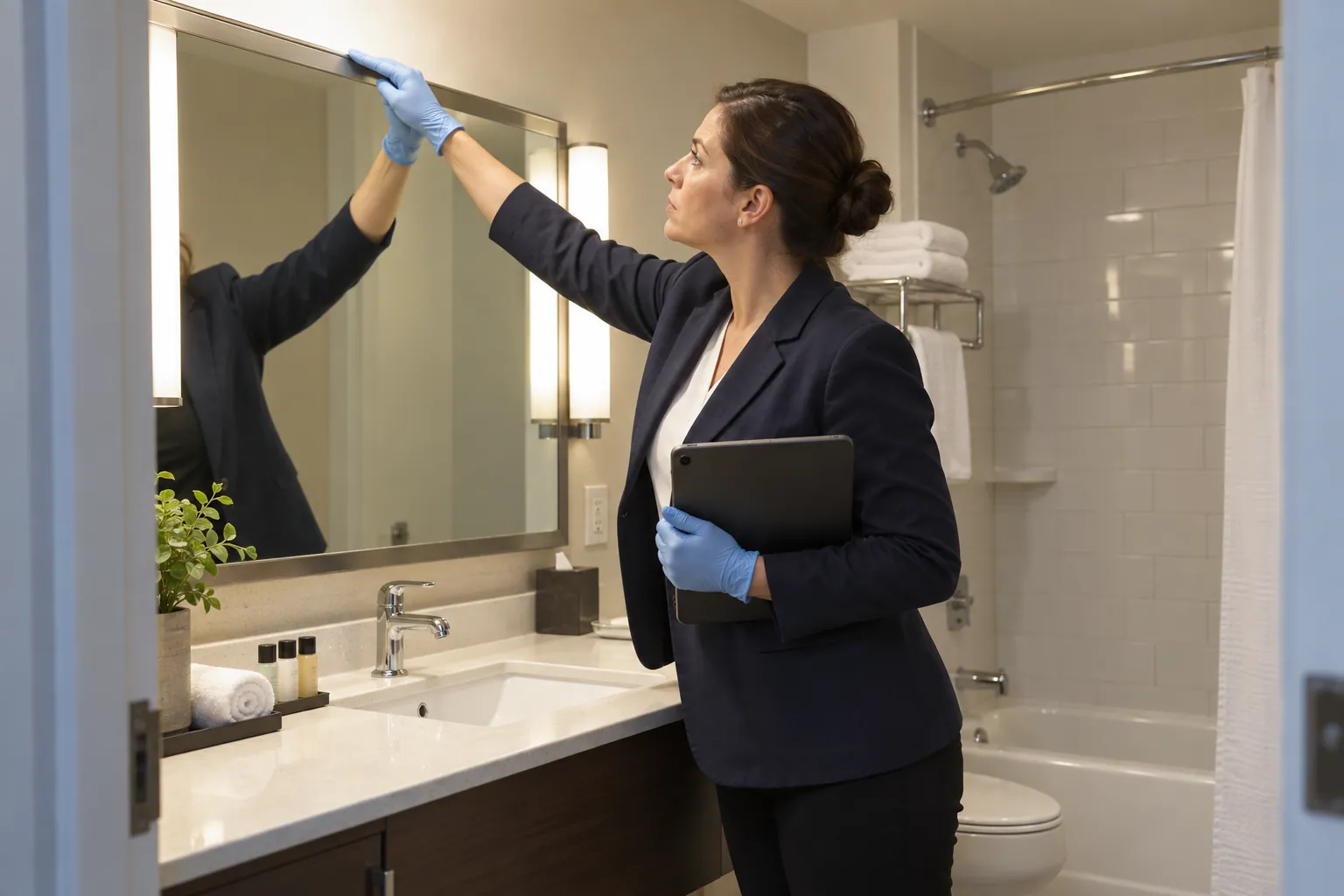
In a well-run hotel, a room is not sold again until it has been inspected. A housekeeping supervisor or floor supervisor walks the room against the same checklist the attendant used, and either releases it as vacant and inspected or sends it back for a re-clean. That inspection is the most direct form of janitorial quality control the trade has, and the checklist makes it consistent from one supervisor to the next.
Good practice in an inspection program:
- Inspect against the list, not a memory of it, the same lines in the same order, recording which failed.
- Inspect every check-out room where you can, and where you cannot, a sample per attendant, with every room for new attendants and rooms that failed recently.
- Look where guests look, such as hair in the bathroom or dust on the headboard, then where they do not: under the bed and behind the door.
- Track re-cleans by attendant and by line: they show who needs coaching and which lines cannot be finished in the time allowed.
- Close the loop on maintenance. Every repair an attendant reports should reach engineering as a work order with the room number, and come back closed.
Guest comments arrive late and say little about which line failed. The inspection record, the re-clean rate and the time a reported fault takes to fix are what a housekeeping manager can act on the same week, and a supervisor who carries out the janitorial supervisor's duties, inspecting, coaching and following up,, coaches and follows up is what turns a checklist that is filled in into one that is followed. Review the list after any change to the rooms, products or brand standard, and ask attendants which lines they skip when short of time, and why.
06
Where the housekeeping record fails, and what SiteClara does about it
The housekeeping record has two familiar weak points. The first is the back of house and the public areas: the staff washroom sheet signed in advance for the whole day, the lobby washroom round written up at the end of the shift. The second is what attendants find: a broken faucet mentioned to whoever was passing, or written on a room sheet nobody reads until morning, becomes a guest complaint before it becomes a work order.
SiteClara puts a printed QR poster at each location that needs a check, such as a staff washroom, a lobby washroom, a linen room or the pool deck, with an optional NFC tag behind it. A member of the team scans the code or taps the tag on their own phone, with no app to install, and sees the scheduled checks due at that location. They mark each one done, or explain what stopped them, and can add a photo. The time and the person are recorded as it happens. A problem found on the round can be reported there and goes onto the team's list of jobs until someone closes it.
The supervisor sees what is due, done and missed across the building, can record the reason a check was missed, and sees open jobs grouped by building and floor. At the end of the day they review the totals and photos, add a note and approve the report, which goes to nominated management or client contacts at 8 a.m. the next morning, showing what was completed, what is still open and how scheduled checks went, for example 14 of 14 completed.
07
Questions people ask
What are the typical daily checklists for housekeeping?
In a hotel, one for check-out rooms, one for stayovers, and rounds for the public areas and back of house. The CCOHS guide to hotel housekeeping lists the tasks a housekeeper carries out, which those lists are built from: making beds, tidying rooms, cleaning and polishing toilets, taps, sinks, bathtubs and mirrors, washing floors, removing stains and vacuuming.
What are the 7 rules of housekeeping?
No Canadian regulator publishes a set of seven rules, or five golden ones. The CCOHS Workplace Housekeeping – Basic Guide lists the elements of an effective housekeeping program instead: maintenance, dust and dirt removal, employee facilities, surfaces, light fixtures, aisles and stairways, spill control, tools and equipment, waste disposal and storage. It adds that "effective housekeeping is an ongoing operation: it is not a one-time or hit-and-miss cleanup done occasionally."
08
Further reading, and a list to take away
Start with your own province's act and regulation, then the CCOHS guide to hotel housekeeping. In British Columbia, WorkSafeBC's accommodation industry page links to its room attendant safety videos. In Ontario, read the page on maintaining clean washroom facilities for workers, and for public areas the commercial cleaning checklist.
Before you hand a hotel housekeeping checklist to your team, check that it:
- is split into check-out rooms, stayovers, public areas and back of house;
- follows the order the work is done, and starts with entering the room safely;
- names each product and its DIN, with a safety data sheet for each under WHMIS;
- puts a sharps container on every cart and says what to do if one is found;
- has a line for faults, damage, pests and lost items, and says who they go to;
- records a declined service or do not disturb as a fact, not a completed room;
- in Ontario, keeps the staff washroom cleaning record the regulation requires;
- can be done properly in the number of rooms each attendant is given;
- is inspected by someone other than the person who cleaned the room.
Sources
Every document this guide quotes or links to, in the order it first cites them.
- Occupational Health and Safety Act ontario.ca
- Regulation 851 (Industrial Establishments) ontario.ca
- O. Reg. 480/24 ontario.ca
- WorkSafeBC Occupational Health and Safety Regulation worksafebc.com
- Accommodation industry worksafebc.com
- Hotel housekeeping ccohs.ca
- WHMIS ccohs.ca
- Working safely with cleaning products ccohs.ca
- Guidance documents on disinfectants canada.ca
- Needlestick injuries ccohs.ca
- Working alone ccohs.ca
- Workplace Housekeeping – Basic Guide ccohs.ca
- Maintaining clean washroom facilities for workers ontario.ca
Related guides
 CleaningCommercial cleaning checklist: area by area, for Canadian buildingsA commercial cleaning checklist for Canadian offices and shared buildings, area by area, with the provincial rules behind it, what to record and how to check it.
 CleaningWashroom cleaning checklist: what to check, how often, and Ontario's new cleaning recordsWhat a workplace washroom cleaning checklist should cover, how often to clean, and Ontario's posted cleaning records required since January 1, 2026.
 CleaningJanitorial quality control: how to inspect, correct and show the standard heldHow janitorial quality control works in Canada: QA versus QC, inspections, sampling, corrective action, CIMS, the PIDAC audit model and records that hold up.
 CleaningJanitorial supervisor duties: what the role involves in Canada, and what good looks likeWhat a janitorial or cleaning supervisor does in Canada: the main duties, a typical shift, the legal duties of a supervisor, WHMIS, checking the work and reporting.