Premises and facilities management
Facility management KPIs: which to set, how to define them, and how to keep them honest
Facility management KPIs (key performance indicators) are the short list of measures, each with a target, that show whether a building and the services that run it are performing, such as regulated inspections completed on time, preventive maintenance completed on schedule, service requests fixed within the agreed time, occupant satisfaction and operating cost per square foot.
Also written for United Kingdom · United States

No Canadian statute lists them: the owner and the facility services provider choose them, usually in the contract. Chosen well, five to ten of them tell a facility manager where to look. Chosen badly, they reward closing work orders rather than fixing faults. This guide covers the KPIs worth setting in a Canadian building, the provincial fire code and workplace safety duties behind the compliance measures, how to define each KPI so that it can be checked, and the records it has to stand on.
01
What facility management KPIs are, and where they come from
A key performance indicator is a measure chosen because it shows whether something that matters is being achieved: a metric with a purpose and a target. In facility management, KPIs track the operational services that keep a building running, such as maintenance, janitorial, security and the help desk, and whether the building itself is compliant, available and affordable to run.
Facility managers use them to see, month by month, where operations are slipping and where effort will improve them most. A dashboard of fifty metrics does not do that; a handful of measures, each with a target and an owner, does.
KPIs are not the same as service levels. A service level agreement sets the standard for each piece of work, such as an urgent leak attended within two hours; a KPI measures how often those standards are met, or tracks something broader, such as occupant satisfaction or cost per square foot.
There is no statutory list of facility management KPIs in Canada, federally or in any province. The nearest thing to a framework is international. ISO 41001:2018, Facility management – Management systems – Requirements with guidance for use applies, in ISO's words, when an organization "needs to demonstrate effective and efficient delivery of FM that supports the objectives of the demand organization". Its requirements are "non-sector specific" and follow the Plan-Do-Check-Act method, so measuring performance is part of the system, but the measures are the organization's own. ISO amended it in 2024 for climate action, and a revision is under way. ISO 41012:2017, Facility management – Guidance on strategic sourcing and the development of agreements gives guidance on sourcing and on the development processes and structures of typical agreement models, and the agreement is where most KPIs end up written down.
Some KPIs, though, measure duties the law does set. Fire safety inspections and tests come from the provincial or territorial fire code, most adopted from or modelled on the National Fire Code of Canada 2025, a model code published by the National Research Council. Workplace inspections come from provincial occupational health and safety law, or the Canada Labour Code for federally regulated workplaces. This guide uses Ontario as the main example, with British Columbia and federal workplaces where they differ; check your own province or territory, and use the French-language sources in Quebec.
02
Facility management KPIs worth setting
These facility management KPI examples are grouped by what they tell you. No building needs all of them, and a laboratory, an arena and a condominium need different measures. Most are operational metrics drawn from day-to-day records; the cost, energy and water measures show efficiency.
- Regulated inspections and tests on time: every inspection and test the fire code, OHS law and other regulations require, done by its due date, by building, with deficiencies corrected within an agreed time.
- Preventive maintenance compliance: preventive maintenance work orders completed within their scheduled window, as a share of those due.
- Planned to reactive ratio: the balance of planned and reactive maintenance work. A rising share of reactive work often means preventive maintenance is being skipped or equipment is aging.
- Response and completion times: service requests attended and completed within target, by priority, reported separately.
- First-time fix and repeat faults: jobs fixed on the first visit, and faults that return on the same equipment or at the same location within a set period, such as 30 days.
- Mean time to repair (MTTR) and mean time between failures (MTBF): how long critical equipment, such as a boiler, a chiller or an elevator, takes to bring back into service, and how long it runs between breakdowns.
- Backlog: open work orders, and the age of the oldest.
- Availability and downtime: how long heating, cooling, elevators or the building automation system are out of service, and how often.
- Help desk: requests acknowledged, requesters kept informed, and requests closed only when the requester agrees the problem is fixed.
- Janitorial and security delivery: scheduled cleans, checks and patrols completed as the scope of work says, alongside inspection scores for quality. Cleaning KPIs covers the janitorial measures in detail.
- Health and safety: injuries and near misses on the premises, workplace inspection findings closed, and committee recommendations answered on time.
- Occupant satisfaction: feedback when a request closes, and a short survey once or twice a year.
- Cost, energy and water: operating spend against budget, maintenance cost per building, and operating cost, energy and water use per square foot against the same month last year.
For maintenance, five KPIs cover most of what an owner needs: preventive maintenance compliance, the planned to reactive ratio, response and completion times by priority, first-time fix, and the size and age of the backlog. Add MTTR and MTBF for the few pieces of equipment the building cannot do without.
Say which floor area a per-square-foot KPI uses. In Ontario, O. Reg. 506/18, Reporting of Energy Consumption and Water Use, made under the Electricity Act, 1998, defines gross floor area as "the total number of square feet measured between the principal exterior surfaces of the enclosed fixed walls", and the owner of a prescribed property of at least 50,000 square feet, other than a public agency, reports energy and water use through ENERGY STAR Portfolio Manager "no later than July 1 in the following year". An energy KPI on the same basis makes that report a check.
03
Compliance KPIs: where provincial law sets the clock
Compliance is the KPI an owner relies on most, and the one most often reported loosely: "98% compliant" averages a missed fire alarm inspection in with dozens of routine checks. Report it as exceptions, item by item and building by building, and build it on the evidence the law already requires.
In Ontario, Division B, Article 1.1.2.1 of the Ontario Fire Code, O. Reg. 213/07 says that if the code requires tests and corrective measures or operational procedures, "records shall be made noting what was done and the date and time it was done", retained at the building for the Chief Fire Official; electronic records that can be made readily available on request are deemed to comply. Article 1.1.2.2 keeps each record for at least two years, so that at least the most recent and the immediately preceding record of a given test or inspection are on hand. Sentence 1.1.1.2.(3) says a device that does not operate or appear to operate as intended when checked, inspected or tested "shall be repaired or replaced" if its failure would adversely affect fire or life safety. That gives two honest fire safety KPIs: each required inspection and test done on time, with its record; and each deficiency repaired, with the date.
The frequencies come from the code and the standards it calls up. Portable extinguishers "shall be inspected monthly" (Article 6.2.7.2), and a fire alarm system is inspected and tested in conformance with CAN/ULC-S536 (Article 6.3.2.2). The building compliance checklist and the fire safety log book list the rest, one row and one due date each.
Workplace safety gives a second set of clocks. Under the Ontario Occupational Health and Safety Act, the designated member of the joint health and safety committee "shall inspect the physical condition of the workplace at least once a month" (subsection 9 (26)), or, where that is not practical, the whole workplace at least once a year with part of it each month (subsection 9 (27)); subsections 8 (6) and (7) say the same of a health and safety representative. An employer who receives written recommendations from the committee "shall respond in writing within twenty-one days" (subsection 9 (20)). The JHSC workplace inspection done each month, and every recommendation answered within 21 days, are both countable. Since July 1, 2025, section 25.3 has required an employer to keep the washroom facilities it provides for workers clean and sanitary, and to "keep, maintain and make available records of the cleaning of washroom facilities as prescribed"; since January 1, 2026, O. Reg. 480/24 has required that record to show the date and time of the two most recent cleanings. See the washroom cleaning checklist.
In British Columbia, section 3.5 of the Occupational Health and Safety Regulation, Part 3 requires regular inspections of all workplaces, "including buildings, structures, grounds", at intervals that will prevent the development of unsafe working conditions, and section 3.9 says unsafe or harmful conditions found "must be remedied without delay". In a federally regulated workplace, paragraph 125(1)(z.12) of the Canada Labour Code requires the employer to ensure the work place committee or the health and safety representative "inspects each month all or part of the work place, so that every part of the work place is inspected at least once each year".
04
Defining each KPI so that it can be checked
A KPI that two people would calculate differently from the same data is an argument waiting for the monthly meeting. Write each one down:
- the name, and the question it answers;
- how it is calculated, including what is left out, such as requests cancelled by the requester;
- when the clock starts and stops, and the only reasons it may pause;
- the data source, and who besides the person reporting it can inspect it;
- how often it is measured and reported;
- the target, the threshold that triggers action, and the owner.
Then check the set as a whole. Input measures, such as hours on site, say little about results. Output measures, such as work orders closed, show delivery and can be met by doing the work badly. Outcome measures, such as equipment available and occupants satisfied, matter most and are hardest to measure. Pair measures that pull against each other: speed of fix with first-time fix, preventive maintenance compliance with the planned to reactive ratio, cleans completed with janitorial quality control scores.
Health and safety measures need the same balance. CCOHS's guidance on leading and lagging indicators describes lagging indicators as "a record of what has happened", such as injury frequency and severity, lost-time injuries and near misses, and leading indicators as "proactive, preventative, and predictive measures taken to identify and eliminate hazards in the workplace", such as the frequency of safety audits. It warns that "not all incidents or injuries are reported", and that many workplaces have too few injuries to tell real trends from chance.
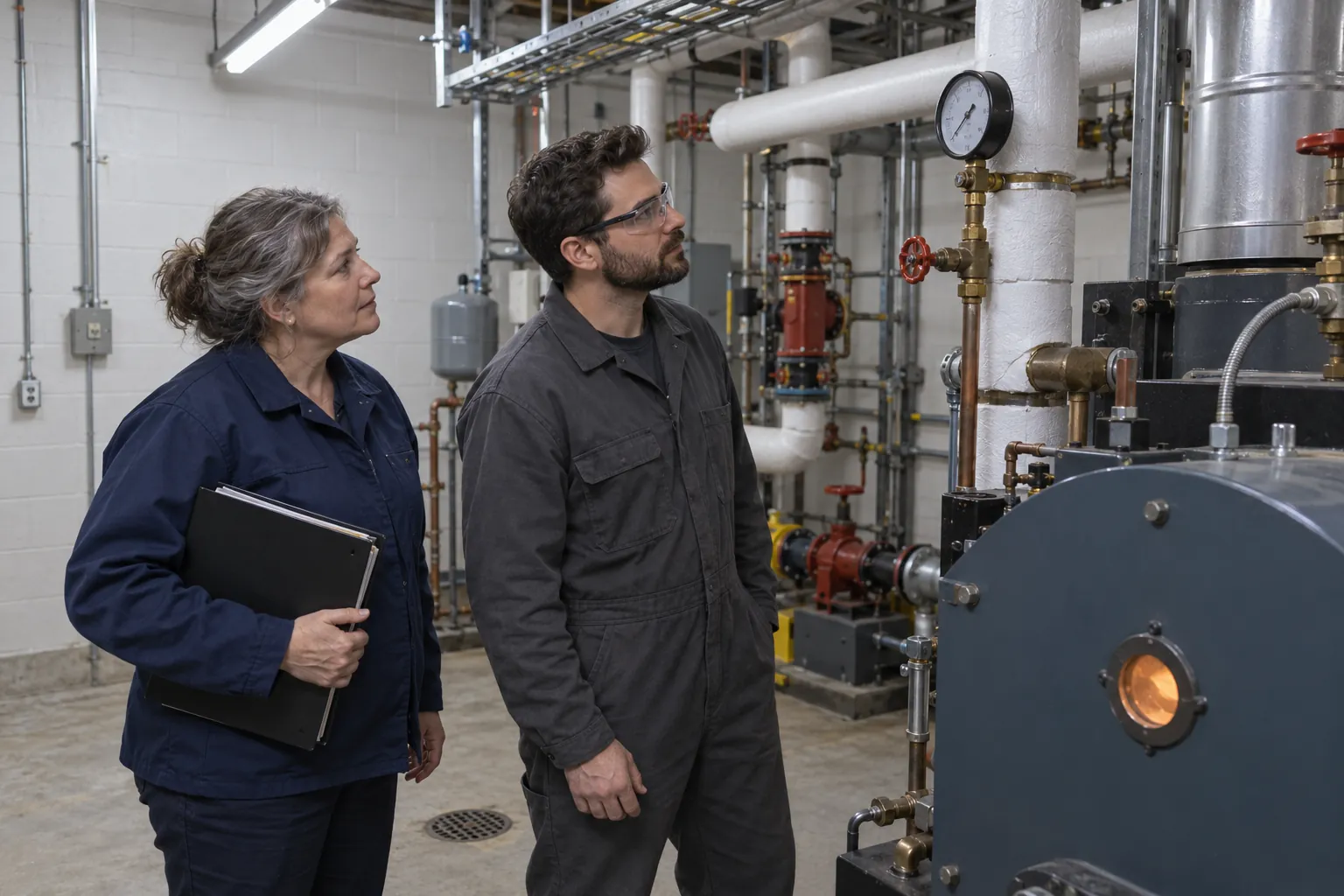
Every KPI needs a data source both sides trust: the computerized maintenance management system (CMMS) for work orders, the help desk log, inspection reports for compliance, utility bills for energy, audit scores for quality, and the records of routine checks and patrols.
05
Targets, reporting, and keeping KPIs honest
Once a measure becomes a target, people change what they do to meet it, not always as intended. Response times improve because jobs are closed before the fault is fixed, preventive maintenance compliance rises because work orders are signed off without the work, and an inspection score climbs because the route is known in advance.
The defences are simple. Pair each speed measure with a quality measure, count reopened and repeat jobs, let the requester confirm a job is done before it closes, and sample completed work orders each month. Report exceptions as well as percentages, and make sure the person reporting a KPI is not the only one who can see the data behind it.
Keep the set small: five to ten core KPIs, reported monthly, are easier to act on than forty. Show each over at least six months so that a slow slide is visible, and compare winter with last winter, not with the summer. The facility management report guide covers presenting them each month. Review the set once a year, and stop tracking any KPI that has not changed a decision.
06
Where the record fails, and what SiteClara does about it
Maintenance KPIs usually rest on CMMS data with timestamps. Janitorial and security KPIs often do not: "scheduled cleans completed" or "patrols completed as per post orders" come from sheets signed at the end of the shift, or are reported as 100% because nobody wrote down a miss. A KPI with no record behind it cannot be audited.
SiteClara records that routine work where it happens. A printed QR poster at each location, with an NFC tag behind it if staff prefer to tap, lets janitorial, security or building staff scan with their own phone, with no app to install. They see the scheduled checks due there and mark each one done, or explain what stopped them, with a photo when one is asked for. An issue reported there goes onto the team's list of jobs until someone closes it.
The supervisor sees what is due, done and missed, and records the reason a check was missed. Each day the supervisor approves a daily report that goes to nominated management or client contacts at 8 a.m. the next morning, showing what was reported, completed and still open, and how the scheduled checks went, for example 12 of 12 completed. A month of those reports is a record a janitorial or security delivery KPI can be built on, and checked against.
07
Questions people ask
What is a KPI in facility management?
A KPI in facility management is a measure, with a target, of whether the buildings and the services that run them are delivering what the organization needs, such as inspections done on time, faults fixed within the agreed time or occupants satisfied. The Treasury Board's Guide to portfolio management and the real property portfolio strategy sets a good test for any of them: targets must "be specific and measurable", "be informed by baseline data" and "fall within the custodian's accountabilities", and the plan should say how each KPI will be measured, how often, and who the results will be reported to.
What are the 5 key performance indicators?
There is no single list of five, but the Government of Canada watches five aspects of its own buildings. Subsection 4.2.4 of the Treasury Board Directive on the Management of Real Property makes real property practitioners in a custodian department responsible for monitoring "the functionality, utilization, and physical, environmental and financial performance of real property assets over their life-cycle". How well a building suits its use, how intensively it is used, its condition, its environmental performance and its cost make a sound frame for any portfolio's KPIs.
What are the 11 core competencies of a facility manager?
IFMA, the International Facility Management Association, sets out 11 competency areas in its Certified Facility Manager (CFM) Candidate Handbook, as "the core areas of skills and knowledge necessary for a successful facility manager": occupancy and human factors; operations and maintenance; sustainability; facility information management and technology management; risk management; communication; performance and quality; leadership and strategy; finance and business; real estate; and project management.
08
Further reading, and a list to take away
For the duties behind the compliance KPIs, go to your own province or territory: in Ontario, the Ontario Fire Code and the Occupational Health and Safety Act; in British Columbia, Part 3 of the OHS Regulation; for federally regulated workplaces, Part II of the Canada Labour Code. ISO 41001 and ISO 41012 cover the management system and the agreement, and CCOHS explains leading and lagging indicators.
Before you agree a set of facility management KPIs, check that:
- regulated inspections and tests are reported item by item and building by building, not only as a percentage;
- every deficiency stays on the list until the repair is recorded;
- speed measures are paired with quality measures, and reopened jobs are counted;
- every KPI has a written definition, a data source, an owner and a target;
- per-square-foot measures say which floor area they use;
- janitorial and security figures come from records made at the time, not end-of-shift sheets;
- there is a date to review the set and drop what is not used.
Sources
Every document this guide quotes or links to, in the order it first cites them.
- ISO 41001:2018, Facility management – Management systems – Requirements with guidance for use iso.org
- ISO 41012:2017, Facility management – Guidance on strategic sourcing and the development of agreements iso.org
- National Fire Code of Canada 2025 nrc.canada.ca
- O. Reg. 506/18, Reporting of Energy Consumption and Water Use ontario.ca
- Ontario Fire Code, O. Reg. 213/07 ontario.ca
- Occupational Health and Safety Act ontario.ca
- O. Reg. 480/24 ontario.ca
- Occupational Health and Safety Regulation, Part 3 worksafebc.com
- Canada Labour Code laws-lois.justice.gc.ca
- Leading and lagging indicators ccohs.ca
- Guide to portfolio management and the real property portfolio strategy tbs-sct.canada.ca
- Directive on the Management of Real Property tbs-sct.canada.ca
- Certified Facility Manager (CFM) Candidate Handbook ifma.org
Related guides
 Premises and facilities managementFacility management report: what to include, and what makes it believableWhat a facility management report in Canada should contain: fire code and OHS compliance, maintenance, KPIs, costs and energy, and the records behind them.
 CleaningCleaning KPIs: what to measure in a janitorial contract, and how to know the figures are trueThe cleaning KPIs worth measuring in a Canadian janitorial contract, how to define and target them, how to report them, and how a green dashboard can mislead.
 Premises and facilities managementPreventive maintenance checklist: what to include, how often, and how to show it was doneA preventive maintenance checklist for Canadian buildings: what the fire code and provincial law require, what to include, how often, and the records to keep.
 Premises and facilities managementReactive maintenance: how to run it well, and keep it in proportionHow to run reactive maintenance in a Canadian building: priorities and response times, the Ontario and BC rules, contractors, costs and closing the loop.