Premises and facilities management
Building compliance checklist: the statutory picture for a UK building
A building compliance checklist lists the legal duties that come with owning, managing or occupying a UK non-domestic building, each under its own law: fire safety, electrical and gas safety, water hygiene (legionella), asbestos, lifts, pressure systems, accessibility and energy.

This checklist sets out each duty, who holds it, how often the work is usually done and where the evidence should live.
01
Who is responsible for building compliance
There is no single building compliance law. Each duty comes from its own legislation and falls on its own duty holder, which is why compliance gaps usually sit between people rather than within one role. The main duty holders are:
- The employer, under the Health and Safety at Work etc. Act 1974 and the regulations made under it, for the safety of employees and others affected by the work.
- The responsible person for fire safety: under the Regulatory Reform (Fire Safety) Order 2005 in England and Wales, usually the employer or whoever controls the premises. Scotland (the Fire (Scotland) Act 2005) and Northern Ireland (the Fire Safety Regulations (Northern Ireland) 2010) have their own legislation with similar duties.
- The duty holder for asbestos in non-domestic premises, under the Control of Asbestos Regulations 2012: whoever has responsibility for maintenance and repair, often set by the lease.
- Anyone in control of premises, such as a landlord or managing agent of a multi-let building, for the common parts and shared plant.
In a building with a landlord and tenants, the lease decides who maintains what, but it cannot remove a legal duty. More than one person can hold the same duty, and they are expected to co-operate. Building owners, property managers and facilities managers often share these duties in one building. A building compliance checklist is most useful when it names, for every item, who is responsible, who does the work and who holds the certificate.
Northern Ireland has its own versions of most health and safety regulations, enforced by HSENI, and Scotland has its own fire and energy performance rules. Check the rules for the nation your building is in.
02
The building compliance checklist at a glance
For a typical UK non-domestic building, the statutory compliance checklist covers:
- Fire safety: a fire risk assessment, and the maintenance and testing of fire alarms, emergency lighting, fire doors, extinguishers and any sprinklers, dry risers or smoke control.
- Electrical safety: periodic inspection and testing of the fixed installation, and inspection of portable equipment according to risk.
- Gas safety: where gas is used, safe appliances, flues and pipework, maintained by Gas Safe registered engineers.
- Water hygiene: a legionella risk assessment and the control measures it identifies.
- Asbestos: in buildings built before 2000, an asbestos register and management plan.
- Lifts and lifting equipment: thorough examination by a competent person.
- Pressure systems: a written scheme of examination, where boilers, calorifiers, compressors or similar systems are installed.
- Ventilation and extraction: local exhaust ventilation examined and tested, where fitted.
- Accessibility: reasonable adjustments for disabled people.
- Energy: an Energy Performance Certificate where required, minimum energy standards for let buildings, and air conditioning inspections.
- Workplace basics: welfare facilities such as toilets and washing facilities, first aid, accident reporting, and the health and safety risk assessment.
Use it as a template for your own register rather than a complete list: a building with a commercial kitchen, a swimming pool or industrial processes will have more. The sections below take each in turn. The frequencies given are the usual ones; your risk assessments, written schemes and competent contractors set the actual ones for your building.
03
Fire safety compliance
Fire protection and life safety are the part of building compliance most often inspected, by the fire and rescue authority, and the one with the most frequent routine tasks.
- Fire risk assessment: carried out by a competent person, recorded, and reviewed regularly and whenever the building, its use or its occupants change. In England and Wales, since 1 October 2023, amendments made to the Fire Safety Order by section 156 of the Building Safety Act 2022 require every responsible person to record the fire risk assessment in full, including all its findings, and the fire safety arrangements for the premises. In England, the government's guidance on section 156 adds that the record must include the name of anyone engaged to carry out or review the assessment, or their organisation.
- Fire alarm: a weekly test from a rotating call point, and inspection and servicing by a competent person, usually at intervals of no more than six months under BS 5839-1. See our guide to the weekly fire alarm test.
- Emergency lighting: a monthly functional test and an annual full-duration test under BS 5266-1, recorded in the emergency lighting log book.
- Fire doors: routine checks that they close, latch and are undamaged, with more detailed inspection at a frequency the fire risk assessment sets. See fire door checks.
- Fire extinguishers: a monthly visual check and an annual service by a competent person under BS 5306-3. See fire extinguisher checks.
- Escape routes: kept clear, with exits that open easily and fire safety signage that is visible, checked daily in most buildings.
- Training and drills: staff trained, fire marshals or wardens appointed where the plan needs them, and evacuation drills held at least annually in most workplaces.
In England, residential buildings with two or more homes, including mixed-use buildings, have further duties under the Fire Safety (England) Regulations 2022, and higher-risk buildings (in England, buildings of at least 18 metres or seven storeys with at least two homes) have additional duties under the Building Safety Act 2022, overseen by the Building Safety Regulator. Our guide to fire safety checks in the workplace covers the routine checks in more detail.
04
Electrical, gas, water, asbestos, lifts and pressure systems
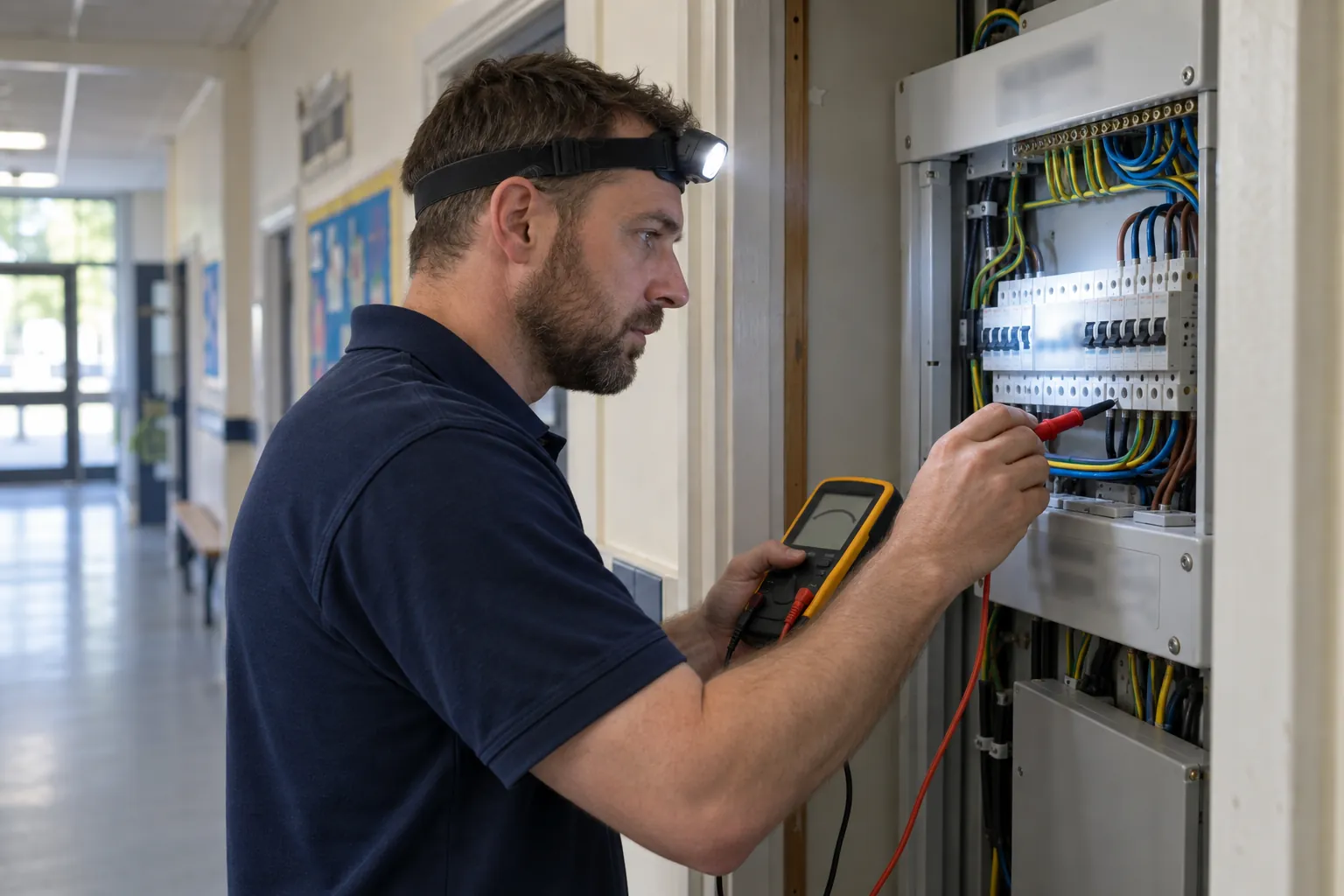
- Electrical installation: the Electricity at Work Regulations 1989 require electrical systems to be maintained so far as reasonably practicable to prevent danger. The usual evidence is an electrical installation condition report (EICR) to BS 7671. There is no single statutory interval for non-domestic premises: the inspector recommends the next date. Electrical Safety First, the electrical safety charity, recommends periodic inspection and testing at least every 5 years for a business, and every year for a swimming pool; these are recommendations, not legal intervals. Portable appliances are inspected and tested according to risk.
- Gas: under the Gas Safety (Installation and Use) Regulations 1998, gas appliances, flues and pipework must be maintained in a safe condition, and gas work must be done by a Gas Safe registered engineer. An annual service and safety check is the usual practice. Landlords of let homes have a specific duty to carry out an annual gas safety check.
- Water hygiene: under health and safety law and the COSHH Regulations, the duty holder must assess and control the risk from legionella, following the HSE Approved Code of Practice L8 and its technical guidance HSG274. That means a legionella risk assessment by a competent person, a named responsible person, a written control scheme and routine monitoring such as temperature checks and flushing. See legionella checks.
- Asbestos: in non-domestic premises, the Control of Asbestos Regulations 2012 place a duty to manage asbestos: find out whether it is present, keep an up-to-date asbestos register and management plan, check the condition of known materials, and tell anyone who might disturb it, including contractors. A refurbishment and demolition survey is needed before intrusive work.
- Lifts: under the Lifting Operations and Lifting Equipment Regulations 1998 (LOLER), lifts that carry people must be thoroughly examined by a competent person at least every six months, or at intervals set by a written scheme of examination. The report of thorough examination is separate from the lift contractor's routine maintenance.
- Pressure systems: under the Pressure Systems Safety Regulations 2000, systems such as larger boilers, calorifiers and air receivers need a written scheme of examination drawn up by a competent person and examinations carried out in line with it.
- Local exhaust ventilation: under the COSHH Regulations, thorough examination and testing, generally at least every 14 months.
05
Accessibility, energy, and where the certificates live
Accessibility. In England, Scotland and Wales, the Equality Act 2010 requires employers and service providers to make reasonable adjustments so that disabled people are not put at a substantial disadvantage, which can include physical features of a building. Northern Ireland has its own disability discrimination legislation. An access audit is not a legal requirement, but it is the usual way to find out what adjustments are needed. New building work must also meet the accessibility requirements of the building regulations, checked through building control, by the local authority's building control department or a private registered building control approver.
Who checks compliance with building regulations?
In England and Wales, compliance with the building regulations is checked by a building control body: either the local authority's building control department or a private registered building control approver, chosen by the person having the work done. For higher-risk buildings in England, those at least 7 storeys or 18 metres high that have at least two residential units or are a hospital or care home, the Building Safety Regulator oversees and approves the building work instead (GOV.UK's guidance on building control approval for higher-risk buildings). Scotland and Northern Ireland have their own rules.
Energy. In England and Wales, an Energy Performance Certificate (EPC) is needed when a building is constructed, sold or let, and is valid for ten years. Let non-domestic buildings must meet the minimum energy efficiency standard, currently an EPC rating of E or better unless an exemption is registered. Larger air conditioning systems need an energy inspection every five years, and some public buildings must display a Display Energy Certificate. Scotland has its own energy performance regulations.
Workplace basics. Adequate welfare facilities under the Workplace Regulations 1992, first aid arrangements, accident and incident reporting under RIDDOR, employers' liability insurance, and a health and safety risk assessment under the Management of Health and Safety at Work Regulations 1999.
Where the certificates live. Every item above produces evidence: a risk assessment, a certificate, a report or a log book entry. Competence matters here too: each certificate is only as good as the person who issued it, so keep a note of their qualification or registration alongside it. The problem is rarely that the evidence does not exist; it is that nobody can find it when asked. A good arrangement has:
- a compliance register listing each item, its duty holder, its frequency, the date last done and the date next due;
- certificates and reports filed against the building and the asset they relate to, in a CAFM system or a well-organised shared folder;
- the log books that must be kept on site, such as the fire log book, kept on site and up to date;
- the building's operation and maintenance manuals, the health and safety file from any construction work, and fire safety information handed over on completion, kept together;
- remedial actions from each report tracked to completion, not just filed.
A certificate with outstanding defects is not evidence of compliance until the defects are closed. To maintain compliance, treat verification of the fix as part of the job, and take a proactive approach to what is coming due rather than waiting for renewals to be missed.
06
Where the record fails, and what SiteClara does about it
Annual and six-monthly certificates tend to be well kept, because a contractor issues them and someone chases the renewal. The weak point is the routine in between: the daily walk of the escape routes, the weekly alarm test, the monthly emergency lighting test, the flushing of little-used outlets, the fire door that someone found wedged open. These are the checks an inspector asks about, and the ones most often recorded after the event, if at all.
SiteClara records those routine checks where they happen. A printed QR poster at each location, with an NFC tag behind it if you want staff to tap, lets staff scan or tap on their own phone, with no app to install, to mark a scheduled check done or explain what stopped them, with a photo when it helps. A problem found is reported there and goes onto the team's list of jobs until someone closes it. The supervisor sees what was due, done and missed, can record why a check was missed, and each day approves a report that goes to nominated management or client contacts at 8am the next morning.
07
Further reading, and a list to take away
The Health and Safety Executive publishes guidance on the Workplace Regulations, electrical safety, gas safety, legionella (L8 and HSG274), asbestos management, LOLER and pressure systems. GOV.UK publishes fire safety guidance for responsible persons in England, and guidance on EPCs and the minimum energy efficiency standard; the Welsh Government, the Scottish Government and nidirect publish the equivalents for their nations. The Equality and Human Rights Commission publishes guidance on reasonable adjustments.
To check your building compliance is in order:
- every statutory item has a named duty holder, and the lease has been checked for who does what;
- a current fire risk assessment, legionella risk assessment and asbestos register exist and have been reviewed;
- each competent person inspection has a date last done and a date next due;
- certificates and reports can be found within minutes, filed against the building and asset;
- defects and actions from each report are tracked to completion;
- the routine weekly and monthly checks are recorded, not only the annual ones;
- someone reviews the whole register at least quarterly.
Sources
Every document this guide quotes or links to, in the order it first cites them.
- Regulatory Reform (Fire Safety) Order 2005 legislation.gov.uk
- Control of Asbestos Regulations 2012 legislation.gov.uk
- Section 156 of the Building Safety Act 2022 legislation.gov.uk
- Government's guidance on section 156 gov.uk
- Fire Safety (England) Regulations 2022 legislation.gov.uk
- Electricity at Work Regulations 1989 legislation.gov.uk
- Electrical Safety First electricalsafetyfirst.org.uk
- Gas Safety (Installation and Use) Regulations 1998 legislation.gov.uk
- Lifting Operations and Lifting Equipment Regulations 1998 legislation.gov.uk
- Private registered building control approver gov.uk
- GOV.UK's guidance on building control approval for higher-risk buildings gov.uk
Related guides
 Fire and water checksFire safety checks in the workplace: what to check, how often, and who does itThe routine fire safety checks a UK workplace needs, from daily escape routes to the weekly alarm test, who does each one, and what the record should show.
 Premises and facilities managementBuilding maintenance checklist: what to check, how often, and who byA building maintenance checklist for UK non-domestic buildings: daily to annual tasks for fabric, services, safety systems and grounds, and who does each.
 Fire and water checksLegionella checks: the routine monitoring, and the record that shows it was doneThe routine legionella checks in hot and cold water systems under HSE's L8 and HSG274: flushing, temperatures, who does them and what the record should show.
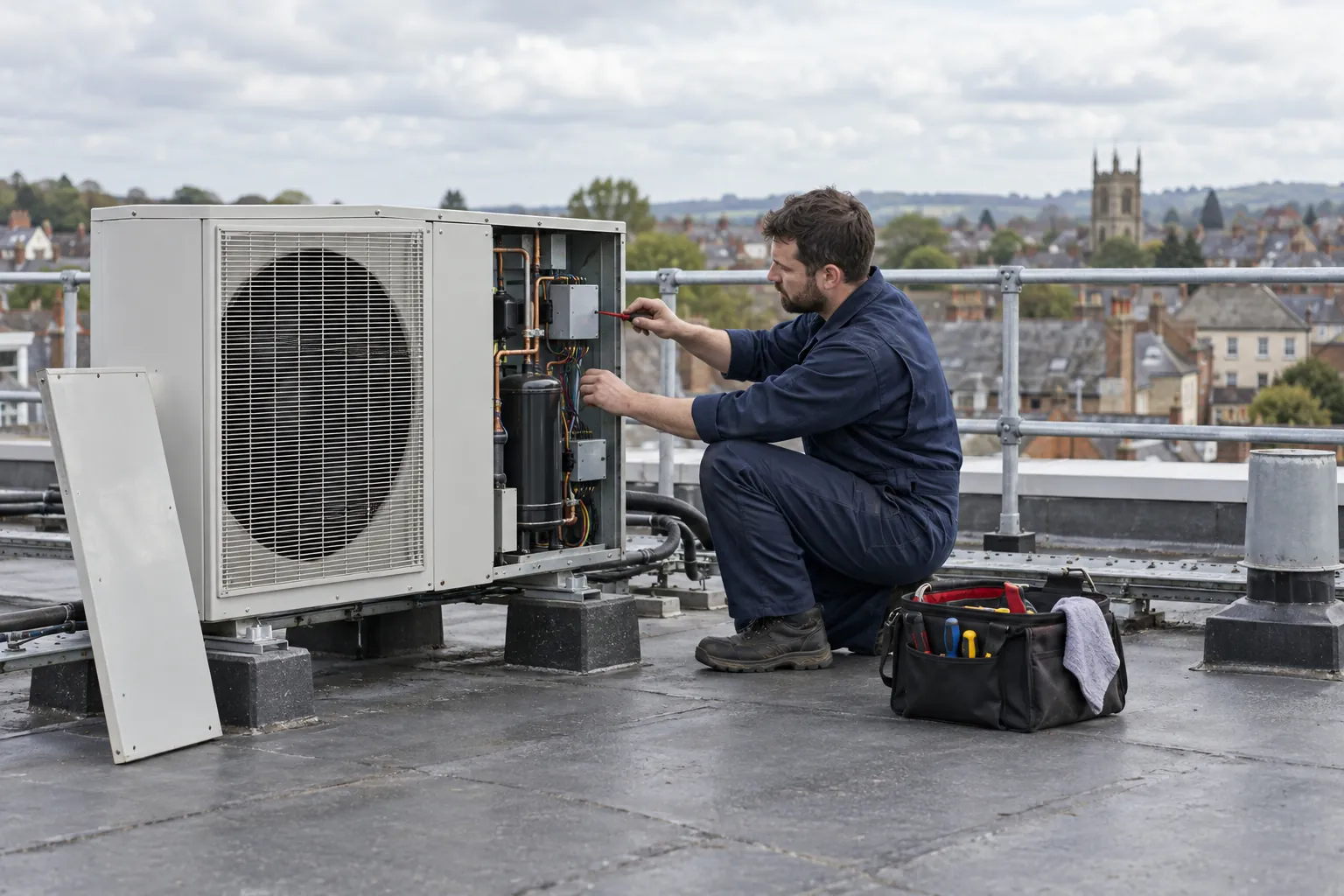 Premises and facilities managementPlanned preventative maintenance: how to plan it and prove it was donePlanned preventative maintenance (PPM): what it is, how to build an asset register and schedule, statutory versus discretionary tasks, and evidencing the work.